Ben Guttmann: Why Clear Messages Win and How to Design Them (#345)
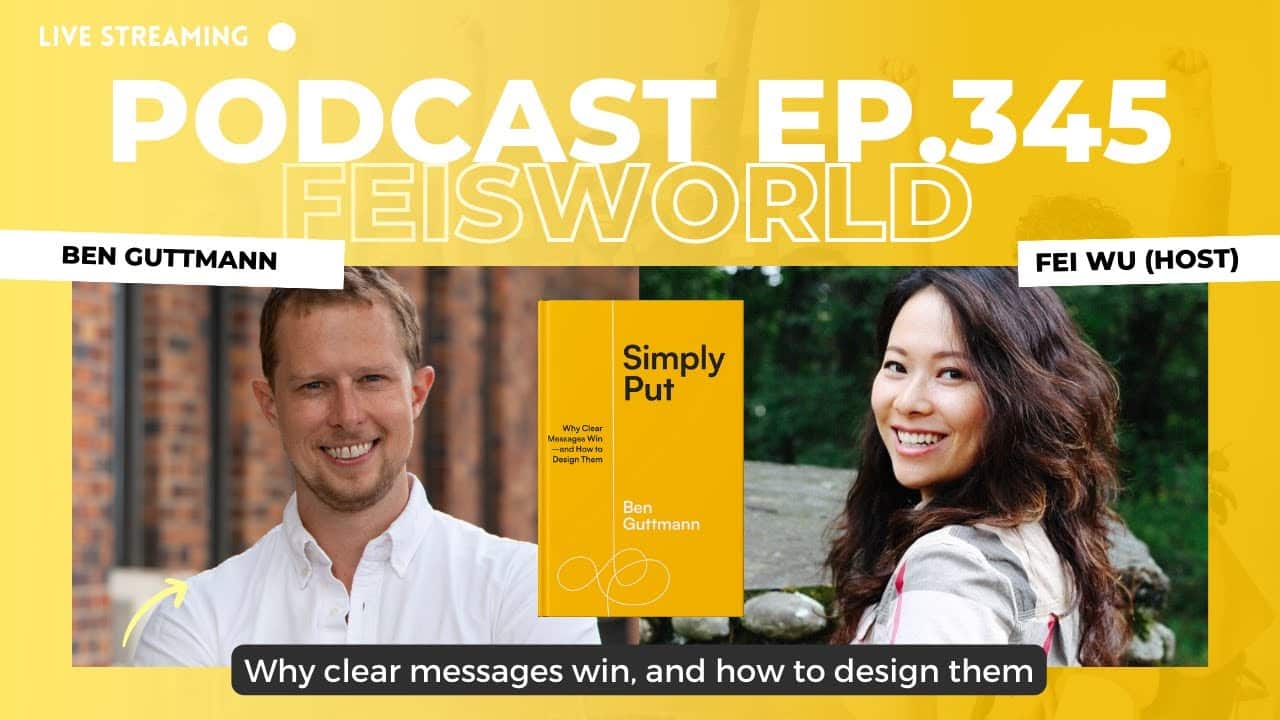
Our guest today: Ben Guttmann
Ben Guttmann is a marketing and communications expert and author of Simply Put: Why Clear Messages Win — and How to Design Them. He’s an experienced marketing executive and educator on a mission to get leaders to more effectively connect by simplifying their message. Ben is former co-founder and managing partner at Digital Natives Group, an award-winning agency that worked with the NFL, I Love NY, Comcast NBCUniversal, Hachette Book Group, The Nature Conservancy, and other major clients. Currently, Ben teaches digital marketing at Baruch College in New York City and consults with a range of thought leaders, venture-backed startups, and other brands.
Watch Our Interview
Transcript
Transcript
Fei Wu: Hi, everyone. This is Fei from Feisworld Media and I'm here sitting with my new friend, Ben Gutman, and thank you so much for joining me on this live stream, Ben.
Ben Guttmann: Thanks for having me, Fei. It's great to be here.
Fei Wu: Yeah. So, you know, we connected and I believe through a mutual friend, Michael Roderick, am I correct?
Ben Guttmann: Oh, yeah, I think we have a few about Mike Roderick. I must be speaking to him later today. So looking forward to that.
Fei Wu: Wow. Fantastic. Really small world. Something's happening today. Well, if you are tuning in, I really appreciate you spending the time. Even if you have a few minutes here and there, uh, this live stream is going to be permanent, uh, wherever we're broadcasting this on Facebook, YouTube, Twitter, and apologies for people trying to watch on LinkedIn since you couldn't, and there's a little bit of a. Tech API issue. So appreciate you being here today with us. Um, if you don't know Ben Gutman, let me just briefly introduce Ben. And we're going to dive into today's question, which is all around how to really craft your message, how to simplify. It's a topic I just think about every single day when it comes to copywriting, preparing every piece of content for my own brand face world, as well as for my clients. So. Check it out. So Ben Godman is a marketing and communications expert and author of Simply Put. It's coming out in October. So there are links in the description below, go ahead and pre order it. Um, Simply Put is about why clear messages win and how to design them. And we're going to talk about not just, not only just why it matters. But how you can think about crafting your own simple and effective messages. He's an experienced marketing executive and educator on a mission to get leaders to more effectively connect by simplifying their message. Ben is a former co founder and managing partner at digital native. And an award winning agency that, uh, worked with the NFL. I love and why I love New York, Comcast NBC, Universal, um, Hashi book group, the nature conservancy and the other major clients. Currently Ben teaches digital marketing at Baruch college in New York city. Consults a range of thought leaders, venture backed startups and other brands. You can definitely check out all of his work at Ben gutman. com for slash simply. Uh, put book is the book that is published right now, and there's also a newsletter as well. So with that said, Ben, welcome to the show. How are you doing today?
Ben Guttmann: I'm doing great. It's nice to be here. I appreciate the introduction. It's funny. So my last name is not simple. It's a G U T T M A N N. And so everybody's going to go to Ben Gutman of one end. com. But if you just go to simply put book. com, that also forwards you there.
Fei Wu: Fantastic. Oh, thank you for clarifying. And, um, I also want to just, uh, mention anybody who's going to be with us now later on during live stream, please, you know, uh, join in on the conversation, ask any questions. Um, so with that said, uh, you know, Ben, this is probably a common question. A lot of people ask you, there are, you have a lot of experience. You've done a lot of consulting work and you are a professor. There are probably a lot of ideas that are floating in your head. And a lot of people who are thinking about writing. Their first book, their second book, even are just struggling to say, what is that one idea I want to put forward? So I have to ask why design such a book? Why is this particular message? So important to you?
Ben Guttmann: Yeah, it's funny. I was having a conversation with somebody this morning who was a consultant and was thinking about, Oh, do I want to start to write a book and do this? Um, and I was saying it has to be something that you love a lot that you care a lot about because you spend a lot of time. You spent a good chunk of time writing it, uh, more time editing, and then you got to go talk about it for like a year afterwards. Uh, so it's gotta be something that, that matters to you and you feel like it's, uh, it's a valuable topic. And for me, if I look back on the 10 years that I ran that agency, if I look back on the Uh, the 10 years now that I've been teaching and, and also just as a consumer user of the world, I would see this problem over and over again, which is people have a really hard time getting themselves heard. They have a really hard time breaking through the noise for hard time. Communicating in a way that actually connects with their audience and forms persuades. And it is. Um, it is something that's only getting harder because we're in a world that is only busier and louder and, and more distracting. And, uh, I wanted to take the tools that, you know, we use as a designer as much my functional background. And see how we can use them to craft messages that actually work and that actually resonate with people.
Fei Wu: Yeah. I mean, I think this is something that a lot of people would resonate with and I'm going to jump in, Ben. Like I was thinking even right before this conversation, when I think about simple, simplifying message, crafting something that's creative and effective. Immediately think about copywriting, but perhaps this actually extends beyond copywriting. There is that communication with whether we're without one's voice, perhaps. Um, so what, what's your, what's your take on kind of your book in relations to copywriting? I had the chance to, uh, read the free chapter. I haven't actually fully delved into the book yet. So I would love to learn with you from you in real time.
Ben Guttmann: Oh yeah. Well, I say it's, it's not a copywriting manual. It's not, um, it's not something that's going to tell you, you know, how to use style a certain sentence and use this word versus that word. There are elements in there, it might be complementary to a copywriting book, but it's broadly, it's a little bit broader than that. It's more about, um, it's about how, how do you... How do you figure out what to say? I break down in that, in the first part of the book there, that there's basically marketing when, when you, when you strip away, everything else is really only two different things. It is what you say, and it's how you say it. And the, how you say it part is what I call it the vessel. This is all the stuff that we would do in our agency, all the stuff that you do. Um, you know, when you're talking about ads, when you're talking about email, I'm talking about social media, all that stuff. Is the vessel and that stuff is complicated. It is, um, very technical. A lot of times, most people who work in marketing spend their time working on that. Uh, and there's nothing, I mean, it's a very important piece of the puzzle, but it is a little bit more technical in, in the way which you can learn it. You can learn the tools, you can optimize things, you can figure that out. The harder part is the contents is how do you fill that vessel? What is the. What is the point you're trying to get across and how are you, how are you articulating it? And so that's what this book is about. And the thesis of why I wrote this book now, why I think it's relevant now is if, if you look at the type of advertising that we ran for years and years, that was, you know, basically hitting people over the head, a thousand times of an ad for retargeting, whatever it is, it's not going to work in the next decade because every single platform is saying, Hey, we're not going to do cookies. We're not going to do tracking. And so we have to look back at the fundamentals of how do we, how do we articulate what we want to say in a way that's compelling because we're going to have less opportunity just to kind of blunt force, you know, uh, that, that idea into somebody. And so that's what the book is broadly about. It's about how, how do you fill that soul? Cause I think it's harder, uh, but I also think it's, it's a more valuable skill.
Fei Wu: You know, I, I've been a creative entrepreneur since 2016, actually 2014 since podcasting. So there's a lot of content creation, crafting my message, changing it. So if that resonates with any one of you who is starting to build a brand, who's pivoting to something new, who's incorporating AI in your work, please comment below, uh, what you're thinking about when it comes to content creation. So I'm going to highlight a message from Adam. Simple messages are important if you want to make. Big change or share big ideas. You have to start small, give people a chance to consider the intro to your idea and choose to move forward with you. And that's really interesting because, um, uh, then you actually do talk about this quite a bit. I, what I love about the part of your book is not only it's about why it's important and here's how, and as part of the house about taking action, what's the point of a message that resonated with someone they go. All right, but I'm just not going to do anything about it. So I think about people who have done this really well. People have moved me forward, propelled me forward. Yes. Michael Roderick. Thank you. But also Seth Godin, Dory Clark, maybe a little Tony Robbins and you name it. So how does that resonate with you? Well, how are you thinking about through the action part
Ben Guttmann: then? Oh, absolutely. I think that, uh, so I define. In the book, I find simple message is something that is easily perceived, understood and acted upon. And that all comes from this idea of fluency, which, you know, psychologists, cognitive scientists, they call it, uh, it could be perceptual fluency, processing fluency. What that basically is that you could be fluent in English or Spanish or Mandarin, you can be fluent in chess or cooking or, you know, or. Or baseball where we, so we know that word, but what it really, what it means is if you go back to the roots of the word, I mean, it's flowing. I mean, and what it means in our context is something that's easy, something that, that we easily take from out in the world and we put into our heads and we make sense of it, and there's a whole body of research that when you look at things that are more fluent. They are associated with a whole host of things that we want, right? They're, they, they, we like things that are more fluent. We trust things that are more fluent or more like that by things that are more fluent. And the opposite is true too. If things are harder for us to see, to read, to hear, to understand, to make sense of, we have a host of negative opinions with it. And so when we're communicating, we always want as a receiver, something that's easy, something that's simple. But the problem is. As a sender, I break up these definitions, I say, you know, there's people who receive people who send, we're both of them at the same time, but just to put all the hats together, senders, when we're wearing that role, we are biased towards complication. We are, we are, we have an additive bias. We tend to add instead of subtract. We are incentivized by the different structures around us to kind of hide behind the big words to hide behind these ideas. And so that's where this, this gap is. Is that receivers prefer something that is easily understood easily active vendors are instincts push us in the other direction. And so then that's what the 2nd half of the book is, is giving us, you know, we identify 5 different tools at 5 different principles that we can use to, um, uh, to, to get past that hurdle and to design things that.
Fei Wu: Yeah, I love it. And, uh, for anybody who's watching this from a consulting or marketing background, I hope something is already resonating with you as someone who did spend a decade in there. They're also as somebody who, you know, speaking English as a second language that we, you know, at least. I know people, a lot of people like me were really triggered by the complexity of word, the acronyms and like, what are we even talking about internally here? So, all right. Another question from Adam, if, uh, as marketers, we're not going to have the chance to retarget potential customers. And if the old. Uh, what is it this word a dodge that it takes 7 to 12 exposures for a potential customer to take action. How do we reconcile?
Ben Guttmann: Well, I mean, I think that that's still generally true is right. You aren't going to win on the 1st sale. A lot of times. I don't think that. The death of the cookie and everything related to it changes that behavior pattern, but I think it does weight the importance of kind of creative, creative work, you know, messaging, copywriting design. I think, I think it starts to swing the pencil a little bit more back in that direction. Um, the. Uh, yeah, I mean, I think that there's there's a lot that changes on a daily basis on a weekly basis on a yearly basis, obviously, in in digital marketing, and I know that from my when I teach digital marketing, my students every semester, I have to kind of read you the syllabus basically the entire time, but the. This book, I tried as hard as I could to make it something that was more durable because human nature doesn't really change all the technology changes, but the way which we, we operate in our brains and, you know, and in our culture is, is a lot slower moving than, than whatever the newest kind of ad policies are for Facebook.
Fei Wu: Yeah, got it. Very clear. And thanks to Adam for using the word adage. I honestly didn't even know what it means. For those of you, again, I just like, Oh, English is a second language. And thanks for the question. So it's a, uh, it basically is a proverb of short statement expressing a general truth. Okay. Thank you for the explanation, Ben. And, um. I sort of think about, uh, your teaching, your book, you know, even the design of it with a yellow cover. And I try to match our thumbnail to that. And you can, can you hold it up? Yes, please.
Ben Guttmann: Yes, please. It's so cool to have the actual book. I got to tell you like this, when this arrived, it was like the best day.
Fei Wu: Oh, the best day. And it just simple. Like I, I try to imagine Lehman just based on the initial content of, I imagine the cover to be that very, like kind of smooth feeling and everything is. Just very easy to it's going to stand out in your bookshelf. Uh, it kind of has this very simple approach to it. Yet. The content is something that we all need to be reminded of, frankly, for me, uh, in talking to you, I want to learn and rethink and reevaluate, uh, And at the same time, appreciate my learning so far when it comes to, you know, newsletters, my daily LinkedIn posts, uh, copywriting, even designing the thumbnail for our conversation, how I articulate a market and share our conversation with the outside world. So how should someone, in your opinion, who is, um, perhaps new to content marketing or creating content should really go about. Oh, I have this idea and we can use anything concrete of that helps, uh, to think about what is. Either the right or the wrong way to approach it. Or what is a, how, how do we catch ourselves of over complicating things? Because I do find myself doing that still often, you know,
Ben Guttmann: these days. Oh, I mean, the, um, uh, there's a famous designer from the 20th century, uh, who, uh, Dieter Rams, who his whole, he designed stuff of Braun. Have you ever seen a Braun product somewhere? And he inspired. You know, Johnny Ives and Steve Jobs and everybody from Apple and what they're doing and his whole thing was less, but better. Right. And so if you can put that hat on, that will. Uh, automatically put you in the right sense, the right framework for, uh, for, for understanding things and, but the idea of less is interesting. So I, there's five principles in the book. Number one is beneficial to the simple messages, effective messages hit these different notes. So it's beneficial. Number two is focused. Number three is, um, salient. Number four is empathetic. Number five is minimal. And I put five at the end, I put minimal at the end on purpose because it's about having everything you need in there, but only what you need in it. It doesn't mean that you want to, if you're designing something to be minimal, if that is a message or even if that is, you know, a thumbnail or a website or whatever it is, it doesn't mean that it's the smallest thing. It means that it has. It has everything you need, but only what you need. It means that you are minimizing, not pixels or words or paragraphs or slides, it's minimizing friction. And if anybody's ever worked in user experience at some point, you understand that's, that's the big thing that you want. To avoid is if you make something harder, it can make it so that it takes more clicks. It takes more scrolls. It takes more mental processing power for you to be able to do something. You're just not going to do it. There's a lot. There's lots of things competing for our attention every single day. You're getting 1000 notifications. You know, the average American spends 13 hours a day consuming media. of some form. And so 13 hours a day, you're hearing thousands and thousands of messages. And there's always the opportunity for something else. People care about a lot of things. We care about our families. We care about our pets. We care about our religion. We care about our sports teams. We care about their politics, but we don't care that much about most of the things that people are advertising to us. And so if we are able to get the opportunity to be heard, even in the tiniest bit, we have to make sure that what we're doing is respectful of that idea is that people don't want to hear us. Every ad that you've ever seen, every commercial you've ever seen. Has been against your will, right? Nobody woke up today saying, you know, it's on my to do list. Let me go on Instagram and click on some ads. Let me go, you know, on open up some spam emails. Nobody wants that. And so if you. You have to put that kind of humble hat on before you, before you do any sort of communicating, uh, and before you do any sort of marketing and sort of messaging, because we are very important to ourselves. What we're saying is very important for ourselves, but we have to acknowledge that it's not the priority of our audience.
Fei Wu: I really love what you're articulating here. And, uh, that reminded me of a recent conversation. With, um, Sean McDonald from board pro. And, uh, a couple of years ago, Sean and I started working on, uh, just a series of zoom webinars, and frankly, he just took off. He started with just 20, 30 attendees to nowadays. He's completely, he's running on his own. He's a content director and every week he has four or 500, uh, registrants and. Their software in terms of revenue is increasing 40%. That's over 2 million. Now, when I had the conversation, when I live stream with Sean recently, and he is very to the point, he doesn't really like fully elaborate into the why the house. And I said, okay. What do you guys talk about on your webinar now? Like, when do you mention your product for pro is a software. And he said, we don't talk about, we don't talk about our product at all. Zero, like not at the beginning, middle or the end. We don't talk about it at all during our webinar and yet the revenue is increasing. So this is so counterintuitive to a lot of people on one hand, of course they're hosting it. So you're intrigued to have to learn more about them. But, um, with your knowledge, Ben, like, could you break it down through like, what is happening? It's a software company hosting these free webinars that don't talk about their own products, yet the revenue has increased 40%.
Ben Guttmann: Oh, yeah. I mean when we used to, before I sold my agency, when we used to go in and do like a new business meeting with somebody, we would probably spend 30 minutes just kind of bullshitting. We weren't, we weren't talking about, you know, our agency, our qualifications. We weren't talking about their technical needs for their website or whatever it was. We would be like, Hey, what the jets, you know, how about like, like, let's talk about, you know, the, this, this, uh, new streaming show or whatever on HBO. And we would have that ability to kind of have that small talk, which really resonated. I think a lot of folks, they, they look at this world of, um, of professional services, like what we do or enterprise sales like and they think. It is very much a black and white, like you have the better product, you have the better qualifications. Therefore, you're going to get it. But what a lot of folks don't realize that the soft skills involved in any of those things probably outweigh the technical skills. Most of the time we would say. In, uh, when we were doing pitches, we're saying, look, if you're hiring an agency, you're going to spend a lot of time with them. You're going to spend time during the scoping. You're going to spend time during the, if it's a app or a website, you're used to the time during the bill. If it's an ongoing marketing campaign, you're going to spend a lot of time during that. Maybe there's going to be conferences we're going to together. Maybe there's going to be events that we sort of get, you kind of have to like the people that you're working with, because if you don't. That kind of just sucks. Like people don't want to spend time with people they don't like. And, and what your friend is doing by, by organizing these types of things is saying, look, I I'm a likable, intelligent guy and you want to work with me or you want to work with our team because we're made up of likable, intelligent people. Um, and it just so happens that we work at this company and you go and you. You know, if you're interested in it, we're not being pushy. You can go check it out. Um, I think that's a, that's a very underrated skill in this industry is to just be like a decent person. I think a lot of people get everything else. Uh, they can do everything else, but they do, uh, they do a poor job sometimes of, of actually being somebody that somebody wants to work with.
Fei Wu: Yeah, absolutely. Fair enough. I mean, in retrospect, I feel like the experiences with agencies, and I know we're generalizing agencies here, but in marketing, advertising, whatever it may be professional services, I tends to, in, in, in honesty, what I have learned is that these, Places tend to hire people who look good on the outside, right? Like, usually they're tall. They're good looking. And I think these, you know, these kind of descriptions and languages are not fully shared in transparency anymore. But that was very clear in my observation. And therefore I noticed people. Some of them certainly not all, uh, come in with an attitude, like, you know, they probably have been very much favored in their lives and life probably have been somewhat easy to a certain degree kind of getting their way standing out. Um, and so how do we navigate that? Like, perhaps even, um, you know, from the client's perspective, or even internally, like, another thing I want to mention is there's an opportunity for all of us to be able to. Learn from one another. We're literally having this conversation for the first time ever in our lives. And there's so much to learn. Uh, how do people, you know, identify these things from the, even if they're working at an agency to identify, like this person is likable, you know, she has something of a contribution. I should be closer to her. Like, what are some of the characteristics, the characteristics and attributes that we, we, we can use?
Ben Guttmann: I mean, I, I think the first thing is you have to. Acknowledge what you just, what, what you just did, which is, is that it is real. It is real. The people do want to work with people that they like, and they do want to work with people that are pleasant to be around and that present themselves in a way which, uh, fits the situation. And all those things are true. And, and none of them are necessarily. Evil, you know, it's, it's benign, it's a benign statement. We do things with, we, that with people we like with organizations, we like it. That's, um, yeah. And, and so understanding those plant, those playing field, that playing field is how do you make yourself somebody, you know, an individual and a group that is more likable. And I think honestly, it comes down to. If you're building a team, choosing the right people, we always, we, we, we chose, we worked very hard to always make sure that the people that worked with us were good people, that they weren't just, you know, technically qualified, but they were people that we enjoyed working with, that we knew our clients would enjoy working with. Because it's a soft skill. I have to be able to pull out from a client. Like what actually are they struggling with? It's it's not the technical stuff is obviously important. You need somebody who's a good designer. You need somebody that's a good developer, a good copywriter, but if you just optimize for the technical skill, you're MIT, you're forgetting about the human component of all of these, of all of these, um, uh, types of projects. And I think that, uh, and then on top of that, that means we would try very hard in our company and I think it benefited us in this situation was to encourage people to have a diversity of. Of lived experiences. And first of all, that's building a diverse team. That's one piece of it, but also we were pretty adamant about, we want the work day to be like a nine to five, you know, somewhere, maybe a little bit more, sometimes, sometimes a little bit less, but we wanted it to be a closer nine to five as possible and not be like this boiler room situation where everybody has to be, be busting their ass all the time, because we believe that having interest and life outside of work makes you a. better person when you are at work. Uh, and so that means reading. That means, you know, going like exercising. It means, um, you know, having community, uh, groups that you're a part of. All these things contribute to you being a person who's better at your job is, is someone who is more connected to the world. And, uh, if, if you're only going to be working nonstop, you're not going to be a good marketer because marketing is about connecting. It's about connecting culture to business a lot of times. And, uh, and you have to give somebody the opportunity to do, to experience the culture.
Fei Wu: Yeah. I, I love the direction, uh, you're going because it, it's so essential, like we hear talking about crafting messages, how to become a, a better communicator. I think you are absolutely right that the people I end up, uh, liking and I even wanna share or alive with, are people who I find interesting, uh, who are curious to begin with. And doesn't matter how good you are at your job, technically speaking, you don't have other interests outside of your, your job, no matter what kind of structure or framework your learning is. going to, it's going to be much more difficult to hold a conversation. And, um, so I think that part is, is really, really interesting. I also want to just like, give it a shout out to people come from a multicultural background, like including myself, you know, I really think between 2000 and 2010, I was a little, not embarrassed. I was always a little hesitant to share that. And, you know, I, Frankly, I didn't think anybody would find it interesting, but then I became a creator. I didn't realize that people were approaching me. They, a lot of them did find it particularly interesting. And that was a way of connecting or connecting with, you know, people who are absolutely new in my life. So, uh, really love that. I don't want to kind of. Share this quote from, um, your book and it was very eye opening to me late last night, the power of orienting our language to highlight benefits instead of features, providing a research back model that can help anyone better structure. Their communication. So there are different components to break down. But one thing as I was working, one of my new service landing pages, I was realized, realized that the, the weight, uh, where, you know, how we write, how we thinking about our services and products, we constantly talk about. Features this is, you know, the feature list could go on and on and on. So I would love for you to kind of break down for people who are thinking about these more complex, uh, problem situations and how they can use your wisdom to, to better
Ben Guttmann: their work. Absolutely. So anybody who's been in sales, for instance, marketing, uh, as well, anybody who's been in sales will tell you that people don't buy features. They buy benefits. Uh, the. The feet are things that you can see in the world, right? You can open up your five senses and you can see that the car Or has, you know, paint job that you can feel that the heated seats are warm. You can hear the, the engine being quiet or this quality of the sound system. All of these things are objectively true in the world. But the one thing that if anybody. It just takes this away from our conversation or from the book. And I tell my students this in class, which is, if you forget everything else you ever learn here, remember this one sentence that comes from Theodore Levitt, who's a Harvard professor in the, uh, in the 20th century, he said, people don't want. a quarter inch drill. They want a quarter inch hole. And if, if you can, if you can just internalize that people don't want the drill, they want the hole. They don't want the thing. They want what the thing does for them. Then everything else becomes a lot easier because you realize, okay, well, why am I talking about this drill so much as you'd be talking about the hole? And I talk in the book about Uh, it actually, you can go further than that. You can go several layers beyond the hole. You say, I don't just want the hole, I want the picture on the wall. I don't just want the picture on the wall, I want to see my family, because I want to feel love and belonging, and all these other kind of foundational needs that I have. And so that's how you start to figure out. What direction you want to go with your messaging is saying, okay, well, what is the actual need that I'm meeting for the, with this, um, with this product, with this feature? Uh, and there is a place, there's time and a place for features. Absolutely. Right. It could be somewhere down in the bottom of your advertisement. It should be on your website or in your brochure or whatever it is, but that's not what moves people. It does. Having, when Apple introduced the iPod 20 years ago, they didn't go out and say, Hey, we have four gigabyte hard drive and we have this much RAM and we have this many pixels on the screen. They went out and they said, it's a thousand songs in your pocket. And a thousand songs in your pocket is something you immediately understand the benefit of, which is that I can listen to music anywhere I go. And I can listen to all the music I have, I want anywhere I go. And that is a message that converts. And I think actually right now, when you look at. Apple still does a good job of, of communicating, obviously, but, you know, like this new phone, which I just got in the mail a couple of days ago, a little bit less revolutionary. And so they're talking about like, Oh, the pics, the megapixels in the camera or this, and the, the, the brightness of the screen is that. And so it's not as, as companies mature, as products mature, as campaigns go on. Um, People start to get removed from the benefit sometimes, and they start to go, they start to fall back on the, the features. And so you have to constantly shake yourself and be like, well, what's the, what's the thing that people are actually buying here? They're not buying the, the heated seats because they want heated seats. They're buying because they want their butt to be warm. You know, they're not buying the minty toothpaste because they want minty toothpaste. They're buying it because they want fresh breath. And they really want it. They want fresh breath because they want to impress the date they have later, right? Uh, uh, yeah, just asking, so what? Several times, it helps, um, unlock all these different benefits, uh, which. Uh, which are the building blocks of a more compelling message.
Fei Wu: So I want to dive in a little deeper here because I realized that, uh, I've been an entrepreneur for a little while, you know, eight, pushing eight, nine years, but a lot of people who are now, you know, coming out of the pandemic or just, this is the perfect moment for a lot of people to work from home to say, okay, I want to start my own thing. Maybe it's small now. A lot of people, like, not necessarily my clients, but more friends who are starting to do this. They struggle with 1 thing, which is where can I get the market research done? Where can I approach people to validate my idea? My products that seems to be a little bit more challenging. So I was wondering whatever the thing that people may be designing, or maybe it's a service. That how can they properly assess, like how much feedback is a sufficient amount of feedback? What is too much, uh, to kind of evaluate the benefits versus the features?
Ben Guttmann: Yeah, there's a great little book called just enough research by Erica Hall and the book's good. I like that. The title is, is important here, which is you want just enough research. It's very easy to get lost in user research and market research and say, well, I need to get more focus groups and you get more studies need to get into more people. I need to have a bigger survey. And some of the, you might gain something from that, but you're going to gain a lot more if you look at the kind of startup model of saying, Hey, I'm going to build something, I'm going to go test it. You know, I'm going to go send out some emails and, and, you know, put it up on product hunt or post it on Twitter, whatever it's going to be. So that's one model of it. But if you want to test a little bit, and I talk about this in the book, when I talk about empathy is that you want to make sure you test your message, that it's speaking in the language of your user, you could do something as simple as leaning over to somebody in the other part of the office and be like, Hey, I'm trying to talk to, um, accountants. You're an accountant, you know, like here, let me, let me try my message on you here. Does this make sense? Just getting a little bit of feedback is often a very informative, it's often a very informative process. You don't need to have a million people weigh in and actually start to become this analysis paralysis situation where, you know, I need more and more and more Nielsen. Uh, uh, sorry, not Nielsen, Gallup, uh, Nielsen also does relatively small surveys, but Gallup has been doing polls of the American population for public opinion for elections for, for a hundred years. Do you know how many people, there's 330 million Americans, do you know how many people they survey to develop, uh, insights on that population? No. A thousand, you know, it's not that big, not that big. Right. And you can, if you remember from like high school statistics class, which I know most of us kind of. You know blocked out at some point you don't need that many people to draw a relevant sample as long as They are representative. You don't want to get you know, if I if i'm You know, going back to that, that, um, model before, if I'm, my market is accountants, like I shouldn't be talking to scientists, right? Like it's a different, it's a different audience, but finding just a couple doing a little bit of testing, um, a little bit goes a long way in that space. But all that being said, you want to make sure that you consider it more so as a temperature check than a, like an instruction manual. It's not, it's, it's not going to be a tour guide, but it might be a compass a little bit to say, okay, am I on the right? Uh, because as the saying goes, you know, people would have wanted faster horses instead of cars, right? Like you, you can't rely too much on, on that, um, on that type of, uh, analysis.
Fei Wu: Yeah, for sure. For sure. I also found the book just enough research and, uh, I have listed in the comments for anybody who's interested in checking out. So I, I mean, so true. Like, I remember. You know, Seth Godin once said, you know, you go to a vegetarian restaurants reviews and there's always people who love me or like, oh, they don't offer barbecues. Like, it's not for you and your feedback is not valued here. Um, it's funny, but it's also very true now. Uh, so something that I've been doing for a little while now, I want to just take a moment, use myself as a guinea pig guinea pig before we pivot to some AI questions here is that Ben, like, for instance. You know, I started when I started my business in 2016, I was kind of a bit of a jacks of all trades. So, um, because I offered like web design, I tried a lot of different things. And then, um, I also happened to be someone where everybody said, well, why are you doing webinars and podcasting? Like, uh, you know, why are you doing everything? You should really niche down now, fast forward many years and niching down. methodology or framework or something that's pretty much like overhyped it to a certain degree. So I found myself having a lot of clients in for YouTube strategy, YouTube production, but to be honest, like there's a whole transformation. I think since the beginning of 2023 is like, we want to reconnect with ourselves. Like we need to stand out really doing what we'd love, connecting the dots and simplify for our clients. So I finally, you know, relaunched, uh, something that I was so passionate about, uh, which is called full stack content marketing. And as I'm talking about this, I'm going to drop a link for anybody who's watching this now or later to criticize the landing page, to say, Faye, you're confusing features with benefits. I would love for your feedback. Um, but it's basically a place where I can talk about the fact that we have capabilities. So these are perhaps. Features of podcasting, YouTube strategy, webinar, and things like that. But then here are the benefits. As I was reading your book, I was like, Oh, I got to reevaluate the benefits now. So I think about what the clients have said to me and I want to distill them into easy, simple, you know, empathetic messages, which are number one is saving them time as opposed to. Working with multiple agencies and people like who's in charge, nobody's in charge. They want to simplify their production process. And, um, secondly is for kind of part of the client's imagination. Like a lot of them feel like need to shoehorn themselves down to, I got to choose one thing, not the other. And when I do, I got to find another expert. Whereas. When they talked to me, they kind of opened up the aperture and to really reimagine what their brands could be. These are just a couple of things I'm thinking about, but I'm, you know, you're hearing this for the first time. You didn't rehearse this. Like what is your gut instinct with someone with agency experience and all that?
Ben Guttmann: It's a really tough question, right? So there's, there's basically, you know, when you're doing this type of, uh, when those type of business, if you're an independent consultant or creative or. If you run a professional services firm, there's kind of two routes. You can generally go you can go and say I want to go be like Uh, the, uh, bright lights of Broadway, like really high end boutique chase, the cool brands, the cool people. And I want to go do big projects and solve interesting, weird problems. Uh, and we did a little bit of that. That was generally the path we took, um, which was saying, Hey, I, you know, this cool brand, they need help with this and with this and with this. And we're going to figure out putting a team together to do that. And people would you, cause you're specializing basically in your approach more so than what your specific offer is. Or you can say, Hey, I'm very specialized in one thing. And you can say, I, uh, I do landing pages for, um, you know, GoFundMe campaigns, whatever it's going to be, you know, or I'm doing, I do, uh, um, like podcasts, bios. That's like, I just write biography bios for podcasters. There's a million different little niches you can get into. And that sometimes. Makes it easier to run that business. Cause you just say, Hey, I need a bunch of people who make landing pages. I need a bunch of people to write bios on as opposed to like figuring out the thorny problem, but it also makes you easier sometimes for the. Uh, customer, the client to find a place for you in their, in their brain. Uh, we would want, we will, when we chase the other half, we ran into problems where we had. Great clients that we worked with on one part of the business, but they, they barely knew that we did the other part of the business. They just didn't associate us. They were like, Oh, these are the guys that do the website or something or the mobile app. But we had a social media division, but they didn't think about us as the team that would do social media. Also, they would think of us as well. So that was, that's a challenge. That's a big thing. I don't have a great answer for that. Um, I will say that, uh, you know, it, it sounds like this is a positioning question and I don't have familiar of like positioning and, and, and that whole universe, but basically it boils down to three questions. If you're developing a positioning statement and doing the whole exercises for it, but they all come down to three questions. Number one is who are you selling to? Who is your market? Number two is what problem do they have that you're solving? And number three is why are you the best solution for it? Why are you better than everybody else to solving that problem? Many, many organizations and individuals have a really hard time answering those questions. They just, they may have worked there for a decade, a generation, whatever it's been, and they just cannot answer those questions because there's two in the weeds for it. But if you answer those questions at the get go, and you can answer them as broadly or as narrowly as it fits your business, that will make everything else you do easier.
Fei Wu: I love this and it's very true. I think for, I haven't really looked too deeply into your previous agency, but I think from my experience working for some of the, the, the bigger guys, I realized that when you pick up a client like the Nike McDonald's of the world, they tend to. They tend to specialize, meaning they want to pick the best social media agency, the best web design company to do the parts that they're interested in doing, because they have these millions of dollars to spend. Whereas, frankly, I do see a lot of the people I work with are small business owners and accomplished, established creators. They are not the McDonald's of the world. So they do not have an infinite budget. They have whatever may be 2, 500 a month, 5, They want to accomplish a lot. Uh, so therefore their choices are in a way limited to working with certain people that may be as a result, you know, I could be the solution. So it's. It's very eye opening. So I want to pivot a little bit. I know we have about, you know, 10, 15 minutes left, um, and I want to ask your opinion, your take on AI. And I know that at least from the content I've read about so far, I love the human centric part of your content. And frankly, that's something that I've been missing. I can't, I'm, I'm futuristically like missing the content that we're creating now because I heard this. Stats of by 2020, between 2025 to 2030, about 99. 9 percent of the content is predicted to be generated by AI. And I literally just felt that the sense of loss and grief when I saw that stat. So I would love to hear your opinion on AI in general, generative AI, and also how that affects our messaging. Is it simplifying things? There's all complicating things. Like what's your take?
Ben Guttmann: You know, I think it was. Harry Truman, who said something about, it might've been like in the great depression or right afterwards, he was talking to one of his advisors, economic advisor. He says, well, on one hand, and then the other hand, and Harry Truman goes, what I would kill for a one handed economist. Um, you know, so, but I feel like I'm going to have a lot of on one hand, but the other hand, when it comes to AI, uh, I think that. Uh, I think broadly, uh, AI is a tool in the same way that a camera or a photocopier or, you know, Photoshop or whatever before it is a tool. Mm-hmm. , uh, I think that it's, it's a, it's a degree different. But it, it doesn't, I have yet to see, um, criticism of it that sounds materially different than what you could have read or heard a hundred years ago about any of those different tools. Uh, it's new. It's novel. It's scary in many ways. So, uh, people are going to. You know, react to it accordingly. Um, I think that the, the same way that something like Photoshop 20, 30 years ago, um, allowed people to do things that they weren't, that they had to do before. I just read an interview with Michael Beirut, who is a partner at Pentagram, one of the most famous living graphic designers. And he was saying, you know, A generation ago when he started graphic design was an industry of, you know, like tape and scissors and, you know, glue and, and going to the library to find a photo somewhere. And it was a really hard technical project. And if you told him then that there'd be a machine that he could put in his desk that would do typesetting instantly, he'd be like, that's crazy. But now, you know, 10 years later, 20 years later, 30 years later, there is. And his, his, uh, his statement, and actually it's funny, I recently, uh, was talking with another partner at Pentagram, Paula Sher, who's, who's maybe even more famous than, than, uh, Michael Bay wrote, and she was saying that she's the creative, you know, he's the creative, they're, they're, they're the creative, it's, those are just tools that allow you to do things that, that you might not have been able to do otherwise. Um, I think that there's no putting it back, the cat's out of the bag, you know, the, the technology exists. Even if you shut down or mid journey or whatever, there's plenty of open source things. There's plenty of products out there. There's no, there's no way to get rid of this stuff, but, uh, it's still, I think still ultimately it comes down to, it's something that's going to empower certain people to do things they weren't able to do before. Um, I know that just like if I could take a much better photo, then I can paint the painting. Right. And so that empowered me to do things. That I wasn't able to do before, uh, even though that predates me by 150 years or whatever, uh, but the. The same way I, I'm not able to do certain types of digital illustration. You know, I can do that better with something like mid journey and by, by doing prompts in there, uh, there are very real concerns that people have about the training data and, um, in copyright. And, and I'm not going to be the expert in that stuff, but, uh, I think that. I think it's a really complicated place to be. Uh, and I, but I, but I'm still, I'm Jen, I'm, I'm generally an optimist. I'm a techno optimist. Uh, and I do believe that this will probably be something that will be a net positive, but I think there's going to be some creative destruction in the process. And it's, it's going to be, it's going to be awkward and painful a little bit as we get there.
Fei Wu: I might. Uh, definitely in agreement with this. I love, uh, content creation. I love what I'm seeing in terms of, uh, generative AI. Yes. Including chat GPT that is enabling people to stop looking at a blank canvas or a page and start creating something. And I love the movement where, you know, people feel so activated, energized. by it and they go, Oh, I love this outline. Let me tweak a few things there, here and there. Let me, uh, write a book now. Uh, I couldn't even imagine starting before. Uh, but I think it's eliminating yourself completely from the process. It's really sad. And then the word I was looking for, I couldn't find was anticipatory grief of thinking about that we no longer matter. Our original thoughts are not important. So if you're watching this, listening to this, definitely think about, uh, Definitely know that you do matter your own experience. You yourself is something that nobody can really replace. So, um, yeah, I, I, I love this topic. I love to know Ben, if you are either using any sort of generative AI or other tools in your daily life, in your creative process or in your, in your teaching life.
Ben Guttmann: Uh, uh, yeah, absolutely. So, I mean, to just respond to something else you said, we don't go to a museum because we want to see. A technically proficient painting we go there because of the human aspect of it because of the way that somebody expressed themselves in their emotion and the same thing we don't want to read a novel because we like want to see the words that you know that describes some stock character doing something we read it because we want to connect to the author and their experience and their view of humanity otherwise, and I don't and if you look at the quality of the you know, like the fiction written by you Uh, these, these different programs and I fully understand that this will all change the quality of it is not there in terms of it. There's no spark to it. There's no, uh, human piece. And I, but I also think that, um. You know, there's plenty of times when it will make sense. You need somebody to do technical writing on something and to customize some, you know, copy that's a caption for a photo or something like that for accessibility purposes, all that stuff's great. So, but just going back, do I use. Do I use generative AI in anything I do? Uh, a little bit. Yeah, absolutely. So, uh, when I was finishing the first draft of this manuscript, ChatGPT just dropped, uh, and I was like, Oh, this is interesting. Maybe this can help me do research. And I went and I said, Hey, ChatGPT, Uh, I am writing about this topic. Are there any studies relevant to this research question that I have? And it says, sure, here you go. Here's a list of them and it spits out this list of something. Oh, this is great. This is so much better than me searching through these databases. And if I take the study name, I drop it into the database to go get the paper doesn't exist. And I'm like, okay, maybe there's a typo. Let me, let me search the names of the authors of the study. And they didn't ever write a paper together and they've, so chat GP just hallucinated this list of studies, their names that are plausible and they are, uh, they're authors, they're researchers. That have written things in that same universe, but chat GPT will just produce something that's a plausible outcome of that. And, you know, if I were to ask chat GPT, chat GPT, sorry, uh, mid journey or dolly three to say, okay, take the, the cover of this book and design it as if Leonardo da Vinci painted it, painted it, there are lots of possible. Versions of that. There's, there's hundreds and thousands, millions of possible variations of pixels that would describe a book painted by Leonardo da Vinci and they all could be right, but when it comes to text, there's a lot more of a like one and zero type of scenario. It's either going to be a true thing. If I'm asking for a factual answer to true thing that exists or it's not. And, um, and so that ends up being really tough. So long way of saying I had, I dabbled in it a tiny bit. Uh, none of the text of my book is written by, uh, uh, but the, um. I didn't find it to be perfectly, I didn't find it to be a hundred percent usable for, for the purposes I did. That being said, I know they just released a new version of it, which does have live internet access. And so we'll see maybe that maybe that'll be the research assistant that you really need. Um, I have used mid journey quite extensively in producing like graphics for my own blog, because sometimes I just want the stylized version of like, give me the Twitter logo as if painted by an impressionist painter or something like that. And it's like, it's a, um. I try to avoid, I try to avoid things that are obvious. Um, uh, copyright issues. I don't, I don't try to do anything for anybody who I don't try to emulate anybody's style that is, um, you know, that's currently alive under copy products, the, uh, and so I, I find that to be as a designer and empowering tool to be able to have, to have that piece, uh, chat GPT. is personally useful, um, when I have, when I have found, okay, I have a hundred words that I wrote about something, but I need to condense it down to 50 words. ChatGPT is like a good, a good first draft of that. I have found that type, that type of uses to be useful. Uh, but I, I'm not looking, I enjoy writing my blog, I enjoy writing my newsletter, I enjoy writing my book. Uh, I'm not looking to have ChatGPT go do that for me. And so that, that, that's the short way of answering this very complicated question. Oh, I
Fei Wu: love it. I, I actually found it really interesting to explore, to actually talk to real people about how they use it. When I first experienced the ChatGPT hallucination, I was, Really turned me off, frankly. And I was like, Oh, I'm not going to touch it. I don't want to use it for a week. Then going back, like you said, giving it its original source, giving examples, knowing his limitations, it's quite useful. So, um, and I also absolutely. Love your blog images and just want to give a shout out of, I was looking at it for the consistency for the interest. I was thinking, Oh, I was already thinking about like, who's doing your web design. Who's giving you all these images. And, uh, did you actually develop the website yourself?
Ben Guttmann: Yeah. I mean, so my background is in design, so I, I've had a lot of fun doing, uh, doing my own stuff for that. The, uh, if you're asking me for tools that I have really fell in love with, they'll talk about. Yeah, before AI sort, but the tool that I've most been enamored by in the past couple of years is Webflow and Webflow is kind of at this middle ground between a, um, a simple website builder, like a Squarespace or a Wix and a custom site, like a. Um, like a, something in WordPress or whatever, it's in this little middle spot where anybody who's ever used like Macromedia, Dreamweaver, I don't know if I'm dating myself by saying that or a Microsoft front page a million years ago, anybody who's used those will be familiar with Webflow. It's, it's a designer's ability to do no code websites. And so I've had a lot of fun poking around and playing with that and doing stuff for myself and for other projects I'm involved in. And I, I, I find that to be a very empowering, uh, movement, the whole no code space as well. Oh, wow.
Fei Wu: Fantastic. That's just such a great reminder. Something that I, I, on my list of to do's were to learns. And now I want to definitely be able to check it out. I've been hearing some of the other folks talking about like, uh, Joe Jetson mentioned wet flow as well. Your website looks super clean. It's so clean. I was like, It doesn't look like Squarespace. So I was just wondering, it seems like there's a lot more freedom to it. Cause, uh, Squarespace is Squarespace really boxes you in, which is beneficial to a lot of people can make decisions. But, uh, this is super helpful. I know we have just like about a minute or so left. Uh, what are some of the, some things maybe I haven't asked, but you want to talk about or any, any, um, leave behind any things that you want to keep our listeners and viewers. Thinking about at the end of this.
Ben Guttmann: Oh, I mean, I, this has been a ton of fun. Thanks for having me on this. I love the conversation and, uh, you know, looking forward to following up on a million of these different ideas. Uh, I would say, I mean, I hope that folks can find my book interesting and useful, and if you do ship me an email, I'd love to hear if it was impactful. Uh, you could check it out again, Ben gutman. com. Uh, has all the stuff on there. I send a newsletter every Tuesday, which, um, includes some of my writing, some links and fun stuff. And if you want to check out the book and get started, it comes out October 10th, but if you want to get started on it, you can go and download it, uh, download the first chapter for free on the site there too.
Fei Wu: Cool. All right. Thank you so much, Ben. I really appreciate your time. And, uh, to be so open with me in our very first conversation. And, uh, I will launch this episode also on Spotify and Google and Apple, wherever you guys are listening to this and, um, yeah, subscribe to the show, please do write to Ben and pre order his book. And with that said, we'll see you next time. Bye guys. Bye.
Connect with Ben Guttmann
Join the Book Launch Event in New York City
- Thursday, October 12 at P&T Knitwear Bookshop: https://ptknitwear.com/events/29872
- Thursday, October 26 at Baruch College: https://www.alumni.baruch.cuny.edu/events/guttmann
You might also enjoy…

Written by
Fei WuFei Wu is the founder and CEO of Feisworld Media, a Massachusetts-based digital media company helping brands get discovered by people and by AI. An Adobe Global Ambassador and brand partner to ElevenLabs, Synthesia, and 50+ other tech and AI companies, she hosts the Feisworld Podcast (400+ episodes, 500K+ downloads — guests have included Seth Godin, Steve Wozniak, Chris Voss, and Arianna Huffington) and co-created the documentary Feisworld: Live Your Art on Amazon Prime. Fei writes for CNET, Lifehacker, and PCMag, and her work has been featured in Forbes, Harvard Business Review, and WIRED. She has been publishing on the internet since 2014 — long before AI discoverability had a name.
View all posts by Fei Wu→Stay updated
Weekly insights on content, AI, and digital media.
Keep Reading
Related Articles
Joanne Lipman on Mentors, Untapped Talent and Why Women Should Stop Waiting to Be Perfect
Marc Randolph on Curiosity, Messy Starts and Why “Nobody Knows Anything”