Danny Gregory: Founder of @sketchbookskool on Teaching 300K+ To Draw and Be Creative (#346)
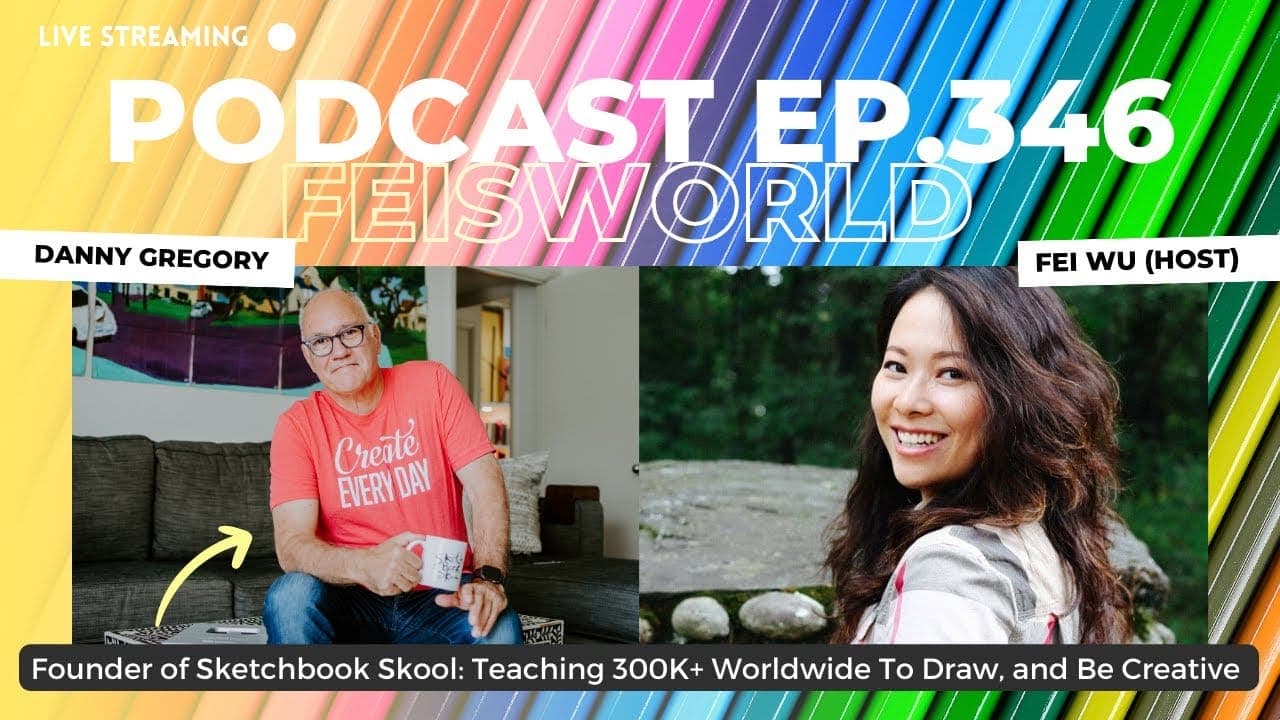
Our guest today: Danny Gregory
Danny Gregory (@sketchbookskool) is the internationally best-selling author of a dozen books on art and creativity. He is the founder of Sketchbook Skool with tens of thousands of students worldwide.
Danny has shown zillions of people how to ignite their inner artists, embrace their creativity and tell the stories of their lives.
Danny is the founder of Sketchbook Skool, an online art school designed to bring artists back to their creativity. Taught by the world’s best illustrators, artists, and educators, Sketchbook Skool encourages its global community of over 50,000 students to draw in a sketchbook, regardless of skill level.
Danny has been writing online since 2003, first on his blog and now in a weekly newsletter. More than 230,000 subscribers tune into his weekly video essays on YouTube: https://www.youtube.com/@sketchbookskool
Watch Our Interview
Transcript
Transcript
Fei Wu: All right. Hi everyone. Uh, this is Fei from Feisworld Media. Wherever you are, we may or may not be able to see you, but this is live and leave your comments and questions related to creativity and learn how to be creative, even if you can't draw. So on the screen with me right now, I have someone I'm just so thrilled to have discovered very recently through ConvertKids featured story, and his name is Danny Gregory, and you can find his work pretty much at Sketch School, Sketchbook School. Everywhere. And I absolutely love his website, love his online art Academy and his YouTube channel. And Danny is, uh, the internationally bestselling author of a dozen books on art and creativity. He's the founder of sketchbook school with tens of thousands of students worldwide. He has shown zillions of people how to ignite their inner artist. Uh, you know, embrace their creativity and tell the stories of their lives. Danny's the founder of sketchbook school and online. Our school designed to bring artists back to their creativity, taught by the world's best illustrators, artists, and educators, uh, sketch school, sketchbook school encourages. It's global community of over 50, 000 students to draw in a sketchbook, regardless of their skill level. He has been writing online since 2003. I'm a huge fan of his newsletters. Um, first on his blog and now in a weekly newsletter, which I highly recommend you subscribe to. And by the way, all the links and descriptions and that you can find in the description below. So with that said, Danny, welcome. So thrilled that
Danny Gregory: you're here. I'm excited to be here. I'm looking forward to our conversation.
Fei Wu: Likewise, I gotta say, when I discovered your work through ConvertKit, which I'm a loyal, you know, creator for, I use ConvertKit, currently I'm not, but because of that reason, seeing your story makes me want to keep subscribed to ConvertKit and discover more real stories. And by the way, I just thought it turned out really well. Did you like the process and how the story was written about you from ConvertKit? I
Danny Gregory: really loved it. Um, ConvertKit has been my... Uh, newsletter platform for, I don't know, a couple of years now, in fact, they were here last week because they're making a documentary about me, which will be out, uh, I don't know, in a few months. And, um, so they wrote the article and then they decided that it had to be a movie. So that's, that's what they're working on now.
Fei Wu: Wow. They love you very much, which I'm not surprised by. So, um, yeah, that's the funny thing is I not recently in 2018, I pretty much self funded found one sponsor and shot my own documentary called face world. Docu series it's published on Amazon prime. It was 2019 still there, but not up there with the tier ones. So I was wondering, what are you doing to prepare for the documentary? Is this something that you've done you're doing for the first time or something that you work you're familiar with?
Danny Gregory: I got a haircut. Um, no, I mean, they, they sent a crew over here, um, to interview me. And then they spent a couple of days filming in my studio and filming me coming up with ideas and writing newsletters and doing drawings and paintings. And I'm just, I'm just the subject. I have, I had nothing to do with it. Otherwise I was flattered that they. Thought it was a story worth telling. So that's about it.
Fei Wu: Wow. Uh, that is incredible. I honestly didn't even know that Convert Kid would be doing these stories. And tell us, please share with us about your creative process. I don't know when the documentary is gonna be coming out. I'll be sure to, to watch. Do you know if there's a
Danny Gregory: timeline? I think they said January or February there's, there's a lot of editing. I guess they have to. That can make me look good, so it's going to take some work.
Fei Wu: There's a lot of editing. So I love your space. I think we started talking about our little spaces, office areas. I love your space. It reminds me of, again, I watched a lot of Seth Godin's work. I love the bookshelf behind him, but I'm seeing. Uh, your drawings, I've shown them to my mom, who's probably watching this live stream right now. And, uh, you know, could you describe maybe, you know, for a lack of a better word, your routine, your daily routine, your thoughts when it comes to creativity?
Danny Gregory: Yeah. So I, I have, I have somewhat of a schedule. I get up really early cause I live in, I live in Arizona and it is very, very hot here much of the time. So my dog and I get up about five 30 or six o'clock and we go for a walk for about 45 minutes. And that's an important, really important part of my creative process is being able to. Yeah. Just clear my brain, start my day off with, you know, I wouldn't say it was walking meditation, but invariably walking is meditative, right? You're, you're just out there. And it's so beautiful here. And so early in the morning, streets are pretty empty. Me and my dog are walking and ideas just pop, pop, pop up in my brain. And I think of things that I want to write essays about because I write an essay Um, in fact, today is the day that I'm putting together my essays for, to be sent out tomorrow and on Friday. And so I, I, I have, I pull out my phone and I use, um, I'm now using a couple of AI apps to transcribe what I say, and they kind of correct my bad language and they put it out as a, as a, just a sort of a, not a script exactly, but a rough draft. Um, It's a great way of having ideas while I'm thinking. And then later on, I go back to my desk and I sit down and I look at them and I go, well, that, that was nonsense or that needs polishing or whatever it is. But a lot of it is just, and I have thousands of ideas that are in an archive. So I put them in there thinking one day I'm going to want to write them. Um, and what's really helpful about that is. If you have a lot of ideas in whatever form they're in available to you when you sit down and say, okay, I'm going to write at this time of day. You've got the work. A lot of the work is done for you. I call it parking on a hill. So it's like if you have an old car that isn't that reliable and you park on top of the hill when it's time to start it. It starts to roll and then the engine starts. So to me, that's comparable, right? Where you have, you've got stuff sitting there, you've got raw materials for your idea, and you're not just staring at a blank page going, Oh, what do I do? So you just that way, you know, and it might be that the first stuff you write is nonsense, but that's okay. Just keep going. And then you can always cut off the first part. And, um, I think that that is. That's been really helpful to me because I make a lot of stuff. I write a lot of stuff and, um, I do these essays on YouTube every week as well. And that's part of the same process. So I have to make a, on Tuesday I send out my paid newsletter. Usually on Tuesday I also upload a YouTube video on Friday. I put out my free newsletter, which you can subscribe to. And um, you know, it's just, I know that every day, every week I'm going to be. I have to do this. And then on Thursday, I do a drawing show on YouTube as well. It's called draw with me. So there's always stuff going on and I've kind of set up a schedule for myself. That's a really important thing too, is to say, I've got a deadline. I've got to do stuff. I can't just sort of, I can't not show up. So that's, that's, that's, those are the ways I trick myself into being creative and productive.
Fei Wu: All right. Hope you guys heard that. How to trick yourself to become productive and creative. I have to say that it's, It's really interesting when it comes to accountability. Even this very live stream, I was walking and I come back. I'd have to change my shirts getting really hot in Boston. I was just preparing for this, but I noticed eventually is going to happen that I can't really bail. And I absolutely look forward to this, but there's also, frankly, Danny, there's a bit of a fear going on here, knowing how much you have accomplished, how much I've read about you. And, um. But I, I knew that you're not an intimidating person. In fact, so much of your work is focused on like, I just feel like you're giving everybody a huge hug and you're sitting down with a sketchbook to say, let's get started. And you're enjoying every step of the process. So, um, before I kind of start ranting on my own reflections, I must ask, you mentioned AI apps and you mentioned there's an archive of your ideas. Could you share what those apps may be and how you end up archiving things? Because a lot of us creators here are just kind of keep. Losing our ideas regardless of the fancy technologies. Yeah.
Danny Gregory: So the app on my phone is, um, I've used a couple, but I think the one I use the most now is called audio pen. Audio pen is there's a free version of it, but then there's a, you can also get a subscription, which is not very much money and it has different settings. So. A lot of these AI apps, you basically, you can talk into it and it will transcribe it, which is useful. And the transcription is so good now. It's just getting better and better, right? You can just, and then what happens is if you want it to, it will turn it into some form. I don't usually really like it, but it will turn it into, if you've said, okay, I want this to be a LinkedIn post. It will rewrite it in such a way, or if you want it to be a business email, it will transform it. I don't need that really. I just want you to capture what I'm saying and put it into, you know, text so I can look at it later on. So that's that. Um, for writing, I use, I also use, I also use Notion to store a lot of things. I have, Lots of sort of ideas as I'm developing them. I'll put into notion, but probably the main app that I use for writing is called Scrivener. And I use Scrivener as a database. So Scrivener is really designed for writing longer things. So I've written a lot of books on Scrivener, but I also have a big. Um, one big file, which I get a fresh copy of every month to make sure I don't lose it because it has every essay and podcast and YouTube video I've ever written. And then also you can, you can tag it. So you can say, this is what kind of an essay it was, um, put in when did I publish it? Um, so I have all that record, but then I also have thousands of other ideas that I haven't really worked on yet. And so that means again, that I. I can always go back. I can always find stuff and having it all together means that if I think of something, um, I, did I cover this topic before? Did I say something like that? I just go in and search and it searches, you know, I don't know, a thousand documents that are all part of this. My YouTube channel is called sketchbook, school. com or at sketchbook schools. Okay. Um, so yeah.
Fei Wu: I love that you're so casual about this and thank you guys for watching here because you are I mean sounds like you have a schedule and at the same time I don't know people realize that you have you know over 250, 000 subscribers on YouTube for which I love your video styles because it feels like you are You are retelling your essays like you don't look like you're reading, uh, your essay speaking of content repurposing. I do want to double check because your essays are really well written. Do you actually use like a teleprompter or do you kind of rehearse or how do you You
Danny Gregory: Um, I, I haven't, I have various ways that I do it. I might have some notes up on the screen. I might have it on my phone and read it. I might, I have a teleprompter function, which I use sometimes. So that can also give me just like my main bullet points. So I can be looking at the cameras. I'm doing it. Um, it's different ways of doing it. And then a lot of times I'll take the raw, uh, Narration and then I'll edit it and I'll do stuff to it. I mean, I, last year I made, um, was it last year? It was this year. I made an animated film. It was my first animated film. Uh, it was, uh, I took something that had been an essay and I made it into a cartoon called the artist who couldn't draw and yeah. So I learned an awful lot about. Animation. Um, and it was really, it was really fun to, to try experiment with a new form, but I want my essays. I find that I want my ideas to get out there. And so it doesn't really matter. I've done, I've done them as a podcast. I've done them as a blog. I've done them as an essay that I email out. Um, I've shared them on social media. And, and I've do this stuff on YouTube and I find that YouTube is the most engaged audience I have, you know, it's really great. I mean, I mean, I love doing my, I love sending out my newsletter and I get one to one connections with my readers there. So, so if I send out a newsletter, people will just reply to it as if it was a personal email from me. That's been my idea. Which is to say, just write back to me and I'll get it all right back to you. It's just a one to one thing, even though there's 20, 000 people who are getting it. I have that one to one connection and similarly on YouTube, I put something up and you know, There's thousands of people commenting and I try and go back in and comment on as many of them as I can. Yeah, yeah, but it's it is um, I find that it is, again, as you said, people feel like a connection with me because here I am talking to you. Um, and I've tried doing like more complex productions and I find that in the end, the thing that people seem to respond to the most is just authenticity to just make something that doesn't seem super slick. Um, but. And if I do use B roll and other things too, it's, I'm doing it to enhance my ideas and to support them not to make some sort of flashy thing. I mean, I've, I've made super bowl commercials in my day. I know a lot about production, but, uh, that's not what I'm doing now these days. Wow.
Fei Wu: And, um, I love when you said YouTube, as well as when you said you don't really need fancy productions because that's precisely the lessons I learned from my documentary, put it on Amazon prime, it becomes social proof. A lot of clients will say, well, I reach out because I saw this, frankly, I didn't even watch the thing, but I realized that. You know, you have the connections, you know how to do this. But in retrospect, I've realized that budget could have sustained me on YouTube for years as opposed to a few weeks plus production. And, um, you know, I would love to ask the question. I was thinking, I wrote it down to say, Dan, you have so many things already going on. You were already successful running your online academy. You're, you know, now you have over 50, 000 students. Uh, but when you started the YouTube channel, you mentioned you want to get the ideas. Out there, but a lot of people who are watching this now, we're later listening to us a podcast. We're watching the replay of this live stream. They're thinking, well, I kind of just want to pick something. I know it's going to work. Whereas I think over the past 10 years for me as a creator, sometimes the quantity really matters. You've got to throw things out there. Um, what's your take on that? Like quantity versus quality and also which platform to choose. People seem to really get stuck in that.
Danny Gregory: Those are great questions. And I've wrestled with them too. I mean, I've been on YouTube for 10 years, longer, actually. Um, and I. Have become a lot. I was not consistent at first. I wasn't consistent in when I posted. I wasn't consistent on what I posted. Um, so we were doing a lot of that, you know, art demonstrations. Here's how you use this pen, those kinds of things. Um, over time I decided I don't really want to do that. I want to focus on advice and I want to give people inspiration because I feel like if I, if I inspire you to do stuff together, we'll help you learn how to do it. But it's, it's so easy to never start because you think you can't. So if you never start and you think you can't do it, what's the point in my teaching you how to use a particular brush or how to draw, you know, a particular subject. There's no point. We've got to, we've got to get you. Into the, into the flow of things. So that became my consistent thing. I would say if I was starting again, I, I would certainly try and set up a schedule and say, you know, it doesn't have to be every week, but, um, I would every week is a pretty good schedule and it's, it's fairly demanding, but it is enough to start to develop a relationship. There YouTube videos. That I think you should make if you want to build a channel or three different ways of looking at it. So one of them is to create something that brings in an audience. So you want to go out and you, those are creating the videos that have the broadest reach that have. Uh, you know, a really zingy kind of, uh, title and, uh, sort of shocking thumbnail. And so, so like I have, I have some videos that have over a million views and those are the ones that have brought people in and they've said, Oh, when they saw my video appearing in the, in the column on the right hand side of their screen, they said, Oh, that sounds interesting. Let me go and look at this guy. And they watch those videos and ideally some percentage of them say, I like this well enough to want to get more of it. So I want to become a subscriber. So then, then you get to the second group, which is, um, the second type of video, which is I call it community based now that you're a subscriber, I want you to come and feel like a regular relationship with me, you know, kind of like what you have with you, with your channel, where people are coming in there, they're seeing on a regular basis. So the kind of content I like, and also maybe connecting with the other people who are viewing it as well. So that, so if you do a live stream, or if you have comments, people are sharing their points of view, and you're starting to say to yourself, this is a channel. Where my kind of my tribe gathers and so those, when you make that kind of a video, you're not you, you're talking to your people, they, you know, you, they understand your language, your sense of humor, those kinds of things. So you change the lens a little bit. You still want to be authentic, but you're less, um, you know, less macro. So that's the second type. And I also do this weekly shows. I said, draw with me. So several hundred people show up every Thursday morning at nine o'clock and we draw for an hour and we tell jokes and I have a, I have some sponsors and those, and we give away free stuff to them. And, and that's like a regular kind of thing. And then the third kind is, do you want to sell something? Do you want to get an act call to action of some kind? And so there you might do videos that are talking about the thing that your business is, uh, you know, you're selling a horse, you're selling an ebook, you're, you know, you have an event coming up. And so then you might do videos that are more focused on that. You can see how those three different groups are different. They're different. And you're moving people from the giant, you know, billions of people on YouTube down to the group that love and respect you down to the group of people who love and respect you and want to give you money as well. I want to buy stuff from you. So that's kind of the, the, the funnel and then. Ultimately, what you want to do is to get them onto your email list. And that is, that's why I use ConvertKit because I want you, so I, you know, the 250, 000 people who are subscribing to my channel, 20, 000 of them are subscribing to my newsletter. And then, you know, a subset of that are actually paying for the weekly newsletter or they're buying my ebook or they're signing up for my courses. And that's all the process. But you, but if you go out there and say, Hey, I just made a course. And you're telling all of YouTube that. People are like, who is this? What is this? Why would I care? The algorithm says the same thing. Who is this? Why is this? Why does anybody care about this? But again, if you've cultivated this whole process, then you're being of service. You're giving out valuable, useful information. You're helping people live better lives and then ultimately you're supporting yourself so you can keep doing that. That's the process.
Fei Wu: Hmm. Love process talk everybody. Please take note. I mean, this, this is such a session to learn something. And we have a question from Adam. I'm gonna hold it for just one moment because I wanna ask a follow up question In terms of, uh, the general funnels, the 1, 2, 3, you know, create, I would say, uh, like you said, a broader topic, um, videos that's gonna attract. And the part two is creating community-based, uh, helping people to get to know you more intimate videos. And thirdly, Those are the call to actions, business products and services. In terms of the breakdown, if there was a pie chart, uh, you know, Danny, how much would you say that a new creator who are an experienced one should focus on the one, two, three categories? What's what's wise and the frequency and the volume, perhaps?
Danny Gregory: I mean, I would say at the beginning. One is important. You need to get an audience. So you need to get out there and start doing stuff. You know, you might want to do collaborations with somebody else who has a lot of audiences reaching similar people to you. Um, you might want to interview people. You might want to do a podcast like this. So you want to just get people to note, to see what you're doing, but you also want to have some clarity around what are you doing? What is your message? Um, and. I guarantee you that the first video you make will not be very good. And that's fine. I mean, it's, it's a learning process. It's iterative, meaning that you make something and then you go back and you look at it and go, uh, this is what was wrong with that. Or this, I could focus that more. Um, there's a lot of videos out there that will tell you all these tricks about what you do in the first five seconds and what, you know, your thumbnail should be like, I think all that stuff is good to know, but. The most important thing is to create from your heart. What is it you want people? How can you help people based on your own experience? What is the inference and trying to go with what seems to work for other people may or may not help you because ultimately, you know, it's is you're just copying another person's product. And people can just go to the original. They don't need, they don't need one more thing from you. So I would say, think also about what is the purpose of doing all of this? Do you just want attention to be, you know, do you have a message that's really important to you to get out there? And you want to figure out the best way to do that. Do you want to find customers and create a business out of it? They're different. Ways that you can do this, but I think have some clarity and, and, you know, you, you don't necessarily need to tell the world what, what, what your purpose is, um, but know in your heart, like, what is it that I'm trying to do? Because then you can say, um, am I doing it right? Because again, there's so much stuff out there telling you how to do stuff. There's so many, like, you should do this 10 top tips for this and blah, blah, blah. But if you know what you want to do, that's what you compare it with. And so you don't, you know, as they say, you know, there's a lot of things you can do. But that doesn't mean that you have, that you should do all of them, you know, figure out those things that matter to you and that you enjoy doing, um, and, and, and ideally get some feedback. Cause really what you want to do is there's a, you know, there's a million, um, I don't know how many people that are on YouTube, but there's a lot of them. You don't want all of them to be your viewers. That's not the point. The point is to find who are the people who are really. And what can you do to find those people and to do, and to do that, you have to be clear and concise in what it is you want to communicate and do it in the most attractive and authentic way.
Fei Wu: Love it. That's absolutely advice. I think that's so, so eye opening. Um, I'm going to read a quick question from Adam, especially for our listeners who won't be able to see the screen or walking around after all the experience you've had creating content and connecting to people on YouTube. Which parts of your work do you still find most challenging?
Danny Gregory: That's a good question. Um, You know, I think that what is the answer to that question? I mean, I like production. I like doing that. Um, I think keeping it fresh and engaging. I think there are times where I, um, am just interested in something. And I think, is anybody else going to be really interested in this? And then I often find that that's actually the thing that people are most interested in, but then there are things I think, well, you know, I should really, this would be a smart thing to do. And so I'm trying to find that this balance between what should I do? You know, that people say is smart to do on YouTube. What do I really want to do? Um, and I think also maintaining your confidence and trying and. Fighting the imposter syndrome, that's something that I wrestle with a lot, even though I've done this for a long time and I've written books and so forth, there are a lot of times where I think, who the hell am I to say this, or is this even right? They must think I, you know, I look like an idiot. I think wrestling with all that stuff is. A never ending battle. Maybe this is my psychology. I think that is, that is the tough part of it is maintaining your confidence, your point of view without being, you know, uh, artificial or, or overinflated. Not a great answer to a great question. Sorry, Adam.
Fei Wu: No, I think it's a great answer because I was, when I was brushing my teeth this morning, I was thinking, wow, I've been an entrepreneur pretty much full time since 2016 and to me, compared to my career, I've been an entrepreneur For as long as I've been a full time person, pretty much. And it's almost like eternity. And yet I still have the feeling of like, probably gonna not gonna make it this year. We're not going to make it this month. And my clients are all going to dump me and this will be the end of it. And even recently, literally, I can't believe I was thinking about this because it's been a while. I was like, maybe. Uh, you know, I was thinking, Oh, with all the remote jobs, maybe I should just go find a job or something. But of course I wasn't going to do that. But I just, it's crazy. Like we all think we're so alone and thinking. That we're surprised that we are the chosen ones and we get to do this and it's such a privilege, but I don't think it's a fluke knowing Danny for you. You've been doing this when I read your story. I'm so thrilled. First of all, let me clarify. I, when I read your story, I was thinking, is this one of those guys who like overnight success? I was thinking maybe everybody started after I did. I was thinking Danny sort of definitely started maybe 2018, 2019. And of course, when I read. When you got started, it was years before I even shaped up any ideas and really blew me away to think about a longevity of your, of your product, of your company. Does that shock you sometimes?
Danny Gregory: I don't know. I mean, I think I've been doing this for a long time and I think, well, there are people so, so much bigger, so much more influential, so much larger audiences than me. Have I not been doing it right? So it's kind of the opposite, which is like, yeah, I've been doing it for a long time, but I I've had ups and downs in terms of my. Commitment in terms of my perspective, things change. Um, you know, so I think that it is, it doesn't really matter how long you've been doing it. I think it's really about how, how dedicated are you to it? How hard have you worked on it? How consistent have you been? Um, you know, how generous are you? I think generosity is a really important part of this. Giving stuff away. Like don't hold back because you think, well, I could sell this, give it away. The more you give away, um, the bigger your, your audience will become, the stronger the connection you'll have. And don't be stingy. Really don't be stingy because, because first of all, it, uh, it is a way to form connections with people, but also it makes you feel good, makes you feel good to think I made this thing. It's helping people and eventually money will find its way to you. I really believe that, you know, you will always be able to make a living if you're working hard and you're out there and you're connecting with people. You don't have to have a, you know, a tight fisted 10 year plan to accomplish things. You just need to be generous of spirit. And then I think the universe jumbo, but the, but I think the universe sort of supports you and wants you to keep doing it. And so your, your bills get paid.
Fei Wu: I very much feel I'm supported by the universe and earth for sure. I, you know, otherwise I feel like I'm living in a very miraculous life that I literally could not even dreamed of, um, thought it was possible. And I love to touch upon this point that you just made, which is you can give everything and anything away. It's not going to hurt you. I cannot begin to tell you, Danny, being working as a digital consultant. How many times I've heard the question from my clients, I'm giving too much away. I don't want to give away my products and services. And sometimes I get really frustrated and impatient. It's like, you can't do that. It's not possible. And so thank you for calling that out. It's, it's a really big deal. I think that's why a lot of people fall short, not reaching the ideal audience is holding so much of it.
Danny Gregory: Right. I mean, I don't know if you've had this experience, but sometimes I'll be doing a live stream and suddenly people are like tipping me. I think it was called where they give you like a little gift. And I think that's bizarre. Like I didn't ask for that. It's kind of slightly embarrassing, but, but thank you for, thank you for supporting me. And that to me is just a small sign of, you know, and I think my paid newsletter, I think I was never super clear as to what the benefit of the paid newsletter was versus the free newsletter. And then people wrote to me and they said, you know, we don't really care what it is. We want to support you. So you keep doing this. And so if we can pay a little bit of money. And that's called the paid newsletter. Great. And so again, going back to what I was saying earlier, if you can find the people who get it, who love you, who really want this thing from you, they'll support you. They will. And, um, you know, it's, it is, it takes a little faith in, in the process to believe that that's going to be the case. But again, I mean, I'm always, I, I think that there are, there are ways of protecting your intellectual property. And I think a lot of times they get in the way of your progress and your success. So, Yeah. Be generous,
Fei Wu: be generous. Wow. I'm really loving this. And I feel like we could really talk about this forever. And I want to pivot a little bit because, uh, I mentioned in my emails to you how much I care about my mom. Who's someone who's been a painter, uh, an artist, watercolor artists. Her whole life. And for those of the people who are familiar with, you know, my work, they pretty much know my mom's work is kind of plastered all over my house. I love it. We're trying to find every space to hang her work to, I brought her to an art, a Worcester art museum yesterday. We do this on a regular basis, but I, number one, I just want to reflect, you know, I know you have a son as well. Danny, but being a child of an artist, I didn't realize so much when I was younger, but now as I get older, it's just something I appreciate so, so much it's so nurturing and it just, I wake up and I see our art and anybody else's art, uh, just makes me so happy. So I, I want to kind of kind of hear your thoughts on if you've heard similar feedback and ideas, and if you know, or have ways that. To suggest that people like myself, or even not just, you know, daughters or sons or maybe relatives and friends can can further support artists because I feel like, you know, support is never overrated. I feel like artists really should have a nurturing community around them.
Danny Gregory: Absolutely. I mean, I think let's start with the word artist. Um, a lot of times we think that an artist is somebody who makes money making art. That's not what an artist is. An artist is somebody who makes art. Money has nothing to do with it. So you could be an artist who is works in an accounting firm and then makes art. You know, I think too often we tie the two together and we think the way to support an artist is by buying their art. That's a way of doing it. But I think really what we want to do is we want to say, um, I support you in having the courage to be on this adventure of, of exploration and creativity, artists and creative people in general. We're problem solvers. That's what we do. So we encountered problems, new situations, and we come up with new answers to that. And it could be in technology. It could be in just about anything. You can apply those creative skills. And so that's why I think it's really important that everybody acknowledge their creativity and not say, well, I'm not creative. I'm not an artist because it's a, it's a meaningless distinction. You don't need a degree or a license or permission from the government to be an artist. You can just make art and it doesn't, and you also don't have to make good art. You can be a bad artist. That's perfectly fine too. There's still an awful lot to be gained from that, you know? So, so I think don't make. Art and artists into a separate tribe, you know, don't say, well, you know, I'll support you by doing my job at the accounting firm so you can make art. I mean, that would be nice, but that's not your obligation. Your obligation is to just be supportive. involved, see what they're doing, discuss it with them, support them in doing it and let them go and, you know, and, uh, and create that's, that's what the world needs is this. Um, you know, we need more creative solutions out there and we need to inspire each other. To do this, to take risks and to try new things. And that's, that's the place of artists in our society.
Fei Wu: I gotta say, when I read your, one of your latest, uh, newsletters and I kept repeating, I think it was paraphrasing a lot of what you wrote, but I remember you said the art, you know, I'm not an artist because I don't make money. And I am personally so against. I. I feel like, you know, especially when people approach my mom, I've seen that in social situations, which my mom is a well known artist in China. And she spent 40 years at the forbidden city. Still, she's not a commercial artist and she's creating her own private collections and all that. And people say, well, how much do you sell per square inch? And it just, just makes me want to like almost want to punch the person in the face, which I won't do. Um, and when I read your newsletter about. People saying, well, because I don't make money or I'm not really good at it, um, you know, therefore I'm not an artist. I think you describe a woman who plants flowers in her backyard. She's like, I'm happy to call myself a gardener, but why can't I call myself an artist? And the other one is the other gentleman said, well, I'm just, why can't I make art? It's because I'm too tired. I'm exhausted. And I think you'd describe how come you're. Not too exhausted, eating, eating ice cream, uh, on a floatie in the pool. Like we're never too tired to do that. So that distinction is just like really painted some clarity
Danny Gregory: in me. Yeah. Cause art is fun and we beat ourselves up about it. Oh, it's not good enough. This doesn't look like the thing I was trying to do. Forget it. I have no talent. There's no point, but the fact is it's fun. And you knew that when you were six, you had a box of crayons, you sat down, you did a drawing, it was fun. It was play. It there's nothing has changed as far as that goes. I have all these pictures hanging on the wall behind me wherever they are. Um, they're not for sale. I didn't make them to sell them. I made them. I don't know. I just I made him and I hung up there so I can see him again. They can remind me that it was fun to do. It can be that simple. It can be. Like so many other things we do in our lives, like you might be a runner every day you like to go running, who's paying you to do that, are you trying to get in the Olympics? Are you trying to get endorsements from Nike? What are you doing that for? You like doing it? It feels good. So you do it. Well, are you, how fast are you? How long does it get drawn to run a mile? Well, I don't know that it's the same thing, you know, uh, so you, you're a cook, you're cooking food. Now, what are you going to open a restaurant? No, I'm just making dinner for the family. Okay. Well, you know, you using the latest recipes are using high quality. I don't know. It's that same kind of activity. It's just a thing that you do. And it does. If you take away the money part of it, take away success, take away other people's judgment and focus instead on just the process of doing it. It was kind of fun to do. And you can do it with a ballpoint pen and scrap of paper. You don't need huge. You don't need a lot of time. You don't need lessons. You don't need art supplies. You can just do it and then see if you like it. And if you do, But the thing that's going to stop you from liking it is the voice in your head that tells you, you suck. So that's the thing you have to wrestle with is how do you give yourself permission to do something that you like, like eating ice cream while floating in the pool. Again, you're not going to do that professionally unless you're really lucky. Um, so just take it easy on yourself.
Fei Wu: Oh, I love the message of taking the easy on yourself because I turned 40 this year and, uh, you know, part of me just realized things that I didn't really. I didn't really have clarity on, you know, uh, as an average human being, maybe this like privileged talk of, you know, keeping our health in check, keeping our weight in check. Finally realized, you know what, summertime I'm gonna eat lots of peaches because I really enjoy it. And I will try to be healthy, but I don't need to. I can get on a scale every day, but that negative self talk of being up and down a pound or two, like why are we beating ourselves up so much? And that kind of like, that gets in your day and gets in your psyche. Um, and you know, same thing as a guitar parked behind me and it's not something that I really played as a child and I'm like really struggling, like spreading my fingers and, and it just, it's just so fun. Even if I hit all the wrong notes, the process is still so fun.
Danny Gregory: Absolutely. Just keep it fun. You know, we have, I wrote this book called shut your monkey, which is about the voice in your head, the inner critic. And a lot of it is about perfectionism. So perfectionism isn't about making things perfect. It's about never making them perfect enough. And that you're going to, no matter what you do. You know, you're like a terrible parent to yourself was always like, why are you doing this? You know, why, why aren't you making more money? Why aren't you working harder? Why aren't you in better shape? All that stuff. That's the thing we have to try and get past. And a lot of times art can do that. If you, if you say to yourself, I'm going to sit down and make some mediocre art, but I'm going to enjoy doing it. That process is going to be fun and is going to be freeing. A lot of times we can't get better at things because we start them with this incredibly high bar. You sit down to do a drawing and you go, well, that doesn't look like X I suck. I have no talent. I, I had never took any classes and then you just stopped doing it well, but if instead you said, well, that was fun to do, even though, even though it sucked, I can laugh at myself about it. That was fun to do. And then the next day I'll say, let me do it again. And then the next week you'll say, let me do it again. And soon you get better at it. Getting better at it is a byproduct of doing it and having fun doing it. Um, it's not a necessary starting point because why would you be any good at it? You've probably never done it before. You haven't done it since you were seven. Why would you be good, any good at it? So just take that out of the equation and just say, it's okay to start poorly. It's okay to suspend judgment. It's okay to shut that voice in my head. That's always nagging at me and just say, give me a break. Do this thing for 15 minutes.
Fei Wu: I'm intrigued. What. Separate. I think what makes people afraid or less afraid or decided to do it, uh, instead of seeing these people as in two separate categories, because people do come up to me to say, well, you know, you're not 20. You're not a makeup artist. Why are you, you know, aren't you afraid? All the negative YouTube comments. I said, first of all, people are very supportive and they're not really focused on my. Face or focus on the content and focus on what I'm trying to do to help them move forward. But I started to not see people in these categories, but I am curious, Danny, you could have just done all this on your own. Just do your own artwork. Why did you feel the urge more than 10, 15 years ago, perhaps to start building a community to help other people break through those barriers?
Danny Gregory: Because Art changed my life and I became like a, like a religious missionary to tell other people that there's this really fun thing that really changed my life. And it saved me from depression and. Anxiety and it gave my life focus and didn't have to become my job and I didn't have to be good at it, but it changed me and our society doesn't recognize that this is a thing. And I felt like I've got to go out there and sort of let people know that this is a thing and that it is something that you can do and that you will reap benefits from it. Like I have. That was the reason. So. I started to get together with other people who started to figure this stuff out too. And we formed community because of it, because we were like, well, this is great, isn't it? And let me see how you did that. And what, what other artists did you see that inspired you? We wanted to share information and become, you know, uh, collaborators in a way, uh, or at least support a support team. And then over time you start thinking, well, okay, a lot of people who come to art, they say, I gotta take a course on, I can never draw. I gotta take a course. And then I'll know how to do it. So I said, okay, I'll teach a course. And in that course, I'll tell you the same thing, which is you don't really need to take this course. I wrote a book. I wrote a course, which then became a book called how to draw without talent. And I just said, you know what? You don't need talent. Here's some basic steps to take. You could probably figure these out on your own, but I'll tell you them, do them together, you'll get some confidence and you'll go off and do this. So I F so it's not really that. I'm being facetious when I say it was like a religious mission, but it felt to me similar than I said, I figured out something that I like. I want the world to know about it. Why not?
Fei Wu: Wow. And thank you for mentioning your origin story. So when I read it, I just felt like. Oh, my, just my heart just went out for you and realize how much you have gone through. And I think you talk about for a period of your life for a period of time when your son was a teenager, you're single parent and you're working at an agency, which I was working in an agency. And I just. No, precisely the amount of stress and the politics that you have to deal with at work and you come home and an art really rescue really saved you. And that is that is something that's so profound.
Danny Gregory: Yeah. I mean, it's. It is so useful, so obvious and free. So why don't we know more about it? Why isn't it just a standard thing that we all learn to do? You know, because there's a lot of, there's a lot of forces arrayed against this vision of art. There's a lot of people who make a lot of money from making art into a thing that only certain people can do. Mm. We want to keep art rarefied. We want to keep it, you know, in the galleries, in the museums. And then we denigrate people who are hobbyists we go, oh, that's nice. You're doing macrame on the weekends. No, it's a necessary part of our lives. And it is something that, and we. We live so much of our life on the phone, right? We're so much, we're always on technology. Get a piece of paper, brush, or a pen, and just that feeling, that physical feeling of being here now, interacting with materials. It's so nice. It's so calming. And, you know, again, just have that be a thing that you do. And I wrote another book called art before breakfast, because my idea was, we're also busy. What if you just spent 15 minutes before, you know, brush your teeth and did a little drawing, you could do literally have a sketchbook by your bed, wake up in the morning, instead of checking your email and checking the terrible headlines. Do a drawing of your dog sleeping on your feet. Do a drawing of the window, the view out there. Do a drawing of whatever's going on in your imagination. Just make that a way to start your day. You know, it's, it is, it is a great way to start your day, let's put it that way.
Fei Wu: Do you still draw every day?
Danny Gregory: Sure. Yeah, absolutely.
Fei Wu: Wow. And you've written so many books, whereas a lot of us are still struggling to publish our first book. How do you gather these ideas, which you talk about having an archive, keeping it organized and in notion, like, because I think what I'm trying to say is you are so multifunctional. You're like a Swiss army knife. You have a community, you have YouTube channel, you have, you know how to write, you know how to produce videos and writing a book kind of requires a slightly different set of skills. So how do you build that, build those muscles?
Danny Gregory: By writing. On a regular basis, I mean, as I said before, I have all these ideas. I have this collection of, of little starting points and my books grow out of that. It's like, there's an expression called eating a whale. How do you eat a whale? One spoon at a time, right? So you tackle a big project by making it into small things, and you can set a goal for yourself by thinking through the stages that you need to go through to, to conquer that goal. And those. Steps can be very small. It can be, you know, literally, you can write a novel in 15 minutes a day. It might take you a year to do it, but you can do it in small things. The things that hold us back are the distance to the mountain. It just seems like I can never get there. So I don't even start. But if you start and just say, I'm going to do a little bit, a little bit, a little bit. And then before long you have a lot. And then the other important thing is to say, I'm not going to judge these little bits. I'm going to throw them into a drawer and I'm going to just keep doing it, doing it, doing it. And then one day I'm going to look, open the drawer and look at all the stuff. Oh, you know what? Half of this is crap, but the other half is pretty good. And if I had, if I was worried about the crap, I wouldn't have written the good stuff. So don't try and separate your critical stage. From your creative stage and, you know, just think of that way. And also I think writing in public has been enormously helpful to me. Writing public means you and I literally sometimes have written on YouTube or I'm like, okay, I'm going live. I have no idea what to do. And I write a thing like what hundreds of people sitting there with me and I'm writing a thing, but that's a bit extreme. But I think just saying, you know what, I'm going to set up a blog and set up a newsletter and I have to prepare some content. Every day, every week, every month, and I have to make that and I'm, and I just got to get it out there, even if it isn't that great this week to do it, having that, that's how you build muscles is by exercising. So do some exercising.
Fei Wu: So true. And I feel like I could be very judgy when it comes to my own content videos, blogging every day. It is optimized for keywords. And I talk about. Full stack content marketing to my clients, to everybody these days, I did include a link below, but I got to say like, once you do this for a year, for six months, for a year, traffic is going to come before, you know, a year ago, we didn't really focus on our blog primarily on YouTube. It was barely, you know, eight, 900 people every month. I was like, okay. That's fine. And the year later, now we have consistently every month we have over 10, 000 unique visitors, which is a lot more for you, Danny, which I understand. Uh, but like the, it will come, the audience will come if you decide to do the work. If you do the work every day, art before breakfast, writing before breakfast. Um, I, I have to check the time. I realized I could talk for hours, but we have just,
Danny Gregory: yeah.
Fei Wu: Yeah. So, um, So, Danny, like, if we have, if I have one more question, then feel free to chime in for something that I didn't ask. Uh, you're eager to share with our audience, but I, I got to say, like, for me over the years, building a community, it's probably the hardest thing ever. And you now have over 50, 000 active students, even more viewers on YouTube, more people on your newsletter. Um, how do you actually build a community? Could, because I heard even from a very successful, uh, successful entrepreneurs like yourself, people tend to sign up and they leave the turns really high. So how do you offset that?
Danny Gregory: You keep showing up and you engage, you know, so as I said before, I'll reply to comments, people write me emails. I reply to them, it's a relationship. And to me. My relationship isn't with the community. My relationship is with the people inside the community. So being able to say, I will, I see you, that's really important. It's not, I'm not up on a stage with an audience. I'm the audience with the other people. And I'm writing from my own point of view, everything that I write is ultimately about the things that I. Experience. I don't pretend to be an expert. Really. Every book that I've written is because I couldn't find that book started out by looking for it didn't exist. So I wrote it. And I think that that's the attitude they have to have, which is again, how can you give, how can you engage? And if you really believe in this stuff, all that is pretty easy because suddenly if you're into some very niche thing, which I was drawing in a sketchbook, keeping an illustrated journal. Not a thing that everybody's doing. It's not hot or trendy. And then you find some other people who do it and they love it and their passion comes back to you and then you grow and grow and grow just that way. But my goal was never to grow. My goal was to share my passion.
Fei Wu: Wow. Thank you so much, Danny. I couldn't find a better way to, to kind of conclude the conversation. Um, and thank you so much for your time. And I don't want to make you late for anything at this point, but for anybody who's watching now or later, please check out dannygregory. com, definitely sketch book school, um, as well. He's online academy. I highly recommend the newsletter, the free as well as the paid. And I hope If you have artists around you, please support their work. Listen to their stories, ask interesting questions. Uh, with that said, Danny, I hope that we'll meet again.
Danny Gregory: Absolutely. This is really fun. Thanks so much.
Fei Wu: Thank you. Bye everyone. Bye.
Connect with Danny Gregory
Subscribe to Danny’s weekly newsletter
Check out Sketchbook Skool
You might also enjoy…

Written by
Fei WuFei Wu is the founder and CEO of Feisworld Media, a Massachusetts-based digital media company helping brands get discovered by people and by AI. An Adobe Global Ambassador and brand partner to ElevenLabs, Synthesia, and 50+ other tech and AI companies, she hosts the Feisworld Podcast (400+ episodes, 500K+ downloads — guests have included Seth Godin, Steve Wozniak, Chris Voss, and Arianna Huffington) and co-created the documentary Feisworld: Live Your Art on Amazon Prime. Fei writes for CNET, Lifehacker, and PCMag, and her work has been featured in Forbes, Harvard Business Review, and WIRED. She has been publishing on the internet since 2014 — long before AI discoverability had a name.
View all posts by Fei Wu→Stay updated
Weekly insights on content, AI, and digital media.
Keep Reading
Related Articles
Joanne Lipman on Mentors, Untapped Talent and Why Women Should Stop Waiting to Be Perfect
Marc Randolph on Curiosity, Messy Starts and Why “Nobody Knows Anything”