Transparency note: Fei is an Adobe Global Ambassador, and Feisworld sometimes uses affiliate links for Adobe-related content. I am mentioning Adobe here because the Semrush acquisition is directly relevant to AI visibility, not because every brand needs Adobe or Semrush.
Updated June 2026: If you are wondering how to get your brand mentioned by ChatGPT, Gemini, Perplexity, Claude, or Google AI features, the honest answer is not “use this one trick.” You cannot force those tools to mention a brand. What you can do is make the public record stronger, so people, Google, and AI tools have better material to work with.
For us, that evidence lives in familiar places: the website, blog, YouTube channel, podcast archive, partner pages, reviews, press mentions, author profiles, schema, and community conversations. Each place should point to the same basic truth about who you are, what you do, and why people trust you.
At Feisworld, we have been living this problem from the inside. Fei has been publishing, teaching, and building online for more than a decade, and the company now carries hundreds of articles, 400+ podcast episodes, a large YouTube archive, a documentary, brand partnerships, and years of creator education work. That history is an advantage, but only if it is organized well enough to be found.
We rebuilt Feisworld Media in 2026 for the same reason. A faster site mattered, but the bigger goal was to make our body of work easier for people, Google, and AI tools to read.
This guide explains the strategy. Our upcoming migration series will show the implementation.
TL;DR: Quick Summary
- AI visibility is now part of brand visibility. People still search Google, watch YouTube, and read blogs. They also ask AI tools to compare, explain, and recommend brands.
- You cannot force AI mentions. You can make the public record stronger: clear pages, useful content, videos, reviews, interviews, technical structure, and updated information.
- SEO still matters. Google’s own guidance says SEO fundamentals continue to matter for generative AI features in Search.
- First-hand content is the edge. Generic summaries are easy to ignore. Real testing, screenshots, workflows, stories, and tradeoffs are harder to replace.
- Your archive is part of your brand. Old posts, broken links, weak metadata, and stale claims can confuse readers and systems.

Why AI Brand Visibility Matters in 2026
A few years ago, a customer might search Google, open five tabs, compare reviews, watch a YouTube video, and then visit a brand website.
That still happens. But now the same customer may ask an AI tool: “What is the best webinar platform for a small team?” or “Which AI video tool should I use for training content?” or “Who can help us build visibility in AI search?”
If your brand is missing from that answer, or described with old information, I see that as a brand problem first.
AI tools work from what they can find. If the web shows three different versions of your company, or keeps pointing to old pages, the answer may skip you or describe a version of your brand that no longer exists.
I do not treat AI visibility as a separate marketing tactic. It sits on top of older, less glamorous work: clear positioning, useful content, clean technical structure, and regular maintenance.
Some people call this GEO, which usually means generative engine optimization. Google also mentions terms like AEO and GEO in its own Search documentation, while making the point that for Google Search, the work still connects back to SEO fundamentals. You can read the official guide here: Google Search Central’s guide to optimizing for generative AI features.
At Feisworld, we often describe the same idea as building a contextual footprint. I do not want the phrase to get in the way. The work is simple to understand and hard to fake: give readers, search engines, and AI tools enough accurate context to place your brand correctly.
How to Get Your Brand Mentioned in ChatGPT
I would start by changing the question.
Instead of asking, “How do I make ChatGPT mention my brand?” ask, “What would make my brand worth mentioning?”
I like the second question because it forces better work.
In practice, I look for a few things.
- A clear website: People should quickly understand what you do, who you help, and why you are different.
- Useful written content: Publish guides, case studies, tutorials, comparisons, and first-hand reviews that answer real questions.
- Video proof: YouTube tutorials, demos, interviews, and walkthroughs make your expertise easier to see.
- Podcast and interview context: Longer conversations give your brand a deeper public record.
- Third-party mentions: Reviews, partner pages, credible interviews, expert quotes, and community discussions help confirm that your brand exists outside your own site.
- Fresh information: AI tools can repeat old facts. Keep your key pages updated so the web has a better source to retrieve.
None of this guarantees a mention. It gives your brand a cleaner public record, which is the part you can control.
I am being specific because there are already too many companies selling AI visibility as if it were a switch. I would rather talk about the work you can actually do.
How to Improve Brand Visibility in AI Search
When we reviewed the current version of this article, Search Console gave us a useful clue. The page was already showing up for searches about AI brand visibility, ChatGPT recognition, and brands being mentioned by AI. People were seeing it, but not clicking it often enough.
The topic was right, but the framing needed work.
If you want to improve brand visibility in AI search, start the same way. Look for the gap between where your brand already appears and where interest seems to drop off.
This is the kind of process I like because it keeps the work grounded.
AI Visibility Measurement Stack
- Google Search Console: Find the questions where you already get impressions but few clicks.
- Ahrefs or Semrush: Check which topic clusters have demand and which competitors own them.
- GA4: See whether people stay, scroll, click, and convert after they arrive.
- YouTube analytics: Find videos that prove expertise and can support blog updates.
- AI answer checks: Ask repeatable questions in ChatGPT, Gemini, Perplexity, Claude, and Google AI features. Record what appears, what is missing, and what is wrong.
- Editorial review: Decide what to update based on usefulness, accuracy, and business value.
Research tools help here. Ahrefs has useful writing on monitoring ChatGPT brand mentions and AI visibility. Semrush also has a helpful overview of AI visibility.
But tools only show you the gap. The hard part is deciding what to change.
For us, the answer is usually editorial first. We look for stale references, weak titles, missing examples, related videos that should be connected, and internal links that would help a reader keep going.
This is also the thinking behind our AI Visibility Audit, but you can start with the same questions yourself before you hire anyone.
How to Create On-Brand AI Content and Visuals
We also see searches like “how to create on-brand content using AI” and “how to create on-brand visuals with AI.”
I understand why. Once people find your brand, they still need it to look and sound like you.
AI can help a lot here, but only if you give it boundaries.
For example, we use AI for early research, outlines, visual exploration, and technical scaffolding. We also use Adobe tools and other AI tools in creative workflows when they help us move faster without flattening the point of view.
Before prompting, I want the brand rules in front of me.
- What words should your brand use or avoid?
- What colors, fonts, and image styles belong to you?
- What kinds of examples feel real to your audience?
- What claims should never be made without proof?
- Who reviews the final output before it goes live?
Web development is one of the strongest uses of AI today because the result is visible and testable. You can ask for a better layout, a clearer button, a mobile version, or a faster page. Then you can check whether it actually works.
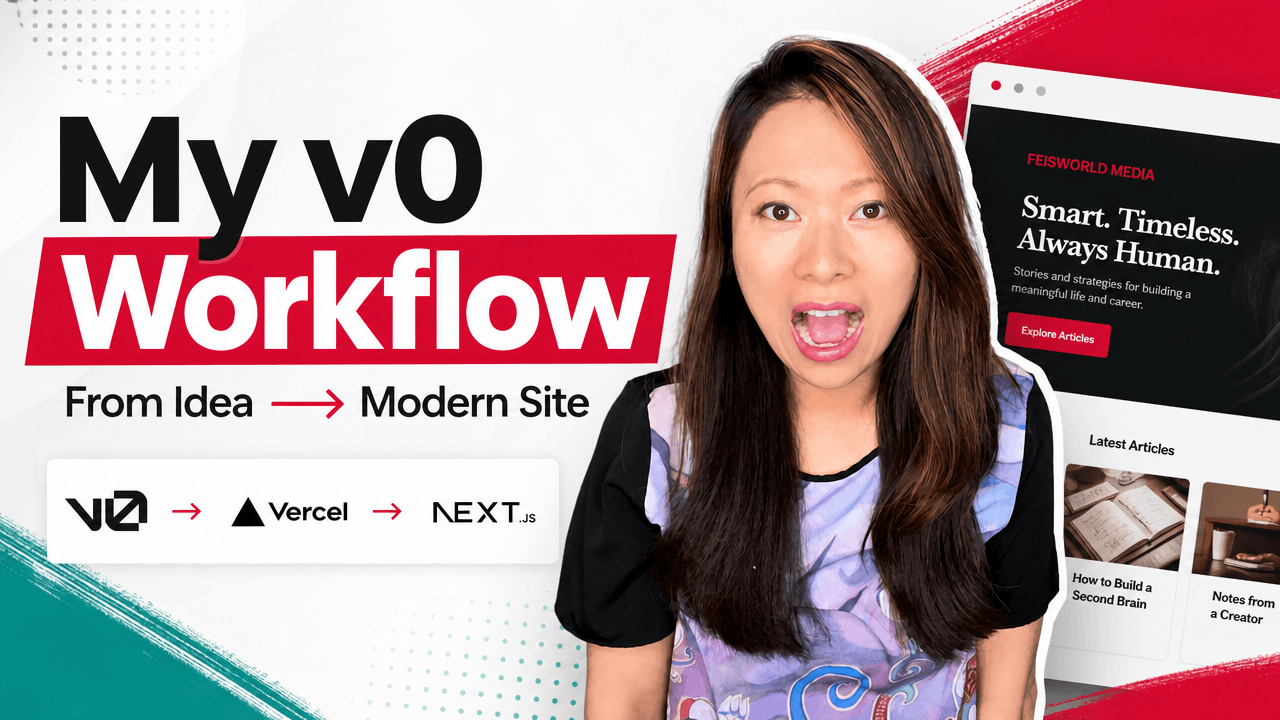
We used v0 during the Feisworld redesign because it was good at helping us explore layouts, buttons, responsive sections, and interface ideas quickly. But v0 did not decide the brand. We did. The same is true for any AI tool worth using.
If you want a practical example of this workflow, read How to Use AI to Generate Complete Website Layouts in Minutes. For visual AI workflows, you may also enjoy Adobe Firefly AI Assistant Public Beta and Adobe Comes to Claude.
Why Small Creators and Brands Still Have an Advantage
I still believe smaller brands have a real advantage here.
Large companies have budgets, teams, agencies, and brand recognition. They also move slowly. By the time a piece of content passes through every filter, the person behind it can disappear.
Small brands can show the work in ways large teams often cannot. They can publish the messy details, explain what broke, compare tools after actually using them, show screenshots, answer reader questions, and update a page because one person noticed something was wrong.
For Feisworld, this is our lane. We are practitioners. We test tools, interview people, make videos, build workflows, update posts, and explain what we learned. A specific example usually does more for us than a polished page that says everything and proves nothing.
Build Public Proof AI Can Read
When I strip it down, this is what I would check first.
Public Proof Checklist
- Clarify the brand: Write a plain explanation of who you are, what you do, and who you help.
- Publish first-hand content: Write the guide, record the video, share the case study, and document the tradeoff.
- Connect the channels: Link blog posts, YouTube videos, podcast episodes, partner pages, and author pages together.
- Make the site readable: Use clear headings, internal links, schema, fast pages, working images, and clean redirects.
- Review what changes: Watch GSC, GA4, Ahrefs or Semrush, YouTube data, and AI answers over time.
The checklist leaves out a lot of bad advice: publish 100 generic posts, stuff keywords into every paragraph, or build pages only for AI tools.
Google’s guidance is direct on this point: create useful, non-commodity content for people, bring a real point of view, and avoid publishing large amounts of low-value content just to target every possible query variation.
Build the Blog as the Foundation
A blog is still one of the best places to build durable brand visibility.
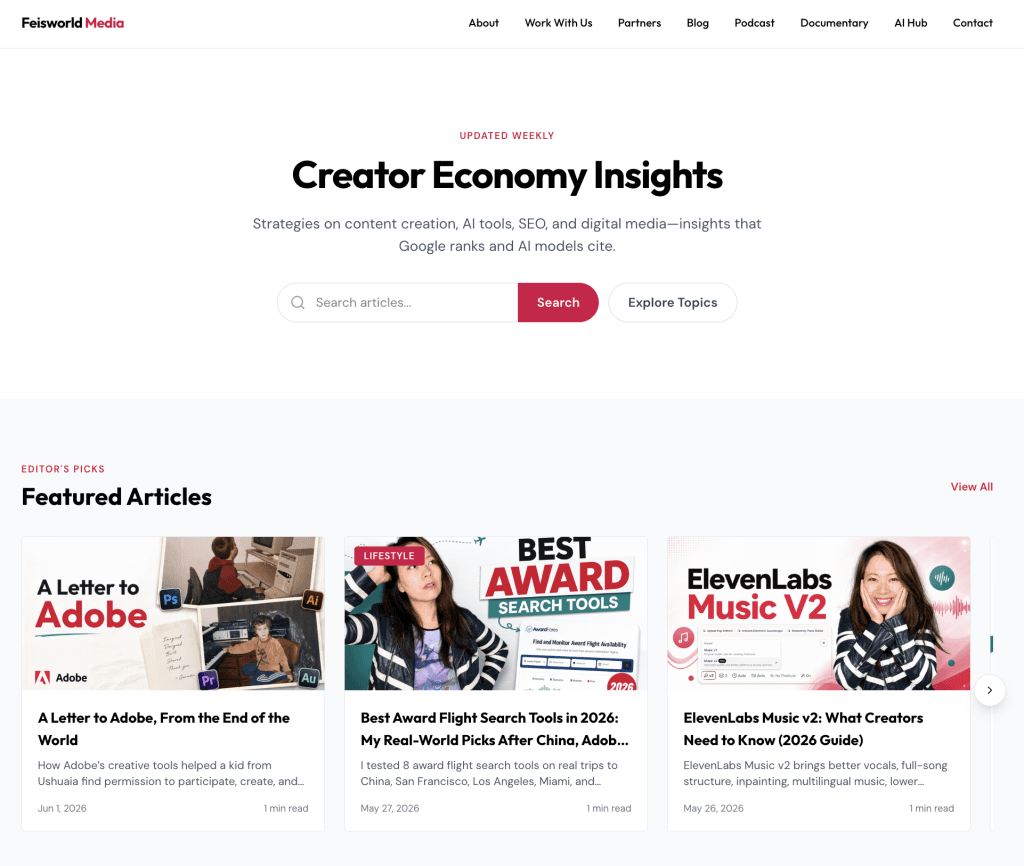
On our site, the blog is where a lot of the other work comes back to. A YouTube video can support the article, a podcast episode can deepen it, and a partner page can point back to it. Search engines and AI tools also have a clearer page to work from.
But a blog is only useful if it is maintained.
That was one of the biggest lessons from our migration. We had valuable old posts, but some legacy blocks were ugly or semi-broken. Some embeds were inconsistent. Some metadata had to be cleaned up. Some old links needed new decisions.
In our last big migration, from Squarespace to WordPress, we improved the site but did not fully solve the archive problem. This time, AI helped us find more of the hidden issues. It could scan for patterns, flag inconsistencies, and help us run repeated curation passes.
AI helped us find the work, but it never got to make the final call.
For content operations, that kind of pattern-spotting is where AI was actually useful. It noticed things a human team can miss after staring at hundreds of old posts.
Use YouTube as Proof, Not Just Traffic
YouTube can do more than send views. It can show how you think and work.

When Fei tests a tool, interviews a founder, or walks through a creative workflow, the viewer gets evidence. They can see the screen. They can hear the questions. They can decide whether the advice feels practical.
For AI visibility, video matters because it gives the rest of your content more proof. A video can become a blog post, the post can embed the video, and the description can point readers back to the full guide. Transcripts and podcast clips can support the same topic too.
Our new editorial workflow connects YouTube data back to the blog. We want to know which videos support which posts, where a video is outperforming the article, and where a post needs a better video angle.
A generic plugin would miss that context, because it depends on our editorial goals.
Use Podcasting to Build Authority Over Time
The Feisworld Podcast has been part of our brand since 2014. Over time, those conversations have become part of the company’s public memory.

Podcasting is slower than short-form content, but the depth is the point. A real conversation lets people hear how someone thinks.
If your brand has a podcast, do not treat episodes as disposable. Turn them into searchable pages. Add transcripts when possible. Connect guests to topics. Link episodes to related articles. Keep the archive clean.
Years later, those conversations can still help people understand what your brand has cared about, who you have learned from, and how your thinking has evolved.
Build Third-Party Proof Carefully
Third-party proof still matters. That can include press, interviews, reviews, partner pages, expert quotes, podcasts, YouTube collaborations, and thoughtful community discussions.
Platforms like Qwoted and Featured can help connect brands with expert-source opportunities. Journalist relationships, podcast guesting, and creator collaborations can help too.
The goal is not random mentions. A shallow mention does very little. A useful review, interview, or walkthrough gives people context they can act on.
For Feisworld, our strongest partnerships have never been quick shout-outs. We build content that can live for months and years: a blog review, a YouTube walkthrough, a podcast conversation, or a partner page that helps someone understand a tool in the real world.
This is also why we keep creative control in our partner content, while still giving brands a factual review before publishing. The brand can correct product details, names, screenshots, and terminology. But the final piece still has to sound like us, from a practitioner point of view. Otherwise, it becomes another sponsored page nobody really trusts.
You can see how we approach those partnerships on our Work With Us page.
The Technical Layer, in Plain English
Technical SEO can sound intimidating. It does not have to be.
The practical question is simple: can the page be found, read, and connected to the right people, topics, and media?
Most brands should start here:
- Pages load quickly.
- Important pages are crawlable.
- Titles and descriptions match the page.
- Headings are clear.
- Images have descriptive alt text.
- Internal links connect related ideas.
- Author and company pages explain who is behind the work.
- Schema supports real facts, not wishful thinking.
- Redirects send people to the right updated page.
The tools can vary.
For Feisworld, we kept WordPress for writing. We stopped asking WordPress to be everything else.
The public site now uses Next.js on Vercel. Turso helps us keep important content data fast and available. Vercel Image Optimization and Blob help with image performance and resilience. The Ops dashboard helps us review redirects, affiliate links, stale content, and performance signals.
You do not need our stack to build a better brand footprint. You do need a system that helps you publish, update, monitor, and fix content without guessing.
Strategy vs. Implementation
| Goal | What we changed at Feisworld |
|---|---|
| Make the brand clearer | Updated About, company, author, partner, and llms.txt pages |
| Make content easier to retrieve | Cleaned categories, tags, schema, sitemaps, and internal links |
| Make the site faster and safer | Moved the public site to Next.js and Vercel, with Turso for fast data access |
| Make updates easier | Built Ops workflows for content monitoring, redirects, affiliate links, and review queues |
A Quick Note on Adobe and Semrush
On April 28, 2026, Adobe announced that it completed its acquisition of Semrush. Adobe described Semrush as a brand visibility platform and connected the acquisition to discovery across AI interfaces and agents. The official announcement is here: Adobe completes Semrush acquisition.
We also wrote about the acquisition on Feisworld: Adobe Acquires Semrush for $1.9 Billion: The GEO Revolution Creators Can’t Ignore.
I do not read this as a reason to chase another acronym. I read it as a signal that the market is trying to measure brand visibility across search, AI answers, and agent-style discovery.
If a company like Adobe is investing in that layer, brands should pay attention and clean up the public information they already control.
How We Applied This to Feisworld
The Feisworld migration started as a website project and turned into a strategy audit.
We had useful content and years of trust. We also had old blocks, plugin decisions, redirects, image dependencies, affiliate workflows, and metadata that had accumulated over many years.
We had migrated before. When we moved from Squarespace to WordPress years ago, the redesign worked, but old content curation was mixed. Some legacy blocks stayed ugly or semi-broken even after hours of manual work.
This time, AI helped us look at the archive differently. We could run curation passes, spot patterns, create reports, and build fixes for specific classes of posts.
One small example: a group of older posts still carried image and embed decisions from the old setup, including assets that were too tied to WordPress uploads or optimization tools we no longer wanted to depend on. In the old workflow, we would have opened posts one by one and hoped we caught enough of them. This time, we could scan for the pattern, group the affected posts, and decide whether each issue needed a content fix, a redirect, or an image-cache fix. It was boring work, but it was the kind of boring work that makes the site feel cared for.
That does not mean AI ran the migration. We made the decisions. AI helped us move faster, test more, and find problems earlier.
My estimate is that the same project would have taken a small team 12 to 18 months without AI support. With AI, it took a little over two months of focused work. It was still hard. The difference was that the work became possible for our team.
This is the part I hope people remember: the speed helped, but the direction still came from human review.
What Not to Do
Do Not Publish Thin AI Content
If your article could have been written by any brand in your category, it probably will not build much trust.
Use AI to help research, organize, test, and edit. Then add the parts only you can add: real examples, screenshots, numbers, stories, mistakes, and opinions.
Do Not Chase Mentions Without Building Evidence
It is natural to want a ChatGPT mention. But if the public web does not contain enough useful evidence about your brand, a mention is fragile.
So build the evidence before chasing the mention.
Do Not Let Old Content Rot
Old content can be a gift. It can also be a liability.
If you have been publishing for years, your archive is part of your brand. Review it. Update it. Redirect what no longer fits. Keep what still helps.
Do Not Rebuild Your Website Just Because AI Exists
You do not need a headless site to build AI visibility.
Rebuild only if your current site is too slow, too hard to update, too dependent on tools you cannot control, or too messy for readers and search engines to understand.
Many brands can make meaningful progress with a focused cleanup: stronger author pages, better internal links, clearer service pages, updated posts, better images, and a simple measurement process.
Brand-Building in 2026: Quick Checklist
- Can someone understand what your brand does in one paragraph?
- Do your About, author, and company pages match your current positioning?
- Do your best articles link to each other in a useful way?
- Do your YouTube videos and blog posts support the same topics?
- Do you have third-party proof beyond your own website?
- Are old posts updated, redirected, or retired when needed?
- Does your site load quickly on mobile and desktop?
- Do your images have useful alt text?
- Do you use schema to support real facts?
- Do you track GSC, GA4, and at least one SEO research tool?
- Do you check how AI tools describe your brand?
- Do you have a process for fixing wrong or stale information?
Frequently Asked Questions
How do I get my brand mentioned by ChatGPT?
You cannot force ChatGPT to mention your brand. What you can do is strengthen the public record: clear service pages, first-hand blog posts, product reviews, YouTube videos, podcast episodes, third-party mentions, schema, and updated information across the web.
What is AI brand visibility?
AI brand visibility is how your brand appears in AI-generated answers, summaries, recommendations, and comparisons. It includes whether your brand appears, how accurately it is described, which sources support the answer, and whether the answer reflects your current positioning.
Is AI visibility different from SEO?
Yes, but they overlap. SEO helps your content get crawled, indexed, ranked, and understood. AI visibility looks at how your brand appears when AI tools summarize or recommend information. Strong SEO is still one of the foundations.
What is GEO?
GEO usually means generative engine optimization. People use it to describe work around AI search visibility. I use the term carefully because the work still has to come back to useful content, technical clarity, and real brand proof.
How do I measure brand visibility in AI search?
Start with Google Search Console to see what people already search. Use Ahrefs or Semrush to find related topic clusters. Review YouTube and GA4 data to understand engagement. Then run a small set of repeatable prompts in ChatGPT, Gemini, Perplexity, Claude, and Google AI features to see whether your brand appears and how it is described.
Should I rebuild my website for AI search?
Not automatically. Rebuild only if your current site is slow, hard to update, hard to crawl, or full of outdated content. Many brands should start with a content and technical cleanup before they consider a full rebuild.
Can Feisworld guarantee AI mentions?
No. We do not guarantee AI citations or mentions. What we can do is help improve the pages, structure, and cross-platform proof that readers, search engines, and AI tools rely on.
Conclusion: Make Your Brand Easier to Explain
Building a brand in 2026 starts with more than AI search trends.
It is about making your work easier to explain, verify, and update.
That touches your website, blog, videos, podcast appearances, partner pages, author profiles, images, schema, redirects, old posts, and monitoring workflow.
At Feisworld, the migration made this clear. For a media company, a website holds the public memory of the work.
If that memory is messy, your brand becomes harder to understand.
When it is clear, current, and connected, you have something you can keep building on.
This is the work in front of us at Feisworld now.
We want people to find the work, read it without friction, and know it is still being cared for.
You might also enjoy…

Written by
Fei WuFei Wu is the founder and CEO of Feisworld Media, a Massachusetts-based digital media company helping brands get discovered by people and by AI. An Adobe Global Ambassador and brand partner to ElevenLabs, Synthesia, and 50+ other tech and AI companies, she hosts the Feisworld Podcast (400+ episodes, 500K+ downloads — guests have included Seth Godin, Steve Wozniak, Chris Voss, and Arianna Huffington) and co-created the documentary Feisworld: Live Your Art on Amazon Prime. Fei writes for CNET, Lifehacker, and PCMag, and her work has been featured in Forbes, Harvard Business Review, and WIRED. She has been publishing on the internet since 2014 — long before AI discoverability had a name.
View all posts by Fei Wu→Stay updated
Weekly insights on content, AI, and digital media.
Keep Reading