Lori Richardson: How to Attract, Promote, and Retain Great Women in Sales (#342)
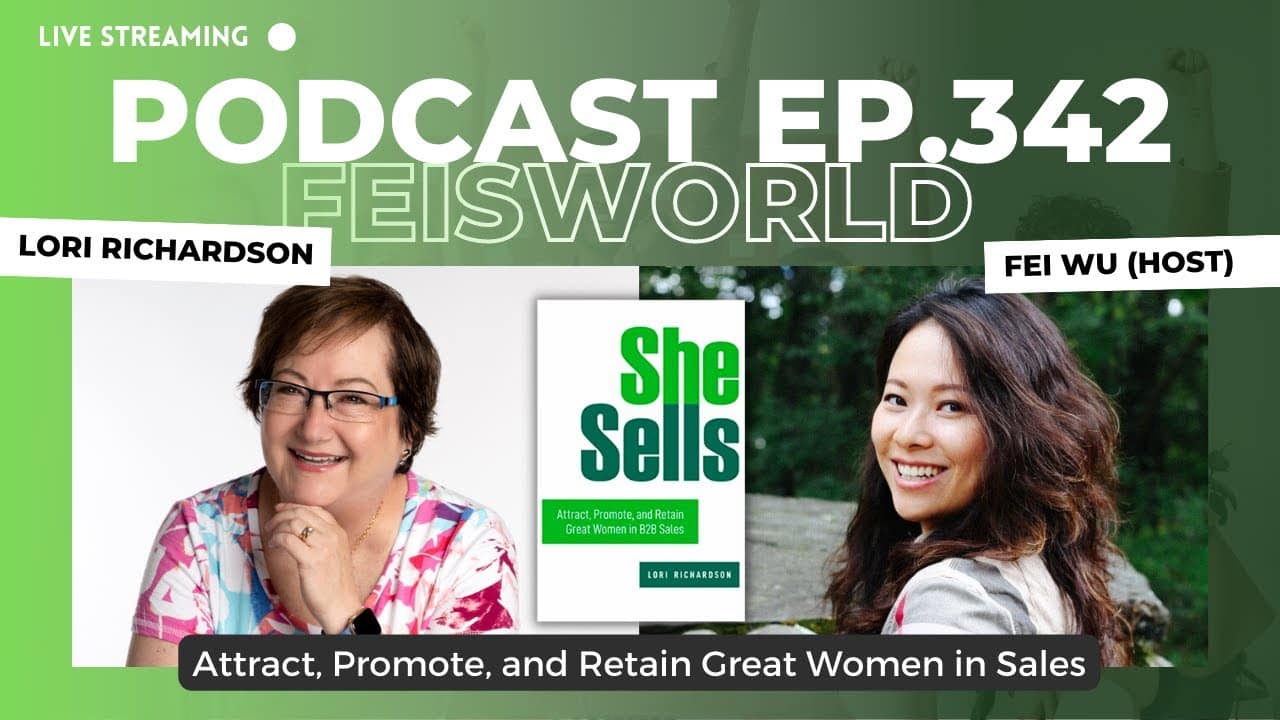
Our guest today: Lori Richardson
After 15 years in B2B sales, Lori Richardson ( @LoriRichardson ) founded Score More Sales to help companies grow revenues through strategy. Noticing a massive lack of women, she decided to lead the effort to change the industry.
She created Women Sales Pros, a community that showcases experts and offers inclusive sales team consulting. Lori’s new book is “She Sells – Attract, Promote, and Retain Great Women in B2B Sales” and she hosts the award-winning podcast, “Conversations with Women in Sales”
Lori is a 3rd year Salesforce Top Sales Influencer and a Sales Coach at Harvard Business School.
Book, “She Sells“
Watch Our Interview
Transcript
Transcript
Fei Wu: From Feisworld Media. I am so thrilled to be here with my new friend, Lori Richardson. Hello. Hi,
Lori Richardson: Fei.
Fei Wu: Oh my God. So excited to have you here because I love the mantra, the message you are. Spreading to the world, to the ether, which is more women, more sales. And I cannot agree more with you. And especially after working as a female full time entrepreneur since early 2016. And frankly, I feel like since I was pretty little. This is something always top of mind for me, um, because we don't really vow for ourselves and the kind of opportunities don't really come our way. And then, you know, uh, immigrating to the U S feeling like again, a woman of color and the certain things I, I wasn't really comfortable with, but I have to go forward anyway. So I'm excited for this conversation before we get started. I'm going to briefly introduce you to, um, our audience who is less familiar with your work. So. Here we go. After 15 years in B2B sales, Lori Richardson founded Score More Sales to help companies grow revenues through strategy. But noticing a massive lack of women, she decided to lead the effort to change the industry. So she created Women's Sales Pro, a community that showcases experts and offers inclusive sales team consulting. Laura's new book, she sells, attract, promote, and retain great women in B2B sales. And she hosts the award winning podcast, Conversations with Women in Sales. Laura is a third year sales force, top sales influencer, and a sales coach at Harvard Business School. Um, and she sells. The book is available on Amazon. Highly recommend you check it out. And as soon as we kick off the conversation, now I'm going to drop in a link tree link so you can find all the resources, tips, and tools, all the sites, uh, and information that Lori owns. So welcome to the show, Lori. I'm so thrilled you're
Lori Richardson: here. Thank you. Hey, what a great introduction.
Fei Wu: Thank you. And I have to say that, uh, we came across, I remember just having you on my radar, honestly, for quite a number of years now. And I'm so thrilled that I posted a message this, you know, when I turned 40, a couple of weeks ago. And if you remember, I said, Hey, anybody who has turned 40, or more, and please, I would love to Kind of hear your thoughts and opinion. You're so genuine, so generous with your feedback, your thoughts. And I realized immediately that I wanted to connect with you. So I just want everybody to know how organic this interaction was. And I'm so
Lori Richardson: glad you said yes. Yeah, thank you so much. And, and I, I do feel like, you know, women. women more than men get pushed down the older we get to the point that some women feel like they're not even seen that they're just, you know, people just walk right by. So we don't, we want to change that.
Fei Wu: Yeah, I, that is very important. And I have to say that it felt vulnerable a little bit for me to say, Hey, I'm turning 40. And most of my friends, my dear friends are all at least 10 years. Or more older than I am. So it was in a really interesting moment where people are like, Oh my God, face 40 years old. That is crazy. And, uh, people remember me when I was like 17, 18. And, uh, you know, so I loved your message. And so please tell us a bit, maybe just on that note of why, Laurie, do you think women need to be seen and what can we do for each other and what have you done for other women? To make them feel more alive, to be seen, to be more empowered.
Lori Richardson: Well, I, I think I'll start by saying that in the business to business sales world, you know, it's a, it's professional selling company to company. So we, you know, we help. into this field so that they can sell to other companies. And, uh, I, when I start off as a solopreneur, I just sold to solopreneurs, entrepreneurs, and I really missed the, the corporate world that I had come from. I'd spent 15 or more years in. And so when I got back into it, I just realized how much I love it. And yet there is such a lack of women. Um, it's a very biased business though. I mean, it's, it's male majority, it's white male majority and. When I was over 40, when I turned 40, um, that was the first time I had ever been downsized was in my early forties. It wasn't because I was 40, but we had, we were about to be acquired. And so I became a protected class. You know, I was a woman and I was over 40 and yet I was at a company where I found out later that the CEO just didn't want people that were. You know, over mid thirties, really, you know, it was, is technology and it's a young person's game and that's what they said, even though that's illegal as we know. Um, but that was, and for me, that was, you know, more than 20 years ago. So I'm, I'm still in, I'm still working with companies and technology as well as other industries. And, uh, you know, I just find that the older women get. The more chances there are for us to not be taken seriously or not be seen or heard. And it's, it's true in, you know, in, uh, in entertainment, it's true in a lot of different, um, industries and it's the exception to the rule. And that's what I love to showcase women on the podcast and elsewhere who are doing really amazing things at any age.
Fei Wu: I'm so glad. I feel like we could be in a way sisters because, uh, sister creators, when I started the podcast back in 29, 2014, I can't believe it. YouTube was 2019. Wow. Yeah. There were not only not a lot of women. It was really, frankly, awkward for me to be an immigrant English as a second language. Uh, yeah. You know, a woman who's probably known in my little inner circle, but I was never really out there and speaking in a podium and, uh, really feeling projecting and feeling confident. So I remember even in the early years of running the podcast, how much I enjoy talking to women. Women always ask questions back and we're always having a conversation. I, I remember that, but it was actually really hard. I remember 2014 to 2016 for women to approach women and for them to say yes. And many of them come back with their extraordinary background as you know, and say, I'm not sure if I have enough to contribute or enough to say. So I wonder if you have run into that Lori, whether. In your personal, in your professional lives now, you're, you know, work with women in sales. That is, I can't wait to delve into that.
Lori Richardson: Yeah. I mean, I don't even know where to start. Where should I start? What do you want me to?
Fei Wu: Yeah. I mean, we can jump, we can hop right in for people, you know, especially so curious about your, I think your methodology, your philosophy, when it comes to, you know, women in, in sales as a profession, I think I envision it to be the most I suppressed maybe as a. You know, a strong word, uh, but it, it's gotta be a tough role for women.
Lori Richardson: It can be tough, you know, for me. So when I got into sales, I was in my early twenties and I was already a teacher with young children, but it was a very low paying job. And I became a single parent. So as a single parent, I couldn't afford to work in, in education. So I thought, what can I. What can I do? You know, I want to make money like my male counterparts. And I actually went through this whole non traditional program for women where I poured cement and I did scaffolding and all these blue collar jobs. And then someone was talking about technology and I, my ears just. Perked up and I thought, you know, I, I grew up in my grandmother's clothing store in a family run business. I, I know how to sell. And so I thought maybe I can sell technology. And this was actually in the mid eighties, mid 1980s as to, you know, to really show when I started, um, When Apple came out with their first computers and when IBM came out with their first computers and Hewlett Packard and all these other companies, I knew that I could, I knew I could sell. And I knew that if I could create this, uh, commission based income where the sky's the limit, uh, I knew that I could support my family. And so I was able, I got into technology. And I was able to buy a house as a single mom when I was 27. And you know, that wasn't the case for a lot of, I mean, a lot of couples couldn't afford a house then at that time. And so that those things, I was able to get my son into a very expensive sport, which is ice hockey. And because,
Fei Wu: so
Lori Richardson: that's so cool. So, you know, it was, it was life changing. So sales is a game changer for women. It, it, it not only helps companies to have women on their sales team and women in leadership. So it's really good for the company. It's really good for their buyer, all the buyers that, that work with the company, but it's also good for women ourselves because it can, it can elevate us to give us a good income. Um, and when women. have a good income. We don't just keep it for ourselves. We support the community. We support our kids if we have them or we support our parents. You know, during COVID, even women without kids left their jobs sometimes to care for their parents or their relatives or, you know, their community. They help their community and that's what women do and that's how we were raised. So we are different from men in that way. And, um, and it goes a long way to when, when women get empowered with a position like this.
Fei Wu: Wow. This is so crazy. We're meeting for the first time. As you were saying that I realized that, you know, I bought a home in the midst of the pandemic in 2020 by myself and still supporting the house on my own. My mom is living here, uh, who I care for. So as you're describing that, I realized. You know, how empowering that is. I'm a very supportive partner with that said, you know, it's important that women have now have the choices to say, if I have to make certain decisions on my own, such as, uh, you know, caregiving for my mom's creative space that she has an artist can thrive in and all these things, the ability to be able to make decisions, uh, independently, it is, I don't know. It's something that in this case, I want to say money can't buy, but in this case, yes, money can. I don't know. Like, what do you think? Actually, money is a
Lori Richardson: tool, money, money can help you with freedom and, and that's why money is, it can be a great, uh, tool to have money isn't everything for sure. And just because you have money doesn't mean you're going to do good things with it. But I find that if you give a, you know, single parent, uh, some added financial stability, Um, or someone who may not have a, I mean, there are women that I've interviewed that didn't have a home. They were, you know, living in a motel until they got into a sales role and then leveraged into technology sales, which had a huge amount of revenue flowing for a long time. We know the bubble kind of burst recently, end of last year, first of this year. And now there's a lot of layoffs and other things, but it will bounce back. You know, everything's cyclical. I've, I've seen this before in technology and, uh, in the, you know, the early two thousands, we saw a big bubble burst. And so, um, so, but there are many fields where you can, a woman can get into sales. And. You don't need a college degree, you don't need technical background. It's really, if you have a mindset for learning and you're open and, you know, there are a lot of tools and processes that can help us. And there are a lot of ways. I just saw a website today where they have a course for 500 that will teach you how to sell. There's also, I've, I work with another company and there's some, a number of them. That will help people get into technology sales. So there's, there's a lot of options for, for even no dollars. You can, you can learn about, uh, what sales is and learn how to sell technology. And then it's just a matter of getting the right, with the right company, getting a really supportive manager where you'll learn and, and have, you know, a company that you believe in that will support you and then, you know, working hard.
Fei Wu: Wow. And so you, you painted, uh, an example. I think it's maybe harder for some people to imagine how is that possible? Uh, but I would love for you to help us paint a picture of someone, uh, you know, like you mentioned living in a motel, uh, you know, don't really have, uh, the stability of a home, maybe even with, Child with children, a single mom. How does someone go from that lifestyle to, uh, getting a job as a sales rep or salesperson at a tech company? Like, what are the steps that you have seen? Obviously this is not the only way. Right.
Lori Richardson: Well, certainly, you know, it helps if you have access to technology. So, you know, you have a laptop. And, um, you're a learner. And so you go online and you look at, uh, and we, I've posted a list. I should do, I'll do an updated list of the different companies that offer training, um, because there traditionally haven't been enough people to fill roles. Now there's, you know, been a lot of people laid off and some different things going on. So I don't know exactly how that stands, but there's still opportunities. Uh, and now you can work more virtually. Um, some companies want people in person, but there are some companies that are a hundred percent virtual now. And I'm telling you, that would have been a dream for me as a single parent. I would have loved that when I launched my own business, if I could have worked five more years remotely. But nobody was doing that back then, you know, and now it's just, it's, there are so many companies that will offer that. So to find the right type of company and, you know, maybe you like to travel, maybe you're not, maybe you're not a parent and you're a single woman and you want to see the world. I mean, there are a lot of opportunities that way too. They're just so many flexible options about when you work and where you work. As long as you're doing, you know, as long as you're producing. So that's a difference, Faith, from, for sales and a lot of other roles is that if I can show you the work, I show you what I'm doing and it's producing results. I mean, that's, it doesn't really matter where I do it or, you know, if I get it done early in the quarter or early in the month, you know, it's, it's, um, it's really, it's really great in that way. And what I love about it is that I can tell, and other people can tell I'm doing my job. And if you're not successful in it, you know, it might not be the role for. For you, because it's not for everyone, but as an entrepreneur, you know, that selling is a component of what you do. So I suggest that if women can learn, you know, spend two years in a company that will pay you to not only learn to sell, but to support, support your sales career. You know, then you can climb the ladder at that company. Um, you can rise to the top at using your sales skills to sell your ideas, or ultimately you can launch on your own and you'll, you have the ability to sell yourself.
Fei Wu: I have some, uh, some, maybe an, an. A number of rapid fire questions. I feel like there are a lot of, uh, myths related to, uh, maybe not only just women in sales, but sales in general. I know a number of my friends who, um, who have been, or are currently working in sales on envision them. Actually they're in their fifties. So number one, uh, in order for you to work in sales, you don't have to be super young. Is that true?
Lori Richardson: That's true. You didn't, but you need to have an open mindset and you need to take responsibility. So it's not like, you know what, I'm too old for the, I've had people say, you know, I can't find a sales job because I'm too old. I'm, I'm in my fifties and no one will hire me. It's like. That's not a really good mindset for, you know, someone would say, you know, I'm, I'm having trouble. I don't know if it's because they see me as too old for, for the role, but I bring this, this, this, and this. And, and one of the best things we have over 50 is wisdom. You know, you can't. Make that up when you're in your early twenties, you haven't lived and you have other things in your early twenties. You have energy and enthusiasm. Um, but if I can bring wisdom and insight and I can shorten my sales cycles that way, it's hugely valuable. So it's, it's all about mindset.
Fei Wu: I love it. And then also another myth, I think, is about the fact that when you work in sales, chances are your income is going to be completely unstable. So I want to hear your thoughts on that.
Lori Richardson: I've had stable income for a long time. Even today, running my own company, I don't make any money until deals are closed and customers are brought on, much like you, I would imagine. And so, um, But I've been able to buy houses and, you know, do different things based on that income. So, um, I, I think that's a myth.
Fei Wu: Yeah. And also I, I want to add a, including someone like myself and most of my community are creators and small business owners, the fluctuations of income, I know it can be literal irritating at first and we're really, um, making anybody feeling a little stressed out and anxious. I think that's normal, but whenever I see my, you know, annual income and does Epson flows and then eventually. Somehow they, they do always kind of come together. I think we, uh, there are certain, there are certain seasons to sales as well. Like we had just have to face it. Sometimes summer, sometimes summers are slow, but I just got back from vacation and literally this morning landed in my. Inbox or three deals that are closing today. So I put in the work, I went on location and they're here now. So how do you, uh, would you say manage to be able to manage, uh, sales expectations and the fluctuations? What are some of the tips and
Lori Richardson: tricks? Well, yeah, you brought up a good thing, which is you need to have a process and you need to have a pipeline. And with your pipeline are opportunities that will close down the road. So we need to be working now for what's going to close in a few months, or depending on your sales cycle, um, down the road, because things don't just happen instantly. I mean, people are harder to reach, but they're not impossible to reach. And if, and if you have something of value and you can convey that, and it's something of value to them. Not just to you. Um, then, you know, it's just a matter of getting in front of them at the right time and, and showing them how it will be value, valuable. So I think that what you say and how you show up online and elsewhere is a big part. It's not just a matter of calling, you know, cold calling, which, you know, I call it warm calling because I'm. I'm going to follow up with people. I only talk to people that I've reached out to by email or LinkedIn. Um, I don't pick up the phone and call people cold. I don't think anybody does. A lot of people don't, um, maybe some have a list to call on, but today. You can set up meetings and appointments and calls and talk to people, um, socially through social channels and, and then, um, set up as soon as you can. I like to get a call on the, on the phone or on a zoom so that we can see each other, or we can at least hear each other's voices and that can help to build trust.
Fei Wu: Absolutely. I love when you brought up. showing how you show up online. Uh, I've been a huge fan of, you know, Seth Godin, Dori Clark's work, of course. Uh, and our, you know, we have a lot of mutual friends as well. So I would love to hear your take on showing up online and that's something, first of all, I want to confirm. Something I feel like personally have benefited, uh, tremendous, uh, tremendously in the past few years, um, having my YouTube presence, you know, we have a monetized channel, uh, 22, 000 subscribers, which grew over time from zero in 2019 to what it is now. And the tremendous amount of impact and just outbound. Sales. I'm actually not an expert in sales per se, but I just see all these leads coming in, you know, from YouTube, from social media and people buy that it completely shortens the sales cycle to add back to your previous, um, right as well. And people are like, I've seen you on, I've watched the people say I've watched the 20 of your videos. I don't know. He's exactly 20, but more than one. And, uh, we trust you. How much do you charge? Okay. I need some help two days from now. It's you and no one else. It's like, uh, so please talk about how we show up online and how do, what does it mean and why did it's important? Well,
Lori Richardson: the first thing that you just mentioned is so such a big deal because it used to be that someone's would, someone would say, okay, Faye, so I'm interested, can you send me three references? You don't get asked for references anymore. Do you ever? If someone asks for references, it's a red flag to me because they haven't seen me out there. I've been out here, you know, for 20 years, I've been helping companies and we guarantee our work. So if someone isn't happy, we'll work with them until they are, until they're satisfied. So you can't find anything bad about what we do, knock on wood. I mean, Maybe someday something might happen, but we've never had a falling out with any clients. And so right there, if you can eliminate, um, having to give out references that that saves time and it, and people are like, yes, I know I've seen you. I know you can help me. I know you can help me. So that's really, really great. So I'm really excited about that. I have a little fly here.
Fei Wu: The fly wants to join the conversation. I know people now it's real. Sometimes I just get this
Lori Richardson: like, I'd like to ignore it, but I really can't.
Fei Wu: I know sometimes I, the flies, these things like to smash into your face. I don't know what that's about, but, uh, like I've only noticed that recently. It's to like kiss my face? And you have to do something about it. What, so how do you, uh, Lori, I think we should, uh, break down, uh, like the online presence or online content. So I specialize in the, the field of video, video marketing in general. And I always tell people, it doesn't mean that you're always shouting on your book. You're shouting out on why, you know, client testimonials. Those are great. Trust me. Like those could be part of the content that you're putting out there, but more importantly, it's. It's about the adjacent possibilities about how you're getting people on board, the one on one content, giving them value in general, that should be 70, 80% of the content,
Lori Richardson: not sales. So could you talk about that? Yeah, I totally agree with that. I mean, I, I was along for the ride with social media when it's first started out, first Twitter, all that stuff. And I learned from the. The social selling experts that, you know, you really want to promote yourself a small amount of time. You're really trying to help people with their problems and then they'll tune you in. If, if they know that, you know, you get what they do and you get what their challenges are, then every once in a while you throw something in that, Hey, if you want to help with this, let me know. Cause that's what we do. And, um, I find that, you know, we still get a lot of referrals from other people, which is really great. Um, we probably should get more socially and it's probably just the way, the lack of, you know, organization of, of how we do our social media. But, um, but I would say that, um, certainly if you can just figure out who your target market is, I mean, for us, it's company leaders of, of midsize companies or large, um. Large SMB company, bigger SMB, they need to have a sales team of, you know, I would say at least 5 to 6 people on up. We work with 50 people or 100 sales salespeople, but we can really do great work with. 5, 10, 15, 20 salespeople in a company. Those are the companies that tend to need help that don't have all the gurus or the answers. And so we can come in and help them grow. And then it's just really understanding what do they want to hear? And then. You know, giving them those answers and giving them ideas and people say, well, don't tell them everything because then they won't hire you. But that's not true. Right? It's it's um, I remember for years, people would say, you know, tell them, but, you know, don't tell them how or, you know, Like hold something back. It's like, not anymore. Just we share what we do. And if they want to try it on their own, that's great. But if they want results that we know we can deliver, they can hire us. And probably the same way you would work, I would
Fei Wu: think. Completely agree on that note of so many people. My clients still ask me, Faye, I don't want to give away too much information. When is it too much? I'll tell them almost never. Yeah. You can't get away, right? People, we either want to, people want to watch the video and do it on their own. tremendously, they feel like they're in, you know, they owe it to you for for their own success. But if their companies at a certain level, they don't want to do it themselves, even if they could hire, you know, they want to hire someone, they don't want to learn it on their own. So absolutely true. I'm so intrigued, Laurie to for you to break down kind of, I think sounds like part of your offering still how you work with bigger companies to help them level up and train their Sales team, because it to a lot of people, honestly, including me, I find it really intriguing. How do you train people, whether it's one person or a team of five to sell a piece of technology, especially now we're in this crazy kind of hodgepodge of AI technology every day. There are three new AI companies, their software that you can pronounce and right. All these things popping up, but I feel like there's something, um, that is. Probably the same, uh, for, for your approach, but I just wonder, how do you train people to sell something that may or may not be familiar with? What are some of the criterias from the company to say, are you sure?
Lori Richardson: Yeah, it's a good question because I used to be very reactive, but someone like you would call me and say, I have this size team. We need this. I do a creative, you know, customized program. I deliver it. You'd like it. And everyone go. Oh, that was so fun. And then later I would say, well, how much did it help your team? How's the ROI? And you would go. Well, I don't, I don't really know, couldn't measure it. So I went back to the drawing board and I found some tools to help me create a process so that we can evaluate the team before we even started. So now we start by finding out who's coachable on your team. Um, do, do your sales managers, will they hold people accountable? Will the VP of sales or the head of sales, will they be involved? Because if they're not involved, we might as well forget it. Cause there won't be any reinforcement or repetition just because I come in and help with, with, uh, you know, some training or some consulting, it's gotta be reinforced over time. That's how we learn. So we start with that. And then in a year or 15 months, we'll redeploy that same. a survey and see how people have grown and how they've learned and whether they're more coachable or whether they, you know, have more skills, tactical skills that we've taught. So it's much more rewarding now. And I've done this for about eight years and it's been really amazing.
Fei Wu: Oh, that's so good to hear. What are some of the do's and don'ts when it comes to sales? And I really want people to pay attention to this, whether you work in the sales team or you're an entrepreneur yourself.
Lori Richardson: Well, Do follow up and follow up and follow up just because someone doesn't get back to you will, we'll, we'll tell ourselves a message like, Oh, they must not be interested. They didn't get back to me, um, but they might just be busy and, and I have people propose things that I'm really interested in and I just, you know, I lost their email. I got buried or something. So it's upon you to follow up and follow up until the person says, you know what? It, I'm just not a good fit, but thank you anyway, until they say that to you. It's not a dead lead. Um, if you feel like there's some reason why, not just because you think your stuff is great and everybody should buy it because that's not true, but if you figured out your target market. And you know that someone as a busy entrepreneur could really use this service and you can cost justify it and show the ROI. Um, and it's upon you to follow up and follow up until you get that answer. Like I gave the second thing is don't listen to the negative. Comments in your head. You can acknowledge them. Those are unsupported beliefs, and you can flip them and turn them into supportive beliefs. So an unsupported belief would be like, Oh, nobody answers the phone on Mondays or Oh, You know, um, this one company didn't buy, so I don't think this other one is a good fit. We don't know that. You're limiting, but those are self limiting beliefs. And so, if you have an open mind, say, you know what, I'll put them in, in my process, and I'll reach out to them, you know, the same number of times I normally do, and then we'll see if we can get any, any bites. And, you know, nine times out of ten, you might... Be, if you're open minded, you'll, you'll see new things will happen. We, we miss opportunities every day that we walk by. That's what I believe.
Fei Wu: Yes, absolutely. And we, we miss all the shots we don't take. Uh, and, uh, yeah, you know, so interesting. I want to. On that note, I kind of want to share some of my recent learnings, given, I think YouTube does a lot and our blog is growing so, uh, more so than ever before, uh, now we find ourselves to be, uh, come from tech, so I'm always signing up for our beta versions of certain things, I'm already on a lot of email lists, and every once in a while I find myself, I just want to write this article, I want to show, uh, the people how to, creators like myself, small business owners like myself, how to use something. It's not intimidating. Here's step one, two, three, as I'm doing this. And I thought, Hey, I'm already paying for this. I'm already using this. I'm going to read proactively, reach out to the company on LinkedIn filter, find people, people in marketing, people in sales, and I'll reach out and we started this collaboration simply by me offering, Hey, I really like your software. Here's some, a piece of content I've already created where in your case, or maybe your, your client's case, you know, here are some of the. Some of the case studies and work we've done and Lori, I've been really surprised in the past few months. Uh, I've basically turned around a lot of sales opportunity by proactively reaching out, which I never, I never really did before. I just always thought, you know, uh, cold leads or like just me reaching out. Cold. Nobody's going to respond. And I realized you've made
Lori Richardson: it a win win for them and for you, right? Yeah.
Fei Wu: Yeah. Didn't like all some of those opportunities. So I, I kind of want to get into this part. A lot of people don't really like, I ran into this a lot also as a business consultant over the years as a video marketer, as a digital marketer that I have worked with, um, didn't really start working with these clients because I noticed there's a there's a gap. There isn't a product market fit for them currently, whether it's whether it's coaching speaking or where they're selling particular service. So have you, I mean, when you work with these, I know you work with B2B, these bigger, larger scale companies, which in which case the fit most likely is already there before they can hire you. But, um, could you help us understand, like, when do we start? Uh, working with consultants or hiring sales, knowing that the product market fit it's already there. Or maybe it's not there. We're just fooling ourselves. Like I never really. Yeah, about
Lori Richardson: this. Yeah. Um, I think that you, you hire an outside consultant when you just don't have the time to do it yourself. You know, even though maybe you could learn how and learn all the steps. Um, you know, a lot of us just don't have the time, you know, I, I don't have the time to become a, uh, A video expert as for sure, and I don't have the time to become an accountant or CPA, but I know enough, you know, about how about our expenses and things like that to know about irregularities. So, uh, but I need experts and I need. Professional subject matter experts to help me and need creators who can crank out, you know, all these, all this output that I don't have time to do. So it's just, I think it's a matter of time as you're, as your business grows, you know, uh, for in the beginning, it's the money like, Oh, I can't afford to hire all the outside people, but sometimes you can't not afford to, like you have to find a way for me. I'll just sell something. You know, sell some extra, extra deal, extra opportunity that can fund something, you know, for a year. And, and that's one way that that's what I love about selling is that if you have that mindset that you're never, you're never stuck, you know, there's always a way to make something happen because we just need to grow our revenue. So we can do that if we can focus on the right areas.
Fei Wu: It sounds like the flexibility. Uh, and the ability to sell more than one product is something that people don't think about. This is no longer a... Oh, this is the nine to five. This is the only product you can ever talk about. I definitely, like you mentioned, I've seen people who can sell and work for different companies. It is that true as well? Laurie, what are some of the
Lori Richardson: things that we can side hustle? Yeah. I mean, I know people that do that. I I've seen people that have. Normal job, um, working in sales and also develop their own company over time. And, and I think if you can do that, it's a great, I didn't get to do that. I was cold turkey starting my own, but. Um, but if you can gradually build up your brand, um, you know, the, as long as you're giving your all to the company that you're working for, I, I don't think it's fair for people to, you know, have a job and not work at it and not do their, do what they've agreed to do. And if they're. Tricking their employer. We, we heard that during COVID that people would have like two full time jobs and they're all remote, so nobody could tell anything, but you know, that's short lived and it's, it's not, it's not fulfilling to, to, to trick employers. I mean, that's my opinion and you know, your, your, your reputation is all you have at the end of the day, that's really what you brought to the company. So, you know, stand tall and. And if you, if you plan to leave and be a full time creator or something, you know, give, give your all to your company and let them know your intentions. Sometimes they'll support you to that end. And, um. And, and I do think people can develop things when they, especially when they have support and people know how they're working, um, you can definitely do that.
Fei Wu: For sure. Yeah. I agree. If the sales position you're in is full time and as contracted to for a single company, definitely. Um, I've, uh, have friends now who work for multiple companies and he is a sales consultant. So that's a slightly different scenario. And his clients are aware and then he never really works in a position where it's contradicting or he's working for competitors. That's also right.
Lori Richardson: Yeah. That would be like us. We would do the same thing. Yeah. Yeah.
Fei Wu: So Laura, you're right about, uh, I find that you're Very not just supportive of women, but also showing them and, you know, having these difficult conversations. I've seen your followed your linkedin posts as well about women in sales and also, uh, You know, difficult conversations like asking for a promotion, a raise, or even asking to adapt, adopt new skills. Like, could you talk about perhaps why it's difficult and if women are living with that pain right now, what are some of the initial intermediate steps they can take?
Lori Richardson: Yeah, women. We tend to not ask for what we want, and that's because of how we were raised, in my opinion, and when I say that, I mean, generally, doesn't mean everyone has the same experience. But, um, we are kind of waiting for someone to tap us on the shoulder and say, Oh, hey, you're doing such good work. Would you like to be a manager? Whereas our male counterparts will say, I want face job. Tell me how to get that. What do I need to do? And. You know, there's nothing wrong with that, because if you're in a company, they, I guess, I didn't think about that when I was a sales rep, I never thought that I could tell my boss that I wanted his or her job someday, you know, it just like it never hit me and no one ever, you know, taught us that or to negotiate our salary. I never knew you could do that. And, you know, that's what most men do is most men will negotiate for a better salary or better conditions or time off or something, even when the company says we don't negotiate salary and you go, great, I need to have the week of Christmas off, uh, or, you know, the end of the year because of this or that. And. And so then they get it and, and we think, well, I couldn't negotiate. So I just went with it. And so we lose out or women will say, you know, I wanted flexibility. So I didn't really focus on the money so much. I really worked to get a flexible schedule because of my kids or something. And I didn't know I could have done both. So I would say right now, just ask, just be a slightly uncomfortable, you know, and just, just put an ask out there or let someone know if you're in a company and you want to get a promotion, let your immediate boss or supervisor know and see what they say, see if they're supportive because some will say, I'm going to help you get there because you're, you know, I know you're great and, and other people don't want you to leave and so, or they don't want you to leave. their department or team. And so they're not going to talk to you. They're going to sabotage you or try to sabotage you. So you have to find that out. And that's why I think men are so successful at doing
Fei Wu: that. Yeah. Yeah. I'm nodding because it's a, it's painfully true. And, you know, I remember just the, the fear for me on top of that, I will say that I was also working on H1, H1B visa, which means I was a nerd. What is it? Sorry.
Lori Richardson: They could like send you away,
Fei Wu: right? They could send you away, uh, under any circumstances.
Lori Richardson: Don't make
Fei Wu: waves. Don't make waves. I mean, it's very real. Like when they, quote, unquote, send you away or you have to leave your job, unlike being, um, American citizen, you know, Oh, you could take your time moving with your parents, with your friend. No, you have to be out of the country. I, You know, I've seen, and then you, you don't know when you can return and that really, I remember that was kind of this cloud over my head. And then of course I wasn't alone. Um, but the feeling of, wow, I've got to be out of the country, say goodbye to all my friends and leave my apartment, whether, you know, there's no time to cancel the lease. I've heard the worst stories. Oh yeah. Uh, and, um, so Lori, how do we think about, I mean, that maybe is a bit extreme, you know, I, uh, of a risk undertaking or the mindset, but in general, I've heard a regular, you know, my American, uh, colleagues say things like, Oh, I don't want to stir up anything. What if I don't get it where they assume if I don't get it, I'm definitely going to leave or I'm dissatisfied. Like, is, is it true? Or do you really have to, how do you assess the
Lori Richardson: environment? I think it's something we say in our heads now. I haven't been on a visa, so I, I don't know. That's real. I mean, I know that's real and you could be two steps from the sidewalk, as they say, you know, you might be out the door. Um, but I think when they talk about having a safe environment, a safe workplace that you feel comfortable, try with smaller things 1st to be more vulnerable. And if you don't feel that response, and I don't think everyone does. Cause I've heard from black women that have told me I can't bring my whole self to work. Like, I don't know who's saying that, but you know, that isn't true. And so it's gotta be true for you that you've, that you're comfortable to try smaller things. Like, do you have any projects I can work on? Um, that might be appropriate as you know, I work to climb the ladder here at the company and I would let them know, I really like it here. I'd love to take on more responsibilities. Now you don't want to take on two different jobs and not get, you know, get paid for one, but as you could take on a responsibility that might align with a future step, or even to say, what are, what is the progression here? And to learn, you know, some companies are more organized than others. And if they're not organized, they're like, Oh, we don't know. It's just kind of a crap shoot. That may not be a good place to plan a future at, you know, or if they say, you know, we're willing to help craft something. What are you interested in? That's what I'm listening for. I'm looking, listening for red flags or green flags, you know, and if it's green, like, Hey, let's, let's help you get to where you want to be. That's, that would be incredible. And if you don't feel it, you know, maybe it's going to happen at another, you know, Another place.
Fei Wu: I love the insights. Um, I definitely respect your time, Lori, but I just, I'm bubbling up here with some, uh, a couple of questions. I think about in the recent conversations I've had with, uh, guests on this, on this live stream talking about psychological safety. It's a phrase I definitely heard more so in the past few years. Um, now that I had been an entrepreneur, I haven't really thought about it consistently. And the other is like. Think it's kind of adjacent to that is how can women actually support and nurture one another. I think we always, when I was at my full time job, 2010, 2013, I constantly heard women, we should care for each other, but it was felt a little rubber, I feel a little empty. And also I've seen women being completely the opposite of that as well towards other women. So I would love for you to maybe chat with us about that. Something more concrete and practical.
Lori Richardson: Well, when I think of my world sales and business in general, business was built by men. Um, you know, that's the fact that's the way it was. And, um, I don't think men necessarily minded the fact that women might be not supporting each other because for a long time in companies, there would be maybe one promotion that they would promote a woman. And if there's three women. Hey, somebody's got to come out on top. And so, um, it was, we were set up to do that. And so we take it in our own hands when we can say, you know what, I support Faye. I support what she's doing. I'm going to share it with the world. You know, that's, that's a really great thing to do is that if, if you can show, uh, the world how we support each other. That's the very best thing. That's why I love my women's sales pros group because we're all sales experts, you know, but we all support each other in different ways.
Fei Wu: What are some of the things you do, uh, in your community? I definitely, you know, it's one of the links we've included.
Lori Richardson: So women, so the, this round table of sales experts, there's 50 of us. It's always stayed at 50. It's never gotten to a hundred or anything. It's, it's a group of 50 who are speakers, trainers, consultants, coaches, and authors. And so none of us do the exact same thing, even if. Even if there were a couple of us that are trainers, we don't train the same size companies, for example, or we don't necessarily train on the same topics. And so we're able to refer each other. And we just do it really well to the point that it has every day. I'm seeing how different women in our group are talking up other, LinkedIn. For example, I saw some of that this morning and I, it just makes me smile because it. You know, it helps them and it also helps us when we talk up other people because people see that we're generous and they see that we care about other people.
Fei Wu: So true. I think doing basically, uh, showcasing how you care and what you do in the community by doing, uh, this is, this is so true. Um, as this conversation is wrapping up in the end, Lori, I always ask the question, what are Some things that you wish to talk about and we haven't really discussed, we haven't had an opportunity where I forgot to ask.
Lori Richardson: I don't think anything other than, you know, I'm always open to new ideas and video. And I know that I, I know how powerful YouTube is in terms of a search engine. I don't think All, all the women do, you know, that might be listening. And so I think it's always good to remind people how powerful that platform is and how, even if you're not comfortable being on video, and I've been known to have some qualms about it, um, to just get out there and do it, right.
Fei Wu: Absolutely. I'm so glad you brought this up, Laurie, because anybody has questions for us for YouTube strategy, how to start to feel free to leave a comment. I will be more than happy to answer specific questions. Um, I agree with you completely. Uh, as we're talking, I'm already thinking about different clips that we can create because Yes. The reality is or something that I have learned and I'm going to like, maybe we can continue the conversation beyond the live stream as well is the fact that we think about video creation, the, you know, unfortunately we've been conditioned by Netflix, Hulu, and thank God we're thinking, Oh, I know I'm not doing a documentary series or anything like that, but I still have to look good. Sound good. Look the part because the other YouTube videos are now in case you haven't noticed, this is getting up there. It's almost like, you know, uh, every time I hear Mr. Beast, I tell people like that's that one video cost him 3 million to produce, and it's not really the standard of how we should think about. What YouTube can do for us. And you could in fact record a shorts that are very popular on YouTube right now under one minute on your phone with or without captions is fine. And, uh, without a ton of action zoom in and flashes and that's okay. Just get your message out there. It will teach you to be more succinct and, you know, the production cost is fairly low, and then you can build your stamina up to three to five minutes, five to seven minutes, still have a point and opening beginning, uh, uh, beginning a middle and end. So it is so fun to create videos, knowing that the barriers are actually not there. Like you said, Laura, it's all like in our mind, I'm not good enough, nobody wants to see me. Uh, so it's not true. It's, it's very fun, very
Lori Richardson: effective. Yeah. And we all have stories to share, you know, you have a story to share and just because you haven't written a book or something. It doesn't mean it's not worthy of sharing. You could inspire one person or, you know, 10 people. And, and that's incredible to have that power and capability.
Fei Wu: Absolutely. Yeah. Yeah. I love that. How you left those messages. We were all have, we're all empowered to do something about it. Thank you so much, Laurie, for your time. Uh, I want to remind people that in the comments below in description, wherever you are on Facebook, LinkedIn, whether you're watching it now or later, uh, there are a ton of resources that Laurie has mentioned and it's There. And this is Laurie's link tree where you can find everything is link tree. dot double E four slash score more sales with that said, thank you so much, Laurie. I hope we continue our friendship and so much more. I want to learn.
Lori Richardson: It's been my pleasure.
Fei Wu: Thank you so much. I'm going to take us offline now. Bye everyone.
Connect with Lori Richardson
Women Sales Pros
Score More Sales
She Sells Summit
LinkedIn
Youtube
Twitter
Instagram
You might also enjoy…

Written by
Fei WuFei Wu is the founder and CEO of Feisworld Media, a Massachusetts-based digital media company helping brands get discovered by people and by AI. An Adobe Global Ambassador and brand partner to ElevenLabs, Synthesia, and 50+ other tech and AI companies, she hosts the Feisworld Podcast (400+ episodes, 500K+ downloads — guests have included Seth Godin, Steve Wozniak, Chris Voss, and Arianna Huffington) and co-created the documentary Feisworld: Live Your Art on Amazon Prime. Fei writes for CNET, Lifehacker, and PCMag, and her work has been featured in Forbes, Harvard Business Review, and WIRED. She has been publishing on the internet since 2014 — long before AI discoverability had a name.
View all posts by Fei Wu→Stay updated
Weekly insights on content, AI, and digital media.
Keep Reading
Related Articles
Joanne Lipman on Mentors, Untapped Talent and Why Women Should Stop Waiting to Be Perfect
Marc Randolph on Curiosity, Messy Starts and Why “Nobody Knows Anything”