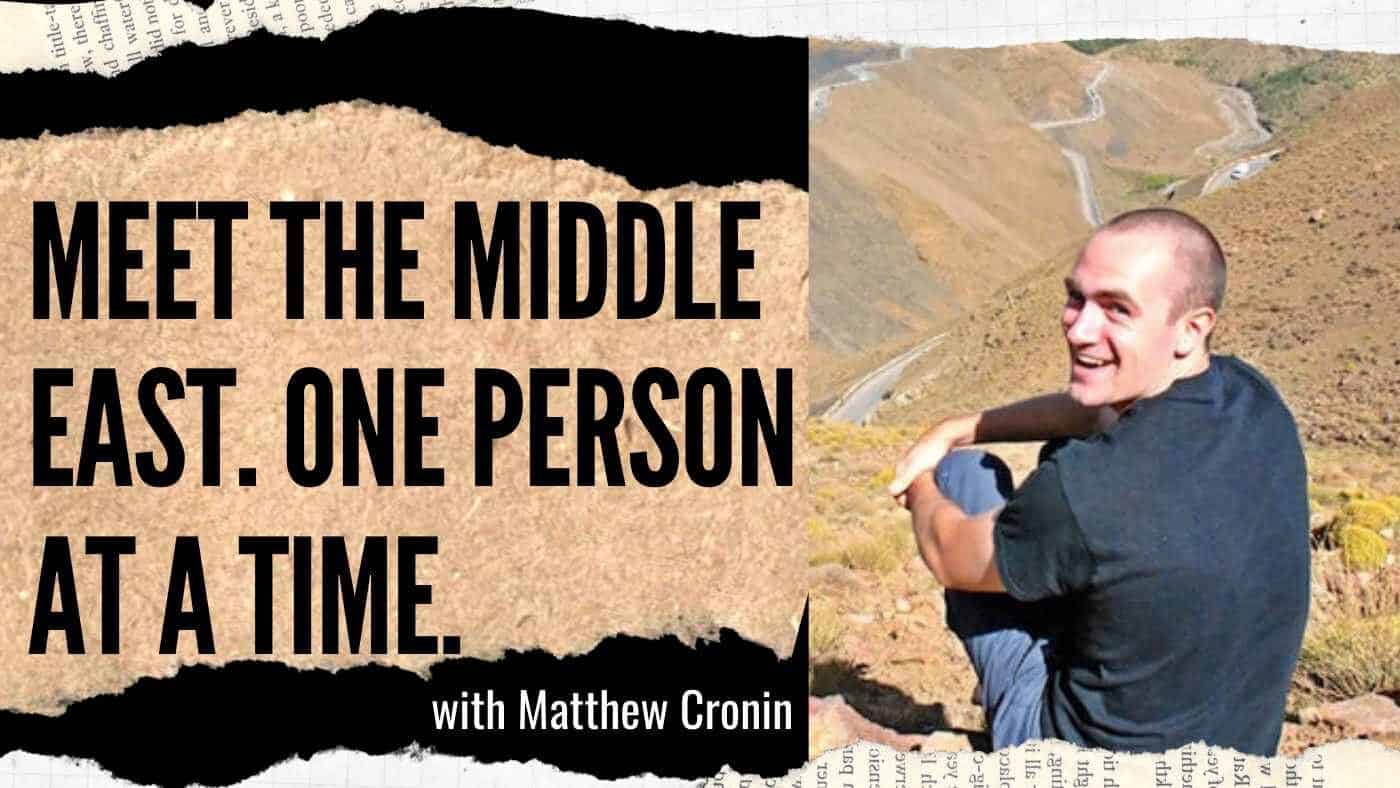
Our Guest Today: Matthew Cronin
Matthew Cronin is a 21-year-old student majoring Foreign Policy at Boston University. He is expected to graduate in May 2016.
Matthew and I met at Inna’s Kitchen in Newton, MA, where he works part-time. Through a casual conversation over a year ago, I found out that Matthew would be studying abroad in the Middle East as part of his study-abroad program. I couldn’t wait for his return and learn more about his experience.
Although study-abroad was not a requirement for his major, Matthew chose a path to learn more about the Middle East through people and culture. To prepare for his trip, Matthew took extensive courses in learning Arabic, a language he finds artistic and beautiful.
In this short 30-min conversation with Matthew Cronin, we discussed
- His earlier life, as a high school dropout, before Boston University
- Learning Arabic: a beautiful language (by its sound and construction in a root system)
- First impressions in Jordan and Morocco
- Getting to the people in the Middle East
- “A high-contact society” in “a system with no system”
- Study-abroad in the Middle East and a social life away from home
- Life skills for immigrants, travelers and students from Place A to B
- A growing appreciation for social networks and human connections
Transcript
Transcript
Fei Wu: Welcome to the Phase World Podcast, engaging conversations that cross the boundaries between business, art and the digital world. Hi you. Thanks for joining me for another episode of the Phase World Podcast. This one is a mini episode of Phase World. Only 30 minutes, but it's your precious time. So I thank you for joining us today on Phase World. I would like to welcome a very special young man. His name is Matthew Cronan. He is 21 years old and is currently majoring in foreign policy at Boston University. He's graduating this May, 2016. He and I met at in this kitchen in Newton, Massachusetts, where he works part-time. Through a very casual conversation over a year ago, I found out that Matthew would be studying abroad in the Middle East. I couldn't wave his return to find out more about his experience. So he finally came back and here it is, our podcast together. Surprise. So studying abroad was not part of Matthew's major requirement, but he chose a path to learn more about the Middle East through the people and. to prepare for his trip. Matthew took extensive courses in learning Arabic, a language he finds artistic and beautiful. In the short 30 minute conversation with Matthew, we discussed his earlier life as a high school dropout before Boston University. At his experience learning and practicing Arabic, I was most interested in his trip to the Middle East. So Matthew shares his first impressions in Jordan and Maroc. Getting to know the people in the Middle East is quite interesting. A system of what's referred to as a high contact society in a system with no system. So unlike living in New England, you will not get away with not talking to anyone throughout the whole day. The high contact society requires that you communicate with each other throughout the. Studying abroad in the Middle East and the social life away from home was a little bit different than what Matthew expected. On that note, he shares real life skills for immigrants, travelers, and students from place A to B. As a result of interviewing Matthew, I discovered a, a growing appreciation for social networks and human connections. And our conversations also trigger so many thoughts and memories of me as a 16 year old coming to the United States. If you are a student who's looking to transition from school to work, face world may be able to help. Check out our services at from school to work.com. Phase world helps students maximize the chance of getting what they want, close the gap between school and the real world, and also owning a concrete strategy and a plan of action. I would like to welcome Matthew Cronan to the Phase World Podcast, and thank you so much for listening. I will see you at the end of the show. I'm here with Matt inside the Newton Free Library, one of my favorite libraries in the, in the world. Mm-hmm. , not that I've been to so many, but we. . We had a tour just now looking for a study room , and found the smallest one possible. We
Matthew Cronin: got good exercise and it's quite warm.
Fei Wu: Yeah. Yeah. Here we are. Yeah, here we are. So, so Matt, one of the reasons for for me to be so interested in chatting with you is because you work part-time at my favorite, uh, diner slash kitchen in this kitchen and Inna herself has been on my podcast at the very beginning. Yeah, she was like first five, six
Matthew Cronin: episodes. Really? Huh? Did you get food on there too? Just make sounds of food and make sounds of you eating their delicious food. I
Fei Wu: wish I. We reported that, uh, when the kitchen was closing down around like 2 33 uhhuh. Yeah. It was actually not a great idea because the sound because the, the mic was picking up all these kitchen sounds and the dishes
Matthew Cronin: can drop. Yeah. Sweeping and cleaning the grill, it's. Not a lovely sound. Yeah. Cleaning the cooking sounds a little bit better than the
Fei Wu: cleaning. So true. Not the cleaning of sound. Right? Yeah. So you, so you work there. I feel like we periodically had these conversations about your, to me, slightly unusual path for a college student. Yeah. You've been around the world and so, so part of it, , that's big. Yeah. So tell us a little bit, uh, about you, your. Your name, your age, if you don't mind exposing. Mm-hmm. . Uh, and then it's not a big exposure.
Matthew Cronin: Okay. Where are you going to school? Uh, so I am 21. My name is Vernon. I go to Boston University. I've been there for, um, about a year and a half now, maybe a little more. I study the Middle East and I've spent the last year in Jordan and Morocco, um, learning Arabic and sort of the politics of the Middle East and mm-hmm. gotten to been fortunate enough to travel around that region and, um, Eastern Europe. .
Fei Wu: Nice. Wow. So you've been at, that's interesting. You've been at BU for only a little bit over mm-hmm. a year, year and a half. Yeah. And you spent the past year in Yeah. The Middle East. Like how, how did that come about?
Matthew Cronin: Uh, what, in terms of my interest in the Middle East, the timing
Fei Wu: pretty much. Everything. Why, why were you there and what, what brought you there in the first place? Okay.
Matthew Cronin: Uh, so a little background story. I, um, I had dropped outta high school. I actually, I'm not a high school graduate, so maybe that's a little more, um, spice in the story. I don't know. Um, I left high school about 75% of the way through my freshman year. Um, and then I, I was working sort of menial day jobs. Throughout my, my mid middle teens, well it was 15, 16, 17. Um, and I had, um, sort of. Had a midlife crisis, though hopefully not a midlife crisis that, cuz that would mean I would die at 30 . Um, so hopefully I live a little longer. Uh, but I, I sort of was searching for purpose in life and I, I remember very specifically, I was watching 60 Minutes and this story by Laura Logan, who's a very great reporter on the Middle East, came up and I'm talking about the, the war in Syria. And this was, A year into the war year after the Arab Spring started and this picture came on and it was, I mean, excuse the gory details, but it was a picture of, um, people, uh, in Damascus who had been headed and their bodies just toss into river. Mm-hmm. . And in the context of my sort of existential wanderings that I had spent all day doing while I was working my menial day jobs, um, this picture really struck me and I decided that, um, you know, I could, I, you know, being in a place like, um, Massachusetts, you see of a lot of very sort. uh, relatively affluent people living, um, very comfortable lives. And I, I, I sort of came to this fork where I said, well, I could pursue that very comfortable life, or I could, um, confront this image in front of me. Literally this image and this image of this horrible war going on in area and. Use my opportunity of, you know, the privileges of being an American, having great access to fantastic education and all these resources around us to do something about that. Um, and I chose the latter path, and that's sort of how I got into all this. So
Fei Wu: between the age of 15, 16 until 21, yeah. There they're, you know, a bunch of years in between and. So from that decision, well first of all, what, what was the job you were at when this was happening in your mid teens?
Matthew Cronin: I think at that point I was changing oil at a drifty lube.
Fei Wu: So I think a lot of what we do in life, it's kind of, you know, back to your point for convenience. Yeah. And I think living in this country, um, we don't. Often think about the privilege. I mean, just looking at the water we are drinking. Yeah, yeah, yeah. You know, there's so many parts of the world and I, I was, um, I think it's called Slingshot recently. I got really into documentaries and mm-hmm. , um, this guy who invented this like pure water filter that's, you know, industrial level, but it's, and then you try to kind of break it down, just like invent the invention of an iPhone, make it smaller and smaller, and be able to ship to parts of Africa, India, and teach people how to use it, produce clean water. Um, and it's really amazing for somebody like yourself, the age. I mean, I came to the realization more so in my mid to late twenties to say, what can I do for mm-hmm. the people around me, not even to say like, countries apart from us. . So you're 15, 16. Mm-hmm. , tell me a little bit more about that transition in the next three to four years. Where has your life taken you to places that kind of begin to fulfill or to actually help answer some of the questions that you had at the time?
Matthew Cronin: Mm. Um, well, I, I mean, a lot of it was just a lot of, and it has been over the past five years, legwork. In terms of education, um, there's a lot to jump through and going from, you know, high school dropout to, uh, Boston University was, um, you know, a lot of community college and things like this. And, um, um, within the last year and a half, I've, um, taken up the task of learning Arabic, which is, um, something, a whole nother journey in itself. Quite, uh, quite the challenge, um, but a welcome challenge because it's. You know, it's not something that, uh, a lot of people know, and that makes it quite the asset for anyone who, um, wishes to learn it. And it's actually kind of a lot of fun. Um, I I know it's very difficult. Yeah, yeah, yeah. Yeah. But it's, it's very artistic in the language itself is, um, quite beautiful to look at. And, um, the system. Uh, on which the language is based, it's based on this very interesting root system where you take, um, three letters and, uh, basically con contort, those letters and a set number of patterns. Um, to make different meanings and, uh, it's just sort of a fascinating intellectual, um, challenge, sort of having to, uh, you, you, you take word and then you break it down through those, um, uh, into those roots. And then you look at the pattern that's used, applied to that root and you can sort of figure out the meaning that way. So, A constant puzzle and, um, very entertaining. Um, so Wow. Three letters. Three, three letters. All the words. Three letters.
Fei Wu: Yeah. I'm just trying to think of the permutation. That was a math major. Yeah. Yeah, yeah. I can possibly think of using three letters or create a
Matthew Cronin: language. Yeah. Well, it's not, uh, there are more than three letters. The language has many more, three Ls. Mm-hmm. . But the point is that, um, there. Um, three letter roots, right? Mm-hmm. and those roots have a root meaning. Mm-hmm. , right? And then you apply a series of patterns to those three letter roots to sort of, um, shift the meaning slightly. Mm-hmm. . Okay? So you have to, um, uh, the, the three letter route Uha means to finish. In, uh, the Deja dialect that means to pay, which is sort of like to finish a transaction, right? Mm-hmm. . So you take this very basic meaning, and then you mutate it in, uh, set ways and you come to a slightly different meaning. Wow.
Fei Wu: Yeah. How long did it take for you to learn from first lesson number one? Oh, oh my goodness. And then two, when you, I mean, how, how long did it take for you to feel comfortable with the languages? Just like the conversation that we are having. Without talking too much about politics and all kind of just the casual conversation, did you have anyone to even practice with
Matthew Cronin: in Arabic? Um, so the first thing is that I've been study it for a year and a half, and Arabic takes much longer than that to learn. Um, most people say, you know, five years if you're really dedicated to it. Wow. So, um, I'm shocked that I'm even at this point, you know, in the first class, you're, you're learning the letters and you have to learn the whole alphabet. You know, it, it's, um, a completely different alphabet. And, you know, before I took that first class a year and a half ago, it looked like a bunch of squiggling lines, which is exactly what it looks like to everyone else and mm-hmm. honestly, sometimes I still think of it that way. Mm-hmm. , um, But, uh, you, you break into it in pieces and there are days where it's really frustrating because you'll, you know, watch a film and I still don't understand, you know, 95% of it. And then there are days where I'll just, things will just click. Hmm. Um, and that's really what language learning is about. It's about putting in a lot of time and, um, Uh, sort of committing yourself and you mentioned speaking to people. Mm-hmm. , um, that's a big part of it and that's why I've been over to Jordan and Morocco and, um, you really start to engage with people. And the good thing is that, um, people in the Arab world are a extraordinarily friendly, not to generalize, but it's true. And B, um, Very interested and, um, enthusiastic that there are, um, Westerners willing to come over and learn Arabic. So they're willing to help with you. You sit down with a taxi driver, he's taking you to school and he'll teach you five new works. Oh. And uh, that's how they do it. It's great. It's great fun, uh, great learning experience.
Fei Wu: Yeah. Wow. So I, I do wanna kind of get into your travel in the Middle East cause that intrigued me. Yeah. Um, How did your parents react to kind of this decision, this path in general? Like they, do they get it? Do they support
Matthew Cronin: it? Uh, yeah, I, um, well part of that probably comes from, um, my, um, my being very stubborn. Um, it was sort of not a question with my parents, it was sort of a statement. Mom, I'm going to study the Middle East. Yeah. I'm telling you that Byebye. Yeah. Uh, yeah. . , they have been very understanding. Of course, there's a lot of friends I have who, um, study the same thing as me and you know, I've heard stories about how their parents were very unhappy about what they chose to study. And um, obviously people have very um, Very large hurdles when it comes to understanding the Middle East. Mm-hmm. , because we have this whole generation of sort of baby boomers who grew up understanding the Middle East as oil crises and, um, wars and, uh, the Iranian revolution and the CIA intrigue. Mm-hmm. And you go over to the Middle East. There are people, there are millions and millions of just human beings. Mm-hmm. just human beings living their lives and lovely human beings at that. And you can, um, I mean there are signs of sort of that very, uh, militaristic, uh, conception that we in America usually carry of the Middle East. You, you walk through a place like Jordan and because of security. Umar Dery forces with, um, quite large automatic rifles walking around. Wow. But you can forget about that too. That, that, that doesn't have to be there. And you, um, this is, this is a, this is a place where people live, right? Yeah. And there're.
Fei Wu: people there. It's amazing because I, I tell people all the time, as you know, I'm originally from Beijing, China. Mm-hmm. , and I don't know, through our sporadic conversation, how much of those stories have you been able to piece together? Yeah. Now I came here when I was 16. Mm-hmm. , and it's almost like the same. It's interesting the same time that you kind of had this like intriguing thoughts of a, what is it like on the other side of the world? Yeah. Is it true what I learned in books and watch out tv? Right, right, right. What I heard from my parents, right? Mm-hmm. And um, so I always tell my friends and then they tell me the same thing, especially after they travel to China. They start to think that, wow, it's, there are people and they so much, we share so much in common. And it's, it's interesting. Some of my friends were kind of afraid of the, the Chinese military and they were thinking just being white, being Caucasian. Would it be arrested? I mean, they, they ask me questions like, would it be arrested on the street? Of course not. Mm-hmm. . Um, people are very interested and especially when foreigners in particular are Americans. Chinese people really just find American people very mesmerizing on so many levels and we can talk about why. And it's just a free spirit and the ability to love the world to accept others. Yeah. Um, but I love the fact that you are seeing that in particular, I think. Easier for American to travel to Asia. Mm-hmm. and, you know, um, but to the Middle East is a place where, especially given the current politics, people are afraid to even talk about it. Mm-hmm. to, uh, to even react or respond. And yet you put yourself physically there. Mm-hmm. . So do you remember, I'm sure you do, do you remember preparing for the trip and literally tell me about your travel, like when. When you, how long did it take to get to Jordan? I believe that was your first destination. Mm-hmm. . And what was your first impression of it? What are some of the events and that you, you, do you feel like you'll never forget?
Matthew Cronin: Possibly? Well, it takes a long time to get there. I'll say that first . Um, it's, um, let's see, when I first arrived, um, , the first thing you notice is definitely the call to prayer. You get off, um, and you know, no matter what time of day, because it happens five times a day, you hear it and that, that sort of hits you. And that is sort of, uh, a lightning rod symbol I think for anyone going into the Middle East because it's, it's reverberates throughout the Sydney in this very, very gorgeous, melodic way. And it is sort of the ever present symbol of Islam. To the Muslim, him or herself, or the foreigner. It's a, it's a constant reminder of the presence of religion in society that just does not exist, especially in Massachusetts. Mm-hmm. , um, Uh, the other aspect that was most startling to me upon arrival was just sort of the, I don't want to use the word chaos, because that's definitely a loaded word with, um, a good amount of. Uh, negative baggage in it, but um, the Middle East depends on where you go. Morocco, especially Jordan, less so is a system of, of no systems. Mm-hmm. . So you get there and, um, people. , uh, their society functions in a, in what's called a sort of, um, high contact society. So that means that, um, relationships are paramount. There's no sort of overarching, uh, rules. Uh, there are, but the, the sort of social organization does not, um, uh, base itself on overarching principles and rules. So that means that to do anything, uh, in society is more social, in a high context culture. And the Middle East is very, very high context. So that means that road signs are less important. It's more about knowing where you're going based on, um, Landmarks based on historical events are based on just asking someone, right? Mm-hmm. . Interesting. So they have, they have road signs, but it might not even be in the language that the local people understand. It might be in English, and most of the people don't understand English. Mm-hmm. . So, you know, I, when I first arrived in Jordan, they said, well, you're not gonna use road signs to tell the taxi driver where to go. You have to know, and you have to explain to him. Yeah. So, It's a lot more interacting with people, especially in sort of our Northeast American culture here. You can get by a whole day without talking to anyone. Oh, so true. Entirely possible. I do it all the time, unfortunately. Mm-hmm. in the Middle East. No, not gonna happen. You're gonna talk to so many people all the time. Mm-hmm. and that, that hit me right off the bat. It was. Um, and people smile a lot too, so you come out smiling. Um, and it's, it's, you're sort of wrapped in this nice warmth of, um, human, uh, human interest. People are interested to talk to you. It's really
Fei Wu: fun. So almost like, because I, I assume you were born
Matthew Cronin: and raised. Yeah. Yeah. I've lived my whole life in
Fei Wu: Massachusetts, Massachusetts. Interesting. Yeah. And so you're very conditioned and that what the way we live here is very familiar to you. Mm-hmm. , and I'm sure when you. Will, you know, sort of prepare your trip, read articles online or gala tours, book or some sort. Yeah, yeah. Yeah. And then you show up in the country, it's completely different than what you imagined. Mm-hmm. , it almost sounds like even when you're shielded up to say, you know, let me navigate, I have no friends here. I'm just here by myself. Mm-hmm. , and, but people are walking up to you to offer you help. Mm-hmm. . And do they do that? Do they smell at you to say, Hey, are you, are you looking to go somewhere you look lost or? Um, do they offer their help automatically?
Matthew Cronin: It depends on where you, you are. Mm-hmm. . Um, obviously the Middle East is big. Yeah. Yeah. And I only actually went to one country in the Middle East, Morocco was in North Africa more appropriately. Mm-hmm. delineated. Um, Morocco is very much like that. You know, if you, if you look lost, um mm-hmm. , someone will probably offer to help you ask people on the street and they're gonna, they're gonna give you directions for 10 minutes and probably have a conversation with them. . Yeah. Um, out your food. Yeah. Yeah. Probably . I've had that happen. It's good. Yeah. Oh yeah, yeah, yeah. It's, um, very ho hospitality is. A critical part of, um, middle Eastern culture. So, um, you are automatically sort of welcomed and people are willing to help. Yes, for sure. Um, which is also pertinent to language learning, right? Because if you're in a very high text, cont high context culture, excuse me. Um, you have to use language. Yeah, so Arabic is difficult to learn, but it's easy to practice if you're in the Middle East cuz people are gonna talk
Fei Wu: to you. They're very friendly. Yeah. Yeah. So what was it like to go to school there? I assume were you, you know, what was the. Education structure, like, cuz I know that study abroad, it's some oftentimes very different than the kind of the structure mm-hmm. that you have at bu Yeah. Right. So what, what was it like, how many classes you had and what, who were your classmates?
Matthew Cronin: Um, well my programs were all sort of, um, Separate from the local university. So I actually wasn't taking classes with, um, the local students, which was quite unfortunate, but my language capability was just nowhere near mm-hmm. um, making that possible. Um, but, uh, so for the most part I was just sort of taking classes with, um, my, my fellow American. Boston
Fei Wu: University students. Mm. So what was the class size like? How, uh,
Matthew Cronin: so there were smaller programs. So a couple of them were, you know, eight students. Wow. Um, nine students, 10 students. Um, yeah. So it was a great experience. So I
Fei Wu: have a feeling, and my assumption is because that was the, you know, unfortunate setup. Yeah. Um, I'm not sure if you knew going into it. Potentially you did, but then again, the moment you break away from the. Hopefully that's not nine to five, but you have some breaks in between and all that. Right, right. Did you, did you proactively seeking out kinda local culture and perhaps leaving your crowd of students, like people you know and kind of making local friends, did you make friends nearby? Are they writing, thinking of you right
Matthew Cronin: now? Hmm. Yeah. Um, in, in both cases I was. Families. So that was, um, you know, a lot of sort of interaction with, um, Jordanians and Mors there. Um, the one thing I will say is that, um, you know, you do obviously make efforts to, to make friends, uh, your own age in the, in these places, but, um, It's incredibly hard to do. Um, and I'll, I'll, um, you know, be frank about that because, you know, I think that a lot of times, especially when you're going over for a very short period of time Yeah. Uh, in sort of a nonwork setting maybe mm-hmm. , um, you have this sort of romantic concept that you're immediately gonna sort of integrate mm-hmm. and that's something that takes a lot of effort. A lot of work because you can say, yeah. Jordanian culture is not that different in theory, right? Mm-hmm. , it's just people after all. Mm-hmm. . Um, but at, you know, once you actually try and. Make friends with people, you realize that your, your social reference points are very, very different, right? So there are things that make us laugh when we, when we talk with our friends, right? Maybe we talk about the movies we like, maybe we talk about football, maybe we talk about, you know, X, Y, and Z, right? Mm-hmm. . And they have this whole other set of cultural reference points that they bond on and laugh on. And, The, the, the, uh, crossover there is highly limited unless you find a way to, um, Either A, adopt their reference points, or B, help them adopt your reference points. Mm-hmm. . Um, so it takes a very active effort and that's,
Fei Wu: it's so interesting. You just, you kind of open up, reopen up a, a very early, much earlier chapter of my own life coming into this country when I was 16. And the funny thing was, you know, I was considered very American in
Matthew Cronin: Beijing. Okay. And how were your
Fei Wu: language. Uh, good question. I was able to speak the language and people often, even when I first, uh, came here, my classmates, my teachers told me that my language skills, it's very, I mean, I was, they thought I was fluent. Okay. But I immediately noticed that some of the. Terminologies, whereas even some of the words I chose mm-hmm. were weird to local people. Right, right. Um, granted I went to school in May, but let's, let's just set aside that joke for a second. But, uh, uh, I definitely struggled and, but moreover, after you get really comfortable with the language, and for me that was. Quick, very quickly, like six to eight months. I was like, okay, I get this and right. School subjects at times, so very challenging, like creative writing and memorizing like words I would never be able to use again, that sort of thing. But um, I remember the social context and that in a sense of, you know, I was 16 and you hear Chinese parents just say, oh, it will take you like two weeks to understand everything there is to American culture. And it's not true. Personally, I have no interest in sports. Mm-hmm. , uh, as in watching sports. Right. But on the flip side, I love playing sports. Mm-hmm. , so I played ice hockey in, in high school and, uh, I'm interested in baseball and all that, but I don't really like to sit on the couch and pop up in a, a bag of potato chips and just, that's not really my, uh, right. The way I was conditioned to have fun. So that part, I feel like fast forward 15 years later today. Mm-hmm. , there's still some things that I struggle with, such as going to work and my, all my coworkers know this, that I struggle to leave a full day of work and use a local bar as the only way to celebrate at a good time. Mm-hmm. . , and I find that so counterintuitive. One, I'm paying $10 for a glass of drink that's worth 50 cents. Yeah. Yeah. Uh, secondly, I can absolutely hear nobody, nobody can hear anybody. Right, right, right. Um, and maybe that's why we do it. Maybe that's, yeah. Maybe , maybe that's, that's still to me, it's like I still haven't figured it out and Right. And so I find other ways to, to channel that energy. Yeah. But actually that's a really interesting, I, I didn't think about. W did you, I mean, you were there for a very limited amount of time, but was there any windows into that potentially things that you find interesting, like American things or activities that you find interesting that local people are like, wait a minute, you know, I know Matthew, let's, let's see how that works out for us. Like, was there any sort of that transition, like you meeting people in the middle and finding something that you. Potentially both. Enjoy, even if it's only for one or twice, you know, it's not like a routine
Matthew Cronin: or anything. Mm. I will say on uh, sort of a, a larger societal level, um, Comparing Jordanian and Moroccan culture, Jordanian culture, um, has very much, um, especially in Armand. The capital, very affluent relative to the rest of the Middle East has sort of adopted a lot of American cultural, um, practices. They. Have bars where you can watch sports. They have bars where they play football. Mm-hmm. , I watched, uh, the Patriot Super Bowl in, in a bar there, . Um, and there were Jordanians there who have traveled to America who were there watching with me. Um, so in Jordan it was actually pretty easy because you say you're American and there are people who know what it is because of our, um, long term security relations with Jordan Jordan, um, there's quite a bit of, um, cultural, um, influence that we have there. Um, not, um, It's not, uh, infinite. Mm-hmm. , but there are common reference points so that, um, you know, I felt like, wow, these are things I could be doing back home. Yeah. Um, in Morocco, definitely less so because Morocco was colonized by the French. So the, um, sort of foreign western culture that Morocco has, um, taken. In is all French. Mm-hmm. . So, um, if I were a French man, it might be a lot easier. Yeah. Interesting. But I am not a less, and there was much less, um, of that sort of American culture. Mm. Almost
Fei Wu: none. One, one thing I thought about is like, were you ever scared and then, or less so that's too strong of a word, uncomfortable, unprepared for certain situations while you were
Matthew Cronin: there. Mm. Ooh, tough question. Was I unprepared? Um, yes. I think on the topics that we've been hitting so far, um, it's, um, I, I think I was unprepared for how difficult it would be to, to culturally integrate and make friends. Mm-hmm. . So I think that for anyone who's going. Um, for extended periods of time and trying to live in, um, very different places. You have to be prepared to, um, be isolated, be lonely at times because it happens. Mm-hmm. . Um, and I think that maybe you could, um, attest to that coming from Beijing at 16 and especially turbulent time of your life in terms of sort of social engagement. Yeah. Um, and I think that's something that we'll ring about with anyone who has moved out and that's mm-hmm. , you know, That's why, uh, in, in immigration, um, bringing families over is so important because when people get isolated, it becomes very, very difficult. Mm-hmm. . Um, so I think that gave me an appreciation for, um, the, um, the need to maintain social networks, familiar networks, um, in moving across
Fei Wu: borders. Mm-hmm. really interesting. So, because we're getting kicked out, and this is so interesting, by the way, For, I, I didn't quite expect that your one year experience, it kind of trigger a lot of memories from, you know, uh, for me, and, you know, I don't like to ask, oh, what are you gonna do in the F five, next five to 10 years? You're very young and a lot of the doors are open to you, whether you know it or not. Um, what are some of the things beyond graduation? I don't know when the estimated time would be.
Matthew Cronin: Yeah, yeah. Uh, so I graduate in May and I'm facing the classic, um, graduate dilemma these days of, uh, just, uh, Jobs are limited in the field. I'm entering at an entry level. Um, what is that field, by the way? So really it's, um, foreign policy. I would like to work to state department eventually, um, in shot law, hopefully. Um, child law in shot law in shot law. That's Arabic. Oh, little Arabic for you means God willing. Um, something you say for hope for the future. Mm-hmm. . Um. and right now I just dunno, so. Mm-hmm. , you'll have to ask me in two, three months. Okay. Maybe I'll be able to better answer that
Fei Wu: question. Yeah. So, you know, this is like also on and off the record, either way, I, I've. Remember how difficult that period of, um, my life, you know, was, uh, even starting at age of 1920, just like, okay. Right. You know, graduation is what's gonna happen.
Matthew Cronin: What's gonna happen. Yeah. It's a big precipice. You, you, you can see to the end of the cliff mm-hmm. , but you have no idea what comes after that. And it's terrifying. Yeah.
Fei Wu: And it's really scary. And then, , listen to podcasts, talking to people. Now I'm 32, I can confidently tell you that everything is gonna be okay. and I literally go to restaurants and I see a 20 year old like you come here, especially for women. Mm-hmm. You know, and I just wanna tell you everything's gonna be okay regardless what you study, what you're into. Right, right, right. Because you don't know that. You don't see that. And you would doubt anybody who will say that to you. Right. And in particular, sometimes parents are not the most helpful people cuz they, they are anxious for you and they want you to be success. So as part of the company I'm starting in this year, if I didn't mention I quit my job. Um, oh, did you? Yeah. So I took the leap that, like you did go to Middle East and to, uh, get myself uncomfortable again. And that's not necessarily the word for you, but for me to kind of create that friction. Mm-hmm. Um, kind of create that friction between what I'm trying to do. So I wanna help small businesses, individuals like the Atherton. And the last category I'm super passionate about is helping students from, I helped a lot of high school students, uh, kind of my sweet spot, but slowly I'm transitioning into college students and then early graduates, meaning people like around your age into the mid to even late twenties, but mid twenties ish that. People are choosing Right before this, I was consulting for a student on his website, and does he tell the right story? I can just tell how smart he is, but how many questions that he asks on his mind, just like, is this good enough? Like, do you know how many people gonna have websites to begin with? Um, especially students. So if you have any questions that I'll be, I'll be more than happy to kind of help you navigate your career. Granted, I, I claim no expertise in, in, in foreign policies and as. Um, but, and I think it will be, it'll be really interesting where you find yourself, uh, doing.
Matthew Cronin: All right. Yeah. Intro A lot works out. Little Arabic for you there. All right. So
Fei Wu: anything, anything else you feel desperate to, to share that I somehow just
Matthew Cronin: didn't, we've covered quite a bit, I think. Yeah. Yeah. Cool. Great. Yeah.
Fei Wu: This is super fun. Yeah. What? To listen to more episodes of the Face World Podcast, please subscribe on iTunes or visit face world.com. F E I S W O R L d, where you can find show notes, links, other tools and resources. You can also follow me on Twitter at Face World. Until next time, thanks for listening. Yeah.

Written by
Fei WuFei Wu is the founder and CEO of Feisworld Media, a Massachusetts-based digital media company helping brands get discovered by people and by AI. An Adobe Global Ambassador and brand partner to ElevenLabs, Synthesia, and 50+ other tech and AI companies, she hosts the Feisworld Podcast (400+ episodes, 500K+ downloads — guests have included Seth Godin, Steve Wozniak, Chris Voss, and Arianna Huffington) and co-created the documentary Feisworld: Live Your Art on Amazon Prime. Fei writes for CNET, Lifehacker, and PCMag, and her work has been featured in Forbes, Harvard Business Review, and WIRED. She has been publishing on the internet since 2014 — long before AI discoverability had a name.
View all posts by Fei Wu→Stay updated
Weekly insights on content, AI, and digital media.
Keep Reading
Related Articles

Joanne Lipman on Mentors, Untapped Talent and Why Women Should Stop Waiting to Be Perfect

Marc Randolph on Curiosity, Messy Starts and Why “Nobody Knows Anything”