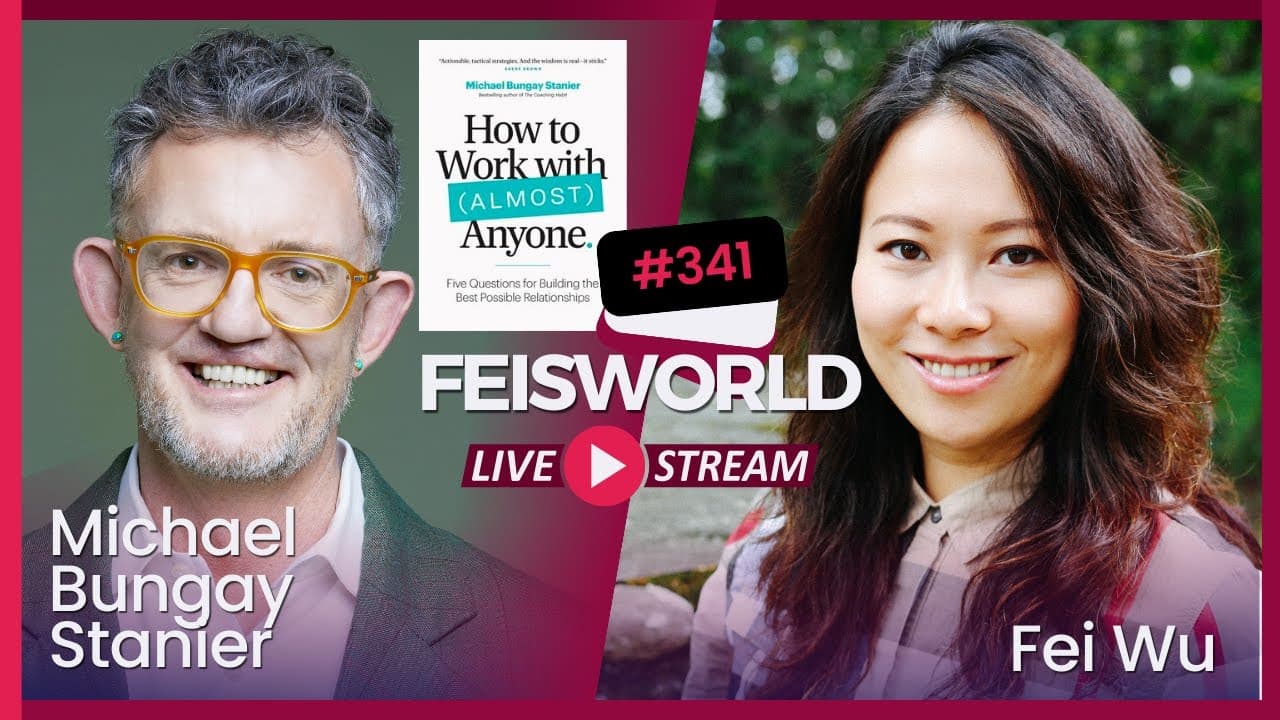
Our guest today: Michael Bungay Stanier
Michael Bungay Stanier did it again! His new book “How to Work with (Almost) Anyone” (released on June 27, 2023) has already been blurbed by authors such as Brené
Brown, Seth Godin, and senior people from organizations such as Lego, Deloitte, and Microsoft.
Check out his new book: https://amzn.to/44ro6YY
This book is going save relationships, careers, and organizations, and this conversation is going to apply to just about anyone. Join me and the bestselling author and teacher, Michael Bungay Stanier for a live, interactive conversation.
Watch Our Interview
Transcript
Transcript
Fei Wu: This is Fei Wu from Feisworld Media. I am so, so excited to have Michael Bungay Stanier join me here on the show today. And, uh, Michael, if I can give you a very brief intro. I feel like So many people are so familiar with your work, but for those who are exploring Michael's work for the first time, please hear me out. Michael Bungay Stanier is the author of The Coaching Habit, sold 1. 2 million copies. It unweirds coaching and is used to improve conversations in organizations around the world. And I have used it to improve my professional and personal lives. And it was one of the few books Seth Godin selected for our. Back then, L 10BA 8, uh, in a little package, we got it, we got it, it was absolutely phenomenal. It's still one of the top recommended books, um, not just by L 10BA. It looks like Microsoft's culture has been shaped because of this book as well. Um, Michael is an experienced podcast guest who has done over 300 interviews and coaching Brené Brown on her podcast. He has also hosted more than 500 interviews on the other side of the mic of his Own various podcasts. Michael is a fantastic storyteller. He helps people find simplicity on the other side of complexity when making abstract, uh, concepts feel really practical and really doable. And for the first time in many years, I'm leaving little sticky notes. It's fantastic. Michael Bungay Stanier: I love that.
Fei Wu: Oh, thank you so much, Michael. Thank you for joining me. I am so excited to feature this book. And for anybody who has not bought a copy yet, please check it out. It was released about a week ago. How has it been? Michael Bungay Stanier: It's been great. You know, if I, there's a, when you're an author, there's this big lead up to the launch of the book. Like you've got the book written and then there's normally about six months between submitting the manuscript for the last time. And then actually the things showing up in real life. And it's a weird six months because you spend the time. Asking for help, trying to get people to kind of help support the book launch, but you do all of this stuff and nothing makes any difference because you're kind of pushing into the void. Um, so honestly, it's quite a relief when the book finally shows up and goes, ta da, I'm here, I'm in the world. Um, so we've had a really good first week of the book's launch. Lots of people have read it. Lots of people have bought it. Lots of people reviewed it on Amazon. It's been a lovely start.
Fei Wu: Wow. It's so refreshing to hear you say that. I mean, I have many questions for the book, but for someone like yourself who has had such a phenomenal success with the coaching habit, do you think, you know, it comes with so much pressure trying to, I don't want to say replicate the success, but it like. Is there a lot on your Michael Bungay Stanier: mind? You know, there's, I like that question, um, which is a nice nod to the coaching habit, but you know, the, the coaching habit is such a freak, like it's, you know, over a million copies sold. My books are self published as well. So that kind of makes the odds of that happening. from minuscule to very, very minuscule. And, uh, I remember, uh, Liz Gilbert at one stage, she's doing a TED talk, I think, and she was like, she just had the success of Eat, Pray, Love, which was her multi million copies book. And she was saying, I'm currently writing on the book that will be the disappointing follow up to Eat, Pray, Love. I'm like, look, If you can sell 10, 000 copies of a book, you have done very well. That puts you in the top 1% of books sold of authors selling books. If you can sell a hundred thousand, that's amazing. To sell a million is a weird unicorn magic fairy dust event. So one of the things that I kept. Telling my team is well, two things. First is we're going to be really committed to the process. We're just going to do the best launch we can because how many copies get sold is out of our control. And the second thing, and this is a really helpful thing to think about was we made sure that this launch was mission led rather than book sales led. So rather than going, how many books can we shift right at the start of the book? I say this. book is the start of us improving 10 million working relationships. And when you're trying to improve 10 million working relationships, you've got some more purpose behind it rather than what's the highest ranking I can get on Amazon.
Fei Wu: Wow. I really like that approach because I think it not only takes pressure off for me, this book actually felt really intimate. Um, I think your writing has given me that sensation, that feeling for a quite a long time. It just feels like. You're talking to me and there are things that you're pointing out, uh, to me. It's something that I wish I could put into words and also into action. So I want other Michael Bungay Stanier: people to hear. Thanks for saying that. I mean, it's a lot of, you know, I'm, you know, some, some people like, like an Adam Grant, for instance, writes at a kind of an ideas level, he's the research is the big concept. I write at the practical level, which is like, you've heard about psychological safety. We've all heard about psychological safety, but how do you do that? How do you actually make a relationship or a team psychologically safe? So I'm trying to get more into the nitty gritty, into the facilitation, into the coaching through a book to help you build in this case, the best possible relationship, relationships that are safe and vital and repairable.
Fei Wu: I love the repairable piece. Uh, I think this book is, uh, such an awakening call for so many of us coming out of years of the pandemic. I feel like even my own social skills, uh, as I turned 40 this year, I just felt like. Maybe the pandemic has kind of move a lot of us backward in terms of letting go certain relationships. I'll just let it go. Or I feel so misunderstood or offended, whatever that may be. And, uh, when I saw the word repairable, uh, it was such an empowering move and actually reminded me. Oh, the scenario actually happened right around, um, 2020. It was a very dear friend of mine and I arranged kind of an introduction. And it just actually worked out really well in the end, but I think the introduction just didn't really end up the way I had envisioned. And I was honestly a little embarrassed and my. So my, um, it was a professional relationship and my friend ended up just calling me up to say, you know, initiated, like be first. It was just transformative. That's kind of the feeling, the reminder I got from this book, like make the first move, Michael Bungay Stanier: you know? I love that you're pointing to that because if you take one action away from this book, it might be to make the first move because somebody once said to me, or recently said to me, nobody likes to be the first person to say hello. Everybody likes to be greeted. I'm like, Oh, isn't that good? So this idea that our working relationships, I mean, all of our relationships, but I'm trying to focus on working relationships in particular, there's such a big impact on our happiness and our sense of self. And our success, but most of us sit back and wait and hope and cross our fingers. And we just kind of like, I hope this is going to be a good, exciting, fulfilling, nourishing, challenging working relationships. Occasionally it is mostly not so much. And if you can be the person to say, what if I was the one who said, I'm going to make it, so I'm going to play an active role. I'm going to. Be the person that helps us co create a best possible relationship, a really powerful working relationship. That is a great gift to you, but to the person and also to the people around you as well.
Fei Wu: I love it. And. I'm referring to this book for people who are watching this, by the way, that's such a rare opportunity. So if you have questions, I know we can't really see you guys. So please leave the questions in the comments and I'll be monitoring that. We can't really tell how many people are live on LinkedIn, but if you're there submit your questions. I feel like you know, this book is obviously a no brainer for people who Work in corporate or who have a full time job. But I argue that for someone like myself, who has been an entrepreneur since 2016, yeah, this is huge, Michael. I, so for instance, like one of the things I learned reading this is the fact that I have so many relationships and so many different kinds of relationships that I ever had to deal with before working with companies and sponsors working with. agency partners who refer clients to me and my various clients. So have you encountered people like myself, Michael, who, who's really loved this? Michael Bungay Stanier: Yeah. I mean, it starts with me. Like one of the people that you and I both know is Michael Leckie. Michael Leckie works with you and supported by you and taught by you. I knew Michael Leckie 20 years ago when he worked for Gartner and I was a consultant and he asked me to come and do some work for him and Gartner. And we went through a version of this process, this keystone conversation to say, how will we work together? So as I sat down with Michael, I was like, when you've hired a consultant like me before, And it's been a really great working relationship. What happened? And then I said, when I've worked with a client like you before, and it was really great, let me tell you what went on. And then I went, and when you've hired a trainer or a consultant like me, and it's kind of sucked, it was a bit mediocre. It was a bit of ho hum. Well, what happened then? What did you do? What did they do? And then let me tell you my bad client working relationships. Cause I've got a bunch, you know, here's how that fell apart. So we had that conversation 25 years ago, and I've been practicing and refining that work. And in fact, at Gartner, I actually went in and I taught the consultants at Gartner, a variation on this same work because within Gartner, they're like coach CIOs. We need to have those relationships last longer and go deeper. And these questions that are in the book are one way of actually building relationships that have more length. More vitality, more safety, more just squeeze the juice goodness.
Fei Wu: Oh, I just, I text, I had to text, uh, Michael and I, he's probably on right now and this is really fantastic. And thank you so much for bringing up Michael Leckie. I've been working with him since late 2019. And when Michael Bungay Stanier: I read, when his book came out, right.
Fei Wu: Oh, yeah, exactly. His book came out shortly after that. So we're working on his website, blog, and now tons of videos, including YouTube shorts, leading to the book launch. And when I read at the beginning, a few chapters about BPR, the best possible relationship, Michael, like he's, it was immediately just came to mind. And there's so many reasons and he matches exactly the description of. How to nurture a relationship that's worth Michael Bungay Stanier: nurturing. Yeah. So to your point, you know, the obvious working relationships that all of us will likely have as the people who we might manage, if we're managers, so people on our team, but also the people who manage us, who are our bosses and in some form or other, but if you have collaborators, if you have key vendors, if you have key clients, basically, if you look around your ecosystem and go, which of the working relationships drive my success and drive my happiness. Well, all of them are potential candidates to go. So how do I build a better working relationship with that person?
Fei Wu: Wow. We are having some comments coming in. Thank you, Michael. Uh, this great new book of MBS. Michael Bungay Stanier: Fantastic. Well, now, now that we know Michael Leckie is listening in, you and I should just spend 10 minutes kind of dishing the dirt on Michael Leckie. Cause I've got some stories that I can tell you about him. If you haven't asked him already, Fay, you should ask him about the planking incident in Paris. I'm just, there's, there's, there's photos, there's nudity, he has no clear memory of it, and you can draw your own conclusion from that, but that's just a kind of gossip around Michael Leckie. That is
Fei Wu: fantastic. I do not know about those details and people want to ask Michael like it. You could go to michaelleike. com forward slash ask and actually ask him those Michael Bungay Stanier: questions. Planking incident in Paris. He knows all he knows exactly what I'm talking about.
Fei Wu: Too much fun here. Too much fun. Um, so we actually have a real question coming in from Adam Leffert. I know I'll find out as I work through your ideas, but have you, Michael, noticed any experiences that surprised people in the areas where the process works out much different than people had Michael Bungay Stanier: imagined? Yeah, and that is a really perceptive question. So thank you for that. The truth is, Most of this process comes as a bit of a surprise the first time people are working through it because it's not actually that common in our working relationships to sit down to say before we plunge into the work, which is there and it's noisy and it's urgent and it's shiny and it's exciting and it's all of that. Why don't you and I have a conversation about how we work together before we jump into the what we're working on. And the first time you do that, and the first time somebody else does it, they're like, uh, I'm not sure what this is about. And they'll be a bit nervous and it might even be a little bit awkward. But as with so many things, what you're doing is you're opening up a one to one personal conversation that could get really interesting. And often, you know, the coaching habit, just as you said in the introduction, is my best known book. And probably the best known question from the best known book is, And What Else? There's this powerful question that says their first answer is not their only answer and it's not their best answer. So if you can stay curious longer as you are present and in conversation with these people, really interesting stuff shows up. I'll give you an example. The second question, there are five questions in the Keystone conversation. And you don't have to ask them all, but I think you could, and you could ask them all in order. The second question is what are your practices and preferences? It is the steady question because, you know, we've all got kind of the mechanics and the logistics of how we work and we kind of all assume that it's common sense because that's how it's kind of become to us, but actually it's one of those little areas where misunderstandings can occur and. In the question. What are your practices and preferences? You can check in on all sorts of things. You can check in on how you like meetings. You can check on how you like feedback. You can check in on, you know, email or slack. One of the interesting questions you might choose is what's your name? And how do you like to be called? So in this world, that's happened pretty recently around, you know, what are your pronouns and how do you like to show up? Understanding somebody name can be really interesting. So I have a complicated name, Michael Bungay Stania. When I got married, I became Bungay Stania. I took my wife's name, but we didn't add a hyphen. So there's all sorts of confusion about what my surname is. Um, Uh, there's confusion about how to pronounce my surname. I once got a letter addressed to Michael Banging Spaniel, which is the best misspelling of Bungay Stania in the world. Um, and, and here's the key thing, Faye. I don't like to be called Mike. Like, five people in the world are allowed to call me Mike. It's my brother Nigel, my brother Gus, my mum, and then their families. That's it. Everybody else, I'm Michael. And I will get to tell you that because if like some people do, they're like, I'm just trying to shorten your name to Mike. That makes me twitch. I mean, I get a little vein throbbing at the side of my thing and it's a minor thing that causes a major irritant. So there's a way that you can go deeper on that and exchange that. And often you're finding stuff that is surprising. And this is Adam's question because we mostly project what we like onto that other person. And what's powerful about this is you're staying curious and you're opening yourself up to be surprised. It's like, tell me about you, tell me about the stuff that I've been making up about you that I'm probably wrong about. Oh, I,
Fei Wu: I really liked that. I wish more people kind of asked me about those things. Uh, and I think it's really interesting for some reason when you just reminded me of, You know, there's part of your book writing about people's personalities and their differences. And sometimes we're trying to suppress that as much as possible, especially at work. And that actually makes the culture even just for individuals to be really unhealthy. And I think as I get older. And being an immigrant living in this country since the age of 17, I suppressed a lot and now more coming out, maybe, you know, I can be proactive at telling people my wants and needs and be okay with that too. Michael Bungay Stanier: Yeah, there's a, there's some research I refer to in the book from Deloitte, they talk about coverage. Coverage is often what people of color call, um, or they call it role switching, um, which is like, I need to be a certain way in a certain context. And coverage is, I need to hide some elements of who I am. And they found that 70% of Gen Z felt they couldn't bring them full, their full selves to work. They had to kind of suppress some part of that. And that only goes up if you're not Reflective of the kind of, let's call it for what it is that, you know, the, the people like me, the tall, straight white, old male look, if you haven't got that down, then you're often playing some sort of, uh, game, some sort of role coverage to kind of fit in and a conversation like this is one of the ways you create safety and you create vitality. It's safe to be who you are. It's I want you to have psychological bravery as well to be who you are.
Fei Wu: I'm so glad you brought up Gen Z because one of my colleagues at the company called Sherlock super coached out AI, they submit some questions and they were so excited for this interview. Um, and the team's a little split in the U S and India and they were worried they can't tune in. So I would love to add a question based on your, um, observation, you know, working with large companies like Microsoft and others. What are some of the struggles that you have seen with Gen Z young millennials, and what are some of the things you've seen that have also worked for them? Michael Bungay Stanier: Well, I'm not sure if this is a struggle or not. It's a struggle about how we work. I saw some research recently that said, I think it was 70% again, 70% of Gen Z quit their first job within a year. Now, I have some sympathy for the companies that are trying to hire people where they're like, man, we, we went through the recruiting process. We ran through the onboarding process. It costs us a bunch of money to actually hire somebody and bring them on board. And if they quit. Um, within that first year, basically it's something like 120% of your salary to replace that person. It is really expensive to replace good people who leave. And if you're a person who's quit, I've got some sympathy for you as well. Cause you're like, Oh, I signed up for something. And I signed up for being treated in a certain way and doing work of a certain caliber and quality. And I am not getting that. So there's that saying that many of us have heard for many years, which is people join organizations, but they leave managers. So I think that, you know, the whole world of work feels like it's, you know, melting and reforming. And I honestly, I'm kind of holding on with my fingernails as much as anybody going, I'm not even sure. You know, like. You know the pandemic if it taught us anything is that all those rules we made up about how work has to be They may not be rules. They may just be kind of big preferences from the 1990s Um, but I think everybody is going what does it take? What does a career mean for me now? What does it take for me to find meaningful work? What does it take for me to show up as I am? What does it take to bring all I want to bring to work? What does it take to manage people who want all of that? And you also have to deliver stuff for your organization as well. This is the dance that we've been dancing for so many years forever, really, but it just feels The the the music is less certain the dance is less certain than before And one of the ways that you might help with that Is building individual relationships that are safe and vital and repairable. That's what the book is about.
Fei Wu: Fantastic. And I just want to give a shout out to, uh, anonymous LinkedIn user. Thank you so much for, I'm so grateful. Thank Michael Bungay Stanier: you. Random LinkedIn user. We love you too. Yeah,
Fei Wu: absolutely. Please check out Michael's book. It's available at pretty much everywhere now. Reviews as well. Reviews are so important for authors. Um, we'll help spread the word and thank you so much for this, Michael. I, you know, we're in this era, AI came out of nowhere or somewhere. Uh, and a lot of people are kind of really anxious. Uh, you're having a lot of anxiety around it. And I want to add, you know, they're folks sending me questions like, is it okay to ask Michael AI related questions when it comes to coaching, building relationships? I said, go for it. Michael Bungay Stanier: You can ask. I, I probably, I'm not sure how good my answers are going to be, but feel free to ask. I mean, it's interesting, like, I mean, AI. What you notice as a basic rule with AI is it can just do a lot of basic stuff pretty well, you know, people like me go, it's a really good generator of a crappy first draft of a lot of things. So, if you think of the type of working relationships you have, there's a transaction of doing the work and AI seems to offer a. A whisper, or maybe it's a kind of quiet shout from the near future saying there's a whole bunch of work where you used to prove your value that won't be valuable anymore because you can just get whatever the future version of chat GPT to do it for you, but what allows you to maintain your value and be valued and feel valued and add value is not only finding the work that is something that AI But it is in the nature of the working relationships that you have. Somebody said to me the other day, actually, the chief innovation officer for Great Places to Work, he said, work gets done through the relationships. So, ChatGPT can't build relationships. You can, but you have to actively do that. You can't just hope. And again, hopefully, there are tools in the book that will help you say, I'm going to figure out who my key working relationships are. I'm going to become Indispensable to them because I know who they are and I want them to know who I am so we can actually work in a tight way together.
Fei Wu: Yeah, such an interesting insight. And for people who are thinking about AI, how it might impact your work, please let us know in the comments. And I'm going to go to one of the questions, which is how, in your opinion, Michael, how does artificial intelligence contribute to the creation of personalized learning experiences and support individual growth in the corporate environment? Michael Bungay Stanier: Well, look, I think there's a ton of really interesting potential with the way how I supports learning experiences. And the thing I know best about, I mean, I know a fair bit about how to design learning and training and organizations. But one of the key things if you want people to shift their behavior is spaced out learning. So you don't cram it all into a half day or a full day, but you're like, how do I space it out so that there's an opportunity to hear, learn, reflect, have neurons wire as you kind of bounce back, practice, get feedback and come back and learn again. And you can imagine that there's a way that you use AI to be really powerful around that. There's also a way that you can use AI to. Effectively coach yourself. There's this great combination of coaching yourself, but also being externally coached. You can say Siri or chat GPT, coach me, please. And chat GPT will go, sure, Michael, what would you like me to coach you on? Let's say Siri, cause Siri has a bit of a memory. I have a bit of a, um, uh, a history with Siri. Siri goes, great, Michael, what do you want to be coached on? And I might say, I have a friend called Michael Leckie, and he's terrible, and he's blackmailing me about photos of Paris. What should I do about that? And Siri might go, Michael, you've talked about Michael Leckie before, in fact, perhaps a bit too much. Um, but what's the real challenge here for you? Which is one of the key questions from the Coaching Habit book. And I might go, well, It's this and Siri might then go, well, what else, what else is a challenge here for you, Michael? And I'll go, wow, yeah, it's this. And so Siri might then go, well, what's the, okay, Michael, what's the real challenge with you and Michael Leckie? I'm like, wow, he has a beard and I have a, I have an inadequate beard and I'm jealous of Michael Leckie's beard. I mean, who knows where this might go? And there's a way that you can use, uh, AI in that kind of broadest umbrella sense to help structure. Insightful learning moments, both through the coaching process and also through the way content is delivered. And there's something very human about how do you figure out how to practice the tools that you're using? So I do think that part of what the human element might be is like, okay, content is easy to deliver through AI, but content. Is never what training is about. It's about how do you engage in content? And that's where that kind of human element might play a stronger role.
Fei Wu: Interesting. Um, wow. I feel like the next question is really related, but based on what you just said, I remember sometimes just pushing apps into corporates or. Doing that alone is, is not always effective, but then creating these little groups of, like you said, actually, I would say best possible relationship, people start to build trust with one another and say, we're going on this journey together, even for two weeks, habits start to, to form, Michael Bungay Stanier: which is, yeah, I mean, you know, in box of crayons is a corporate training company. I started, there's SAS force and beyond. Um, MBS. works is the more B2C individual training that I do, and we really do no training that doesn't involve cohort and community. Because just content these days, it's, it's, it has very little value because you can, you can Google anything you want. The content is free, the experience of community and moving along the journey together and learning together. That's where some of the magic happens.
Fei Wu: What a, what a great reminder. Um, here's an added question. What are some of the potential challenges and limitations of using AI for coaching Gen Zs? I think you already started covering some already. And in this case, what role can managers play to mitigate limitation, ensure effective learning, growth, communication? Michael Bungay Stanier: You know, um, there's a philosopher called Martin Buber, and he says, and this is my attempt to summarize this, um, there are basically just two types of relationships you can have in the world. There are I it relationships and I thou relationships. And I thou relationships are adult to adult, they're human, they're intimate, they're vulnerable, there's exchange of value, they're sharing. There is a way that you feel seen and heard. In either our relationships, as there's a way that you see and hear that other person, they are, and then there's relationships, which just tend to be more transactional or more kind of give and take and kind of get stuff done. And you kind of lose some of the humanity in that. What AI coaching doesn't give you or AI training, wherever you want to frame that is the opportunity for an I Thou relationship. What working with people does and what this new book, how to work with almost anyone offers the invitation to do is saying, how do I get closer to having more? I vow moments with you where I see you for the human that you are. You see me for the human that I am. We seek to bring out the very best and who we are. We seek to avoid the very worst of who we are. We seek to you. Do work that is meaningful to us and make progress on that work that is meaningful for us. You know, that's when you get into what it means to manage humans as a human.
Fei Wu: Love it. Are there anything on the market, uh, you have used, uh, Michael, when it comes to, I guess, AI apps or kind of coaching apps in general, you have seen or used or implemented that are helpful or could be like better examples. Yeah, Michael Bungay Stanier: I haven't seen anything myself that I've kind of gone. This is the moment, but I also say that I haven't been looking very hard for that. So I'm perhaps just not the best source for that. Um, I do constantly keep asking myself though, which is what's the support I need around me to be the best version of me. And sometimes that's structures and processes. Sometimes that's technology like my, you know, I use a sauna to manage my tools. And that's one of the things that brings out the best in me. And sometimes it's potentially a I based tools to say, this is the structure that I want. So really, the bigger question I've got is what's the ecosystem, human and structural and organizational and techno technological that gives me the very best chance of being the best version of Michael Bungay's tenure.
Fei Wu: Love it. Okay. So this is, um, we have more questions coming in and this is going to be, this is the, maybe the, the last part of the little, um, series of questions, which is I often hear where people, you know, email me about considering the cost of engaging human coaches, especially someone at your caliber, Michael likey, Mark Bowden coaches and availabilities are quite limited. Um, what You know, what are the advantages of adapting, um, AI or tech coaching platforms without a human in the loop, um, for, is there, are there any benefits for early employees like Jen's years who really don't have the benefit of working with Michael Bungay Stanier: senior coaches? Oh, I think there's a great advantage in that. I think a lot of what coaching does. Is gives you the space to figure out stuff about the situation and about yourself in the situation. So it's what, uh, what I coach does in many ways is it holds space to think and it holds space for you to reflect on who you are and what's your role and what's the real challenge and what's really going on. And it's difficult to do that just by yourself. Because we're easily bored and we're easily distracted and there's a thousand things on your to do list and you're behind on your emails and behind on your, you're behind on everything. So who has time to think when you're just trying to get through the busyness of everyday work? So there's a way that these tools can be very helpful just to kind of create thought and space for you. But there are other ways of doing that as well. Like most mornings I go for a bit of a walk. And I do that. And I'm trying to think about stuff almost every morning. I spend two to five minutes doing a tiny bit of journaling. And I asked, I'll tell you the three questions I asked in the morning. Number one is what do I notice? And when I say that I'm going, what do I notice about me and how I'm feeling? What do I notice about what I'm thinking? What do I notice about what I'm preoccupied? What do I notice right in front of me? So I'm actually, it's kind of a, be present to what's going on, Michael. Um, another second one is what am I grateful for? Because there's a bunch of research that says if you have a regular gratitude practice, you will be happier. And then the third question I ask myself is what's the one thing today? What's the one thing today that I need to do? Because I know that I've had plenty of days in my life where I have done 78 out of my 80 tasks. I just haven't done the two tasks that actually mattered. I've done all this other stuff that was getting myself beyond your own tools that you use for yourself. There's a way that you can find other people just to support each other. Like for many years, I've been part of a mastermind group, my mastermind group, check in on a regular basis. We talk every two weeks, we meet up once a year, we're from all over North America. And this is me getting the quality of coaching and support that I want without having to pay any money to a coach for it. And then if you really want to, you can also hire a coach. Um, and there are ones that are expensive, but there are ones that go, I do group coaching. So it could be me and five other people and we work through stuff together. So there's all sorts of ways to get impact coaching without actually forking out hard cold cash to an actual coach. Hmm.
Fei Wu: Well, I love it. It's such a great reminder that there are so many different alternatives, um, depending on the level of your career. And I agree that I remember when I was younger, having certain apps that, uh, reminding me to check in with myself to reflect, even if I'm having a. Not so great of a time, but Michael Bungay Stanier: to actually, if you're having a not so great of a time, because when you have, when, when you're caught up in the misery of a moment, you're, you're, you're in your own head, you're swirling around, you've got, you've got all the feelings, you've got all the thoughts and pausing and having a moment to pull yourself out of that and notice you having that experience. Is one of the ways you immediately lessen the impact of that experience. It's
Fei Wu: so true. And I, and I feel like, uh, people say like when you're, when you turned 40, uh, is like, you started to feel very differently. And I noticed sometimes everything is going well, I'm walking and in my living room, living the house of my dream. And all of a sudden it's like, huh, something's not feeling quite right. And taking that moment to acknowledge that. And, and knowing it takes 15 minutes, sometimes a couple of hours to, to feel better. It's really liberating as opposed to just running away from it, like blocking the feeling. Um, this is fantastic, Michael. And, um, Michael Bungay Stanier: I, so for me, I'll just add one tiny thing for you. One of the reasons I asked, what are you noticing? Yeah, it's because I'm a really heady intellectual guy. I am not that good at noticing stuff, particularly about how I'm feeling, particularly about stuff in my body. So this is forcing me to go, Michael, what's going on? What's going on physically? Because there's often a clue in how I am physically as to what I'm feeling. So I'm practicing, I've still got a long way to go, but I'm practicing actually using feeling words. You know, Brene Brown's got the Atlas of the Heart, so that's 75 feeling words if you want them, but I choose five. Mad, sad, glad. Ashamed and afraid and that for me is a really helpful primer around kind of most of the major feelings and I'm like, okay, which of those, which of the five am I feeling? Oh, it's a bit of mad. It's a bit of sad. It's a bit of shame, tiny bit of fear. And then I might find some more nuanced words around that, but it just helps me get a little better at noticing that stuff. Cause as soon as I noticed it in my body, it starts to change. Hmm.
Fei Wu: I'm already thinking about designing that micro content, that video clip we just did. It's going to be so fantastic with emojis and words. I'm not going to ignore Adam for too much longer, but I do have a question for about your working with Brene Brown. So people who are watching, stay tuned. Um, Adam asks, I'm getting better and clearer sense of dues of your approach. Any hints on some of the don'ts, any common pitfalls to avoid? Michael Bungay Stanier: Oh, I like Adam. Adam has got some really great questions. So if we, we've covered a lot of the things you think this is a question about the do the don'ts of this building best possible relationships. I think so related to death. Yeah. Um, you know, the book is called how to work with almost anyone. So one of the things to be aware of is that not everybody is going to be up for a keystone conversation. So. I'm going to suggest one of the don'ts or one of the limitations you might impose, which is, who do you have these keystone conversations with? These five questions that help set up a best possible relationship, one that is safe and vital and repairable. You have some choices around how much you expose of yourself. I mean, you mentioned Brene Brownfay a few times. She's like, vulnerability doesn't mean sharing everything. It means knowing what to share in what context. So if you're a person who is the leader of a team, say, that means you have status and you have authority and you have power. And then I'm like, the do is like, Be the role model for how vulnerable people can be because what the distance you travel is the distance that other people will travel with you. But if you're thinking to yourself, I would love a conversation with my boss, but that feels, that feels riskier because it's my boss. It is riskier. It is riskier. So you need to have a think about, okay, so what's at risk and how do I manage that risk? You know, I say every choice you make, every choice has prizes and punishments. So in this context, thinking about, do you have a conversation with your boss about how do we work better together? There is, you know, got two options have the conversation, don't have the conversation, having the conversation has prizes and punishments, not having the conversation has prizes and punishments. So look at those two choices and go, well, when I weighed up, how does, how does, how do things balance out? And you may say, honestly, the risk of me having that conversation would outweigh the benefit of having that conversation. I had a boss for a while. Who we called Red Dot. Because, you know, you know, in the movies, when the assassin... Like puts their laser rifle on somebody and that little red dot appears right on their forehead, and you know, it's gonna end badly That's kind of what the weekly team meeting was like red dot would pick one of us a red dot would metaphorically appear the rest of us would be moving our chairs out of the way to try and avoid the carnage that was about to happen and there was no value in me and trying to have a keystone conversation with that person because just it wouldn't work and I think of some of the dysfunctional working relationships I have had, and I know that if I had the courage to have that conversation, there's a really good chance that those would have got better.
Fei Wu: Hmm. This is great. Great question. Great answer. What I also love about the back of this book towards the end, there are a list, short list of frequently asked questions. I really like that because you, um, you're so transparent with when this might not work as opposed to, you know, I've read books in my life, which is all reinforcing these key concepts that are guarantees and things like that. I'm like, uh, almost anyone. Uh, Michael Bungay Stanier: I know is that what I love about this book? Uh, I love this book. I think it's a, it's a good book, but when I came up with the title, I was like, that is a really good title. And everybody I tell it to best, you know, how to work with almost anyone. Everybody laughs. Everybody immediately kind of thinks who their almost person is. So, whereas with other books, I'd be like, I've written a good book. What's its title? How do I find a really good title? This tastes, it's flipped. I've got a really good title. How do I write a book that lives up to that title?
Fei Wu: That's it. Almost anyone, uh, please check it out. I love just how handy, just like all your books, it's so easy to hold on to. I realized when I was preparing for the interview, it just. It was just very real as a relaxing read. Uh, it's easy to notate and it just like fits my, I'm not a very big person. And it just like, it also fits my Michael Bungay Stanier: hands. No, that's cute. Isn't it? It's like more compact than any book I've ever written when I'm working with my designer on the book, I had a really clear person in mind. I was like, she is busy. She is flying somewhere. She's actually in the airport bookstore and she's looking for a book. Um, she picks it up because it's, it's small enough that it's going to fit in her bag and her handbag. She flicks through it and it doesn't look too scary because there's a fair amount of white space. So it's designed to feel friendly. And she goes, look, my team is already fine. I quite like being their boss and I quite like leading it, but I think I can do better. And they pick up this book and it. It's their lifestyle. So we really wanted to design a book, felt tempting, felt irresistible for people. So thank you for saying that. Cause that was our goal. Oh,
Fei Wu: it totally works. Well, I'm, you know, looking at some of the reviews, I was like, I recognize everybody and people I absolutely love and admire Seth Godin following him for 20 plus years and couldn't help noticing Brené Brown and notice that you actually worked with her on her podcast. Could you please share that experience with us? Yeah. Michael Bungay Stanier: So. I got to know Brene before she became super famous, when she, when I could email her and her email was, you know, I'm not sure, breneaol. com or something like that. And we kind of connected, I'd reached out, I invited her onto a podcast I had at the time. It was such a case that actually for her first book, or her second book maybe, she actually reached out and asked me to write the blurb on her book. So that gives you a sense of how far she's come and how not far I've come in that time. Um, and then, you know, as she, she and I had been on various things together, but, um, as she grew in stature and fame and authority and kind of legendary status, um, I just kind of lost touch with her. Her AOL. com email stopped working and she had people around her protecting her from the, I'm sure the incessant barrage of people saying, read my book and come on my show or whatever else. Um, but then out of the blue, um, after a previous book of mine, the advice trap came out, her team reached out and said, come on, come on the website. I come on the podcast. And, you know, I was like, that is so exciting. And then immediately went into panic, which is like, okay, this is probably, this is probably a bigger break. I need to make, I gotta be ready. So I listened to all her podcast episodes and I prepared and I was all ready for it. And at the time I was in Australia, staying with my parents. Um, and just because of timing, it was like 4 a. m. when I was doing this, so I had to get up at 3 a. m. and splash water on my face and have coffee and be awake because it's going to be a video and audio and then two minutes into it, the video failed. I suspect because the Wi Fi is not that great in Australia. So now I'm like, Oh, so I'm, I'm now doing this blind. I can't see her. And, uh, about 45 minutes into the, the conversation, she says, okay, then Michael will coach me. And I was like, ah, she hadn't warned me, she hadn't told me anything about this interview. So I didn't know I was going to coach her. I was like, okay. And in my head is like, don't screw this up. Don't screw this up. Don't screw this up. Um, part of the benefit of, you know, having coached for 20 years and, and having practiced coaching in public and coaching people in front of audiences is like. I had some experience to help me with this. So, the key thing was to stay curious, stay kind of present, and, and not worry about the silence. And if you listen to this interview with me and Brene, it's about the 45 minute mark in the interview. You'll hear these long gaps. I'll ask you a question and Brené just takes her time to figure this out. And you know, believe me, on my side of the microphone, there's like, do I say anything? Hello? Is it, is it still working? You know, all of that was going on, but it actually, I think, makes for a powerful coaching moment because you see me holding the space and allowing her to do the work to figure some stuff out, as well as Thinking about, you know, how very few questions, because in the coaching habit book, I'm like, here are seven questions. And in this coaching, I probably use just three questions. How just three good questions can take you quite a long way into a conversation. So it was exciting and quite sweaty. Like I was kind of like, you know, a little anxious on the other side of the mic. I thought
Fei Wu: I would be super sweaty and scared, scared and, uh, feel unsure during this interview, but clearly we know so many of the same people. And, uh, When we kick it off, he said, Hey, let's just take me to have a normal conversation. That's it's been super, uh, exciting for me. And thank you for reminding us. Do not be afraid of silence. That's usually there's a lot of inner work happening. And, um, you know, sometimes your own anxiety and security want to fill that space. So mostly Michael Bungay Stanier: it's your own insecurity and silence and how do I add value? And it is most often a great gift. If you're able to ask a question, then shut up and listen to the answer. One of my favorite coaching moments actually was with Michael Leckie, who may or may not still be listening. I mean, now that we've exposed his planking exploits in Paris, who knows what's happening, but effectively he called me up and he went, okay, Michael, I need some, I need to think through this. So can you do a little bit of coaching with me? I'm like, sure. He goes, okay. So you always say what's on your mind. That's always the first question you ask. And here's the thing that's on my mind. But then you always say, so what's the real challenge here for you? So, well, here's the, what's the real challenge, but actually it's never that, is it? So what else? Well, actually here's the real challenge. Effectively, Michael Leckie coached himself for about 12 minutes. I didn't say a thing during the whole thing until at the end. He's like, okay, that's it. I got it. I'm really clear. Thank you. You're fantastic. I'm like, Thank you very much. This is my grasshopper moment. Um, and it just goes to show that holding the space and not feeling you have to add value by saying the stuff. But by just being present and being curious, you can just go a long way in this conversation.
Fei Wu: Absolutely. Do you still remember what you said to Brene Brown about your, I don't know, coaching advice to her? Michael Bungay Stanier: Uh, I, it's, it is primarily you, um, your value, your advice is not as helpful as you think it is. That's one key lesson, which is like, we tend to make up how useful our advice is. And so often a person who's coming to you doesn't want your advice. What they want is compassion and to be seen and to be heard and to help to figure some stuff out for themselves. And occasionally they want some advice, but my. The key behavior that I'm encouraging people is can you stay curious a little bit longer and can you rush to action and advice giving a little bit more slowly. So in other words, sure give advice, but just give it later, a minute later or two minutes later or five minutes later. And if people want to go deeper in this, I actually have a TEDx talk that I did four years ago called how to tame your advice monster. So if you want to kind of kind of deeper piece of teaching around that, you can certainly check out the TEDx talk. Oh, please
Fei Wu: do. That's something I'm going to watch next. How to tame your advice monster. My favorite Michael Bungay Stanier: comment in that was from somebody who, shortly after it was posted, she said, I tried to watch this. But his trousers were too tight. So I don't know what to do with that other than to celebrate it. So if you'd like to see me, even if you don't enjoy the content, you'll see me in very tight trousers. And that might, that might be enough for you.
Fei Wu: No, I feel like I have to go see it. I love it. And then there's one I haven't done these like sticky notes in a little while. So one thing on page 126, um, I love the stay kind portion where you, uh, quoted towards the end of his life. Author Elders Huxley wrote, It's a bit embarrassing to have been concerned with a human problem all one's life and find at the end that one has no more to offer by the way, uh, advice than, than trying to be a little kinder this work. And you noted this work is difficult and doing it flawlessly is near impossible. You're doing your best and they're probably trying hard to, and that is very eyeopening for me. Yesterday. Michael Bungay Stanier: Yeah, you know, the book is structured in three parts. The first part is kind of thinking about and preparing for the conversation. So we go through the questions and we give you some exercises to help deepen and create a more nuanced reply to your those questions. The second part is how do you actually have the conversation? So how do you start it and what happens in the middle and how do you finish it? And that's really practical. It's full of, um, kind of what to do and not do what to say and not say. And then the third section is actually maintenance. After you've had the keystone conversation, after you've had that first, how will we work together before we plunge into what will we work on? It's like, you're not, it's not one and done. You're not, it's not going to be, you know, You've got to keep caring for the relationship and this commitment around being kind to yourself, but also to the other person is one of those kind of principles behind how you do maintenance, how you keep. This working relationship safe and vital and repairable.
Fei Wu: Yeah, that's the, the chapter. I feel like I, I was focusing on, I'll continue to focus on, um, for my best possible relationships. Otherwise all that work has been put in there, I think goes to waste in a very unnecessary way. Michael Bungay Stanier: It doesn't take much. I mean, it's one of the insights around repairability is. You can be doing great for a long time, but if some hiccup happens, um, people aren't always that good at repairability. So it means that a really good relationship can get damaged or an average relationship can go from average to not very great at all. So there's a way to come back and go, Hey, how do we fix this? How do we get back to where we are? How do we actually get back to beyond where we were? Because the act of repairability often strengthens the relationship.
Fei Wu: Absolutely true. I think for people who took their first steps, I remember precisely who they are. And I feel like our relationships are absolutely stronger as a Michael Bungay Stanier: result of it. That's a perfect moment to kind of capture that going, you know what? This person fixed this up with me. We're better for it. Yeah.
Fei Wu: And then I think there's one example you mentioned about the, uh, coaching group or mastermind that you're in that went down for many years. And for that one moment where repairing wasn't prioritized and people kind of just dissipate or, or kind of just disappeared. And that reminded me of my mastermind group since 2017. It's absolutely time to open that conversation. How's everybody doing? Where do we go from here? We're all very different people now, different Michael Bungay Stanier: creators. Yeah. And what I, what. What happened in our mastermind group, which lasted for 15 years, which is a really long time for a mastermind group, is that, you know, safe, vital and repairable. It became very safe. Like we became very comfortable with each other, but we took our eye off vitality. And so it kind of just got a bit boring and we were less vested in it. Um, and it meant that when we had a trauma, something happened, um, it wasn't repairable. And we'd gone through three or four cycles where we kind of reinvented the mastermind group. Somebody was brave enough to say, this is not really working for me anymore. We all went, what does it take to get back to a level of vitality and kind of excitement around this? And so we reinvented it, but we missed our window. And then when the, when the, the crisis came, the whole thing kind of imploded into dust. It was a bit sad. It was sad. And also it was like, okay, so it was time. Yeah.
Fei Wu: So how do you tell, actually, I kind of, I know we have a few minutes left. How do you know, especially when it comes to a community, big or small, uh, in this case, masterminds usually are, are smaller. Uh, how do you know is a, of a group or relationship community is rescuable or worth repairing or sometimes it's just time to let it go? Michael Bungay Stanier: Yeah. I'm not sure. I think it's probably by asking those questions, which is like, what are we getting from this? Where's the value? Is this something I want to keep investing in? Um, there's a question that I learned from a thinker called Roger Martin. He used to be the Dean of Rotman Business School here in Toronto. He's written a number of really great books. And this is a kind of strategic question, and it's what needs to be true for this to be a good choice. So if you think of your mastermind group as an example, it's like what needs to be true for this to be a brilliant mastermind group that I would love to be part of. And what that will show you is what you have and what you don't have. And we'll also ask you, it's like, is it worth it to get all the stuff that's currently missing? Um, so what needs to be true, um, is a really good way for you to kind of understand where the gaps might be and understand whether the effort is worth it.
Fei Wu: Love it. Love it. Okay. Michael, if I may ask one last question. Of course. Okay. Awesome. So as you mentioned, um, Before this book, a table of contents really give you the structure of what you need to follow. Um, and one of which is actually the first question I was just thinking, it's called the amplify question. What's your best, and there's even a section to help you prepare and condition yourself to answer that question. So I actually wrote it, uh, down as an okay. What's, what's my best or asking someone else, Michael, what's your best? And then there's a third question that surface. What if two people in this case, sit down and say, what's our best? And what, when I changed that question around, I felt really vulnerable, like instantly nervous. Like that means very different things. And when we're at our best, like individually, um, so what. How do we approach the what's our, what's our best question? Or is that really a meaningful or helpful question? Michael Bungay Stanier: Well, I think it helps if you both put your cards on the table about what your best is and what my best is, then we can go. So what would it take for it to be our best then? Because, you know, if, if I'm sitting with you, so let's say you're having a conversation with Michael Lackey, because why not just keep picking on Michael Lackey. And you're like, let me tell you about my me at my best in terms of helping people become known as thought leaders, helping them build a social presence, helping them build a digital presence. Here's what I'm at my best. Here's the stuff I do really well. Here's what lights me up. Here's the type of relationships that I work. Here's what I. But here's my genius zone is how, what I stand for and what matters most to me. And then Michael Leckie says, well, this is great for you. I'm happy to see that. Let me tell you who I am at my best. I'm this not necessarily that I'm really great at this. I'm not that great at that in these types of relationships. I really flourish in these types of relationships. I really struggle. It's like, you're both sharing, when do you shine and when do you flow? And when you look at that, there's already a really valuable, a change of information here, because you're like, okay, so I'm going to do all I can to bring out the best in Michael Leckie. And he's going to go, I'm going to do all the best I can to bring out the very best in Fei Wu. I'm going to there's already something powerful and vulnerable there. So now you're in a place to go. So we're, we're, we're now starting to figure out how do we be at our best? Because that's the umbrella question behind all of this, which is how do we be the best possible version of us? And when we're together in this working relationship, it is vulnerable. It is an act of going to going. I'm going to, I'm going to be a bit, a bit human with you here.
Fei Wu: Yeah, I love it. Wow. This is so insightful. I, even just as you're saying that, you know, Michael, like Ian and I were very independent. We used to say, Oh, Michael, whenever you have a moment, just record a short video on your phone. You can send it to me. And then he actually opened up a week later to say, Faye, I really love having you as an audience. Uh, we would just record on zoom or on podcast together. I have all the files. And we ended up working at like 10 times the speed as a result of it. So thank you so much for pointing that out. Michael Bungay Stanier: And you get to then pass it on to other clients. You're like, you know where I'm at my best, where I'm actually in the moment with them. So I can help bring my personality forward. I can help them shine. I can be a producer for them. I can whisper in the air. That's what I'm, I mean, I, I know how to post on Twitter, but this is how I really. Help my client shine. Yeah,
Fei Wu: wow, this is, uh, fantastic. Yeah, you're absolutely right. I actually ended up repackaging that into a service. And turns out many other people would like, um, to not deal with file transferring, to have an audience, to not feel vulnerable with these very mature speakers. They still prefer something. I just assume that they didn't. Um. And so thank you for anonymous LinkedIn user. I hope I find out who you are and which I'm going to go back to LinkedIn. Um, thank you so much for anyone who's listening in. Uh, and, uh, I want to just point out, uh, one more time, please check out Michael's book, how to work with almost anyone. Anyone and all these other books as well. You're very welcome, uh, Michael. And I will release this episode also on my podcast platform in both video and audio format. So check it out on YouTube, LinkedIn, Apple, Spotify, Google podcast, wherever you listen to the show later today. So thank you so much, Michael, for your time. And I look forward to continue our conversation and Michael Bungay Stanier: our relationship. That's perfect. Thanks so much. Thanks.
Connect with Michael Bungay Stanier
You might also enjoy…

Written by
Fei WuFei Wu is the founder and CEO of Feisworld Media, a Massachusetts-based digital media company helping brands get discovered by people and by AI. An Adobe Global Ambassador and brand partner to ElevenLabs, Synthesia, and 50+ other tech and AI companies, she hosts the Feisworld Podcast (400+ episodes, 500K+ downloads — guests have included Seth Godin, Steve Wozniak, Chris Voss, and Arianna Huffington) and co-created the documentary Feisworld: Live Your Art on Amazon Prime. Fei writes for CNET, Lifehacker, and PCMag, and her work has been featured in Forbes, Harvard Business Review, and WIRED. She has been publishing on the internet since 2014 — long before AI discoverability had a name.
View all posts by Fei Wu→Stay updated
Weekly insights on content, AI, and digital media.
Keep Reading
Related Articles
Joanne Lipman on Mentors, Untapped Talent and Why Women Should Stop Waiting to Be Perfect
Marc Randolph on Curiosity, Messy Starts and Why “Nobody Knows Anything”