Nancy Goebel: CEO and Podcast Host at the Digital Workplace Group (#352)
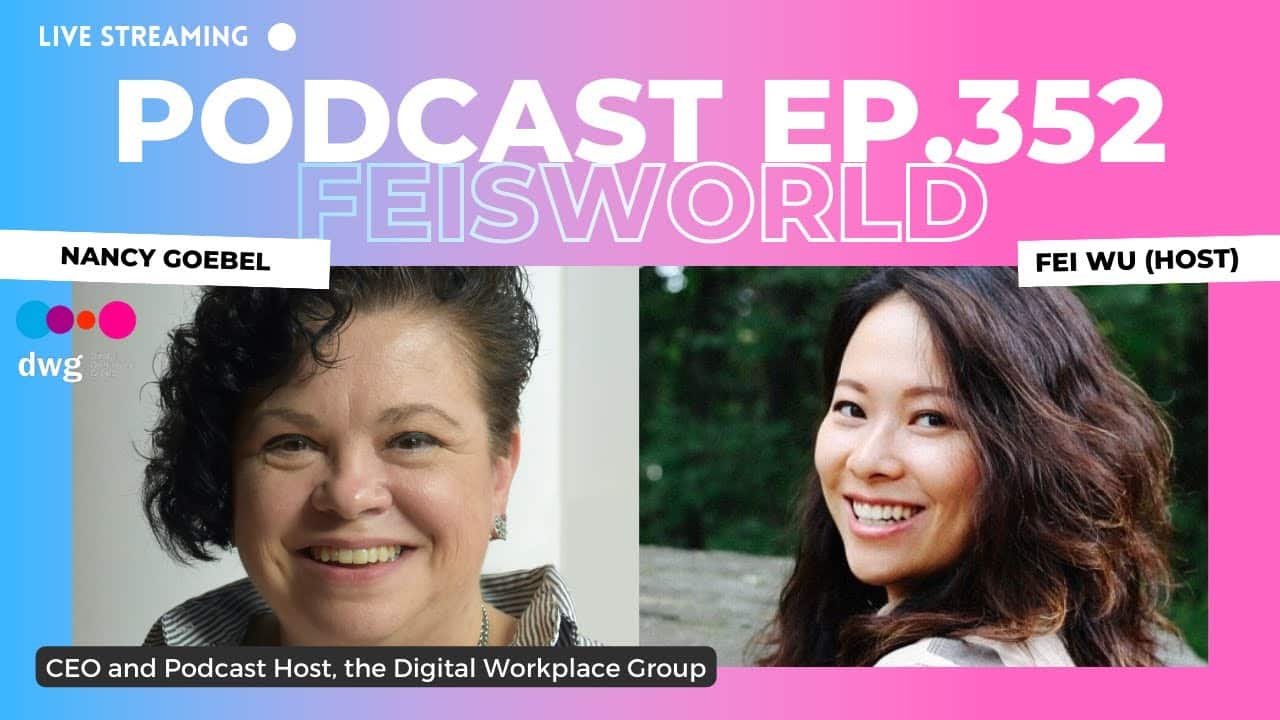
Our guest today: Nancy Goebel
Nancy Goebel is the chief executive officer (CEO) of Digital Workplace Group — the world’s leading membership forum for digital workplace leaders and their teams along with a highly-respected provider of boutique benchmarking and consulting services.
In this conversation, we discussed:
What it’s like to be the CEO of Digital Workplace Group (DWG) Nancy’s journey inside DWG in the past 17 years, and how she grew into her current role as a CEO. We also talked about how Nancy manages to run two popular podcasts for DWG! Last but not least, we openly discussed grief.
Watch Our Interview
Transcript
Transcript
Fei Wu: And I'm really excited to be sitting here with Nancy Goebel. I consider Nancy, uh, not just a friend, a colleague, but someone that I really look up to, a woman in leadership. So welcome Nancy. I'm so grateful that you're
Nancy Goebel: here. Oh, I couldn't be more excited to have a chance to share some time with you over a backdrop of.
Fei Wu: Thank you so much. And for those of you who are less familiar with Nancy's work, I wanna do a brief intro. I'm gonna just hop into today's questions, and by the way, we're gonna be talking about a series of topics and things like podcasting, being a creator, and also Nancy in a. Leadership position as the CEO of DWG, so I'm gonna say it correctly, which is Digital Workplace Group. And uh, with that said, Nancy is the Chief Executive officer, CEO of Digital Workplace Group, the world's leading mentorship forum for digital workplace leaders. And their teams, along with a highly respected provider of boutique benchmarking and consulting services. In addition to being responsible for DWGs growth acceleration plan, Nancy served. On DWGs board of Directors and is executive producer for Digital Workplace Impact a top rated podcast in its industry. So even with such a, you know, brief intro, there is already so much to talk about. So, Nancy, I'm gonna break the ice by letting you talk to us and really help me understand better of what DWG is, what you guys do at a high level, how it works.
Nancy Goebel: It's a great place to start. So DWG works with about 70 major organizations across North America and Europe. Household names that everyone would recognize from Campbell's to CVS Health, from Barclays to the Coca-Cola company. Michelin, the list goes on. And when I think about DWG, there are a couple of key parts to what we do. So membership is where we get to explore what good looks like. Benchmarking is where we get to measure against that. And then the consulting side. Boils down to providing expert advice and targeted interventions that really help organizations drive the success of their digital workplaces. So very often we work in combination across those three areas. Um, and occasionally we bring in technology providers to help add the technical lens to the work across the digital workplace.
Fei Wu: Hmm. Wow. I love the summary. Clearly. This is, this is really interesting that, that you are on the ground and you understand just ins and outs of how everything works together. And I gotta say, sometimes people ask me and I struggle to cons more concisely describe Face World, especially as things as you know, change so rapidly. So. One thing I noticed, one of many services and expert areas of expertise for DWG is automation. I saw the word ai, phrases like digital transformation, change management. So I was curious like especially in the past year, year and a half, things are changing so rapidly. Uh, how have you seen the company transform? What are some of the decisions that you may have to make?
Nancy Goebel: Well, I think one of the most important things that, that we do at the heart is we serve as a listening post. Um, we are eyes and ears, not only with what's happening across our membership. But looking at our wider industry vantage view as well. And so our members count on us to help them not only stay grounded in, in what good looks like in the here and now, but also to help them think about, um, how to. Uh, new ways of working in support of where things are going for the digital headquarters. And so I think we've had to turn the dial up on that in a sense, because emerging technologies such as generative AI really came on the scene in a bold way. And, uh, when you're operating in. You really need to be centered around sensemaking because for me, that's the difference between content and knowledge and insights. You really need to help people understand what does this mean for us? What does this mean for me as a digital workplace leader and practitioner? And I think sometimes in of change there's a level of skittishness, and so I. And a lot of the conversation that we've had in and around the generative AI arena in particular, um, is that we needed to help people think about things from the standpoint that anytime you have, um, new technology, uh, a secret to change management is figuring out what you need to, uh, to operate as necessary, as differently as. When you look at, uh, previous generations of emerging technologies, the birth of the internet, uh, the introduction of Dialup, and then VPN, and then instant messaging, and then the list goes on. Social networking and collaboration, cloud, the metaverse, and now generative ai. I think sometimes you need to look to the. Um, in order to go forward. In fact, when I put out predictions for the digital workplace for this year, um, I always cap off the predictions, um, with a super prediction and recognizing that's where we are at the moment. Um, I referenced an iconic film back to the Future. Why? Because as we work with emerging technologies, we need to make sure we don't lose sight of the fundamentals as we move forward. So things like purpose, strategy, and roadmap, policies, governance, measurement. User experience, experimentation, very important and, and change leadership. So DWG is really there working with organizations like the ones I mentioned to really help, um, create that pathway forward and to do that in meaningful and impactful ways for the digital headquarters.
Fei Wu: Hmm. Really interesting. So as people are listening to this, a lot of my followers, subscribers are in the space of being a creator, being artists, musicians, as well as small business owners, which many of them are growing very rapidly. And I love the conversations talking to like sort of the one person million dollar companies or small team, multimillion dollar companies, and go, wow, just incredible how scalable they are with such a small team. Um, what would you say when it comes to DWG, we're hearing a lot of, at least medium sized or many enterprise companies, you know, who are currently the, the makeup or is there a place for smaller business to also take advantage of your products and services? I'm just
Nancy Goebel: curious. Yeah, so we're primarily working with Fortune 1000 or equivalent organizations. However, what I would say is. Almost every organization at this point has a digital workplace, good, bad, or otherwise? Mm-Hmm. Um, most organizations have a level of digital capabilities that they're using in servicing clients and getting work done. And, um, certainly generative AI is, is all around us at the moment. And so, um, while we're primarily working with large enterprises, I always think that there are insights. That others can draw from. Mm-Hmm. Um, and, you know, things like, um, our Digital Workplace Impact podcast or research that we're sharing can help, um, even smaller or medium sized enterprises think about, uh, what's needed next as they can continue to look for new ways to service their clients and customers.
Fei Wu: Great. Yeah. Uh, you know, uh, one thing I didn't even plan on asking, but in terms of the Gen Z workforce and young millennials, um, just like, uh, triggered me to wanna ask that what are some of the things, uh, that DWG may be thinking about or doing to kind of rope them in? Because I talk to a lot of leaders and one thing is that, that. You know, given what has happened in the past four to five years, and you know, gen Z is kind of graduating from college, it's really hard to provide a level of training, even face-to-face opportunities. That someone like myself once had. Mm-Hmm. So we're just wondering if you have any insights or kind of stories to share there where this is not your area and don't worry about it.
Nancy Goebel: Well, um, a couple of thoughts spring to mind at the heart. DWG is a professional development organization because we're exposing our members to. He thought leaders and practitioners in the industry. Mm-Hmm. Really, uh, synthesizing industry insights. Uh, but at the heart we're also connecting people to each other. Mm-Hmm. Who otherwise are working behind closed doors day to day. Mm-Hmm. And so I think about, um, the events that we've run and those have. A powerful place for people to share their story. Mm-Hmm. And it's easy to default to hearing the executive perspective only Yeah. In those kinds of, um, environments. Mm-Hmm. However, um, we take time and care in working with our members to make sure that we create spotlight moments for rising leaders and in. Uh, to be able to share their stories and their insights. So very often when we have our in-person events as one example, mm-hmm. Um, members will come as teams and give people exposure to the players who are essentially their peers. And so, um, it's an opportunity for, um, all generations in essence to come together and share and learn from each other. They're not only opportunities, um, for our Gen Zs to learn from those who've got a wealth of experience, but by the nature of, um, curiosity and challenging, there's reverse mentoring and reverse learning that happens very naturally as well. And promoting the idea of 360 Learning is I think a really key thing for us to do to bridge the generations.
Fei Wu: Yeah. Funny that you said that because just, uh, last week around the same time I interviewed re-interviewed Florian, and Avanade actually appointed someone who's in his, uh, late twenties and from their leadership, uh, council training program. And it was such an interesting conversation to hear from. Both perspective and as we both know, as humble, as sweet, as someone like Florian is, he was really like giving the spotlight to the younger person, Gonzalo in this case, and really just listening very intently, asking such curious questions and frankly I was really blown away. It just how much respect and space, just like you said, he was able to give the to the other person.
Nancy Goebel: Absolutely. Florian is is someone that I hold in. Uh, especially high regard. Uh, not only having been a long time partner in industry, uh, but he's also one of my mentors. And part of the reason I've gravitated towards him is because he is such a thoughtful leader and, uh, is very generous in sharing information and creating opportunities and helping to cultivate the next generation of leaders. That's on all of us. Whenever we're in a leadership role, um, we had someone help lift us up. So we've gotta continue to pay that
Fei Wu: forward. The paying it forward is so key. I think about the relationship you described as someone who is a mentor, you know, in the industry is like somebody who's a sponsor, but I think he's such a champion for Mm-Hmm. Who you are in your work. Um, Nancy, you've been with the organization for 17 years, if I read it correctly on LinkedIn. That's
Nancy Goebel: absolutely
Fei Wu: right. Right. A, a lot of things must have happened. I can imagine the, even the size, the nature of DWG 17 years ago compared to what it is today, and I saw on LinkedIn briefly there are, you know, 5,000 followers, which many company pages don't have a ton of followers or a lot of content. I wonder if you don't mind kind of walking us through your journey, some of the key points, how you got to where you are today and, and really I. Adapting all the changes that are happening inside a company. That's something people don't talk about. It's like, okay, it's DWG. No, 17 years ago. It probably was a very different company.
Nancy Goebel: There's no question, and I have to almost start with uh uh, a preamble to say this is actually what I consider to be my second career. So I spent roughly 20 years. In the corporate office at JP Morgan. So the first leg of my career was on Wall Street. And I have to say that one of the most powerful lessons that I learned in an organization like that was that, um, I needed to build a special kind of currency and, uh. In that world, knowledge and relationships are the most powerful currencies that you can trade. And so I think my time at JP Morgan was amazing training ground to become a connector of all things people, technology, knowledge, and by asking smart questions. Um, it allowed me to just build process and capabilities where nothing existed and really helped drive innovation through the co corporate office, um, and first generations of the digital workplace with my colleagues. So, fast forward that to my second career. Um, it was actually a shift into the entrepreneurial. Arena while leveraging knowledge and social capital just the same. Back in 2007, and at that time, the idea was that I was linking arms with then CEO Paul Miller. I. To launch the business in North America and over the years, um, I had to learn how to become a salesperson. Not an easy thing to do when you've come from a corporate staff function. Um, but I also, while doing that, had a real hunger to learn all sides of the business. From research to benchmarking to, um, the advisory side, to events, production facilitation, content curation. And so as the company started to grow, especially in North America, I then started to move into leadership positions and ultimately succeeded Paul as CEOA year ago.
Fei Wu: Mm-Hmm. Wow. That is a journey for sure. I didn't even think about or, or know that DWG uh, was not founded in North America. Where, uh, where was it originally from or, or founded. I. In London, in the uk. Oh, I didn't know that. Wow. So how many locations? I saw There are multiple locations worldwide now for DWG. So
Nancy Goebel: on paper we're registered in London, New York, and Malmo, which is in Sweden. Mm-Hmm. But actually we're an office list company. Mm-Hmm. So I'm sitting here talking to you today from my favorite room at home. Mm-Hmm. I'd say I'm here probably 80% of the time. And then traveling the rest.
Fei Wu: Wow, that's so fascinating. Uh, if I may ask, how many people currently are either full staff or contracting freelancing for DWG?
Nancy Goebel: I'd say we're about a global team of 80 with a definite mix across staff and, and freelance, um, at different points in time, especially in the consulting side of what we do. Mm-Hmm. We need to call upon deep subject matter experts to work on specific. Client engagements or projects. Mm-Hmm. So having that flexible staffing model has really been, uh, a strong practice inside of DWG for many, many years at this point. And for those who interact with us, um, they never know who's who. Ultimately, what they see is a passionate group of individuals who wanna help, um, digital workplace teams.
Fei Wu: You know, you mentioned just a few moments ago, uh, you talked about content marketing, you know, event management, all these whole suite of what we call like full stack content marketing. It's something that I find myself, my producer and I decided that that's the, uh, the angle that we kind of. You know, basically how we set, that's our, that was our vision for Face World many, many years ago. And then the industry said, you need a niche, niche down further. Do one thing and do one thing really well. We felt like the urge of like producing different landing pages, telling our clients about different things. Um, but now I'm so glad to hear, you know, to see ourselves and see someone like. Yourself to be able to hone in on so many different skills. Not just podcasting, not just writing white paper, but you have learned a lot of things, uh, over the years. One of which that you have really made a name for is being a podcaster, posting two shows. Uh, both are highly recognized, uh, in the industry. So I would love to hear your thoughts on starting the podcast. Whose idea was it? Was there any friction and challenge at the beginning? Because a lot of companies, including people are watching this to say, oh, we've been talking about this for a long time now. We just don't know. When is the perfect moment? Are we gonna hit all the milestones and build the consistency we need? You know, I. It's open forum here.
Nancy Goebel: So yes, DWG has two podcast channels. One is audio only, and that's Digital Workplace Impact. Um, but we also, um, have our Rewilding series, which is, um, a YouTube channel. Um, I host Digital Workplace Impact and our chief creative Officer, Paul Miller. Think about the content space. We need to be mindful about the fact that there are different kinds of learners, right? There are, uh, kinesthetic learners, there are auditory learners, um, and, and then of course visual learners. And over the years in sharing stories, um, across our industry, we were heavily geared towards research and expert blogs. Um, so, you know, that's, um, a lot of our visual content, um, and, uh, also, uh, the events side of what we do to really stretch people's thinking. And, um, we hadn't ventured into, uh, the podcasting arena until about 2016 when we started to realize that our members wanted to be able to have portable. Content. And we also wanted to be able to extend our reach on a thought leadership level. And so that gave rise to dipping into the podcast arena. And I think, um, it was easy in the sense that we're so well networked as, uh, an organization that it was not only. The people we already know, but by reputation we were able to. Major organizations around the world, um, as well as, uh, practitioners of, of various kinds. And so, um, it became an important platform for us to give those stories of who's doing interesting and impactful work in our circles. A level of life and attention, and in the process, it was also an opportunity to showcase what we do inside of DWG, which is not only giving people a vantage view of what's going on from a trend standpoint, but also to really help make sense of what's going on as well.
Fei Wu: So you started in, you know, 2016 for the podcast, so that's still pretty early on. We started 2014 and we're considered sort of like almost veteran like dinosaur podcasters by, you know, how people are considering that in this stage now. So what are some of the advice, learnings, tips, and tricks that you've come across? Uh, if you were to start a podcast today or to convince someone? Uh, that this is a good idea as a content marketing engine, as a vehicle for their businesses.
Nancy Goebel: So I think you have to start with great stories. Um, and making sure that you know who your audience is, um, so you can bring the right stories to life. Um, the other is, uh, to make it feel like a conversation just like you do Faye. Oh, okay. Uh, because, uh, people don't, uh, just want to hear, uh, you know, a ping pong match of question answer. Uh, but there's a level of enriching the conversation by reflecting, by sharing, by probing, um. Layers to a story. Um, the other thing is to think about, um, ways to make that content accessible. So, uh, we always make sure that there's a transcript that's published alongside, uh, the podcast so that, uh, whether it's because of language, because of cognitive issues, um, or, uh, you know, core accessibility needs. That transcript can help, uh, with, uh, people taking in, uh, the insights and information as well. Um, the other thing is, is thinking about how you spread the word, uh, for us. You know, our, uh, key marketplace is really grounded in LinkedIn, so we promote each, uh, episode very heavily on social through LinkedIn. Um, so, you know, knowing where to find your customers and making sure they have access to your podcast Mm-hmm, um, through those channels is important. Um, and then, uh, taking time to celebrate, uh, the studio guests who've come through because they've given you the gift of time. So each year, um, I do a review of our podcast and that's another opportunity to revisit. Some of the great stories and insights that have come to life. Um, so those would just be a few starter ideas on salient learnings that, that I've.
Fei Wu: Yeah, I was listening to one of your latest episodes, which is an aggregation of your favorite moments. I think there's like a 2023 review sort of episode that I really like where you voice over the beginning. And that part by the way, I think is very important for the host to have a voice. It sounds like it's a host, host, you know, host. Always have a voice, not. Always, I think especially for a lot of female creators, I notice they tend to wanna fade into the background. Mm. And I think we come through with some level of maturity and experience, whereas a lot of the hosts, I hear this, it's like. Oh, the show is not about me, it's about my guests. I'm like, no, it is actually about you because your name is on it. You are the starter of the show. You shouldn't disappear from your show. Mm-Hmm. Um, and, uh, you know, there's no clear measurement. I don't think it's about like 2080 rule or how much the host should be speaking, but I think having an active presence is really important. I wonder. If you have, you know, a thought, thoughts on that as well. I know you're running a corporate podcast, which there's also some level of complexity that a personal podcast doesn't have.
Nancy Goebel: Yeah. I, um, I don't know that I necessarily stepped into it with a formula Mm-Hmm. Per se, but I wanted to make sure that I struck the balance between, um. You know, having, um, the story come to life and also making sure that I'm reflecting on the conversation as we go along and ensuring that my voice and my personality shines through as well, because I'm the point of continuity. Mm-Hmm. From episode to episode. And so ultimately it's not only about representing the DWG brand, um, but also my brand as. As an individual, um, thought leader in our industry as well. And so making sure that my, my voice comes through and sharing my sparkle is all part of.
Fei Wu: All part of the magic. I wanna talk briefly about long form versus short form. That is a very popular topic right now in this industry, content creation, and that's, uh, a realm I've stepped into for the past couple of years. Something I didn't really bother, didn't really think about as much for the first. I don't know, like seven years of podcasting. But then later I realized, wow, sharing these soundbites, these clips, these moments that are keyword driven and having content calendars can actually be very helpful. Um, and then, you know, we produced, uh, basically this tool called Pod Intelligence to make it way more sustainable that you pour in 300 episodes, boom, here's a list of topics and the keywords associated with. You know, collectively all the topics or individual topics, um, have you experimented or tried with micro content in terms of, you know, producing maybe audiograms for the audio shows or, uh, video clips from the, the video content? Um, have you explored that?
Nancy Goebel: Um, what I will say is we haven't done it for the. Podcasts specifically, but we do a lot of that within the knowledge sharing inside of our member circle. So as a, a quick example, um, we did, uh, you know, a similar highlights reel, um, of all of the live tours that we've done as part of our member events. Just, uh, this past week for, um, uh, our members in particular because the thought with micro content is that sometimes, um, attention spans are short. Yeah. There's a lot of information that people need to process day to day, but I also think there are windows of opportunity that we need to seize to revisit. Specific insights with our audience, right? Um, because you need to meet them where they are at any given point in time. And so. Um, an important insight from a larger piece of content. You give it a second life and can start a conversation afresh or spark innovation where maybe, you know, it didn't hit your audience when an initial episode came out, but several months later you have a new Windows opportunity to raise that dialogue again. Yeah, with a new twist.
Fei Wu: Yeah. Isn't that interesting? Because, uh, we haven't, it's so funny, I, I didn't even write down seasonal content, but you're absolutely right that in the conversation, whether that's 30 minutes, 45 an hour or more, different things may come up, which one of the topics we're gonna be talking about is also grief, which is something people don't talk about in a corporate setting. And I experienced that. In my early to mid twenties, I felt really alone. So we'll table that, but I noticed like whenever certain things that would come up, you know, uh, women leaderships or AI or grief in this case, they come up in these moments. But then seasonally, whether I. There's a date for people to remember. Mm-Hmm. Or a holiday for people to celebrate and things like that. It, it's super helpful to pull out episodes from way back and I'm, you know, the other day I experimented with episode from like season one in 20 14, 20 15. People are like, oh, I've forgot about this. And then some, there's a lot of evergreen content we can still repurpose and for nothing else. I like how you said it. Even if it helps one person, it's really worth it.
Nancy Goebel: Absolutely. And you know, grief is a very personal thing. Um, but I also feel like we have to pick a path when we've entered a moment of grief. Uh, I, I shared with you Faye quite, you know, quite openly that I lost my husband a few years ago. And I recognized in watching others who had traveled down a similar path that you go, one of three ways you exist. Do you survive or you thrive? And in my case, I'm someone who, who comes at things from, you know, my glass is refillable, it's not half empty or half full. So I chose to, uh, swim in the Thrive Lane. And I always try to look for opportunities to, to live in the land of yes. And, um, look for new ways to. You know, step into a new day. And whether that's, um, meditating first thing when I sit down at my desk because I don't have a commute. So I set my mindset for the day. Or, um, uh, a couple of years ago, um, I, I took down the dream board that my husband and I had created and was amazed that we had actually achieved all but one thing on the dream board. But I said, I need to, you know, paint a picture of what my new life is gonna look like. Um, and so I redid my dream board so that every day when I wake up I see that. And, um, uh, you know, I, I pull things down and I change them, sort, sort of like a collage as, um, my interests and my needs change.
Fei Wu: Yeah, I wanna dive in a little deeper here. I think there's so much, uh, to talk about for women, and even in my lifetime. I turned, uh, 40 last year and I, I realized just how much I have seen women transform and thrive in the past 10 years, in the past 20 years. For example, you know, six years ago I saw one of my dear friends, uh, um, losing her husband. She was in her. Early forties, uh, he was 47, so they had young kids who were just seven and 10 years old. And I remember sitting there and just grieve, you know, grieving with her and it just felt so heavy. And I, and in that moment nobody knew what's gonna happen next, and she was in so much pain. But then six years later, I'm sitting here laughing with her. We did a podcast together and she was literally sitting right here and she's. And now a sponsor or really a patron for these nonprofit organizations, we finally could talk about it to say, wow, Tripti, you've thrived. And I wanted to tell her because I saw that as a possibility for her then, but it's almost too difficult to even fathom what it means. And so, um, what are your thoughts on that? Like for so many people are living in grief right now. Things are happening. Every day. Some, some, you know, a lot of us are caregivers and I know people whose children are sick, but we don't talk about it at work because it's unprofessional. Right? And then you feel really alone. Sometimes you lose that cohort. You, you lose friends and family because they feel triggered somehow not to talk about it. Whereas I feel just the opposite. I wanna be there, you know, together with them. So.
Nancy Goebel: Well, it's one of those things very often when someone learns that I'm a widow, the first thing they say is, I'm sorry. And I watch their heads go down and there's, there's almost this level of awkwardness like, okay, now what do I do? What do I say? And I came to realize that it was incumbent upon me. To put them at ease. Yeah. Um, to say, you know, I'm, I'm here, um, in a space where yes, um, I, I've experienced some life challenges Mm-Hmm. Um, but I'm still me. I'm still a whole person. That's not my only label. Um, and just sort of help people get past that, um, that initial moment and. Um, set a tone that, you know, we can talk about anything and everything. I think you're feeling that as part of this conversation, you know, there, there are no walls. Yeah. And sometimes I think, you know, it takes a person of strength to be able to take that on. Mm-Hmm. Um, but I think that's just inherently part of my nature. Mm-Hmm. Um, and I think in. When my children were young, I remember they were coming home from school and talking about all the things that went wrong in their day. And so one of the things I started at the dinner table was the idea that we each needed to go around and share one thing that we were grateful for. Mm-Hmm. And at one time, my in-laws came to dinner and I. Looked at that process a little questioningly. And I remember my father-in-Law on the very first night, could only come up with, I'm grateful for salt and pepper and, and, um, it was a little bit tongue in cheek, uh, but the next day it became obvious that he thought about the question in advance and offered something a little more substantive. And then the next night, something greater still. And. I think it's very easy to stay in the pain and in the dark light, and sometimes if you take just one step and just think about something that you're grateful for, it starts to create a pathway to happiness or at least being receptive to drawing in the light, so
Fei Wu: to speak. Isn't that interesting? When my dad passed away, uh, after suffering is suffering very deeply for two years, he passed away when I was 26 and a half. And I just remember being in pain for so long, living in that dark place. But even I, I should say that even before he passed away, what he was living at ICU for a little while, we laugh pretty hard together and there is that moment and almost a twist of me. Questioning myself, should I be laughing right now? Is anything ever funny again? Like, am I disrespecting the moment? Am I not feeling the pain as much as I should be? And uh, that was really interesting. I think giving ourselves that permission to feel, to acknowledge the pain, but then coming through it to still living, living in love. In, you know, in these moments just let our natural, there's like a natural breakthrough and if that makes sense, that it was really fascinating to me to reflect on that. I think that
Nancy Goebel: makes perfect sense and I like to think that every time a loved one comes to mind, if you, uh, think of a happy memory or you share a story with a smile, to me that's. Wow. So holding them in the light, holding those special memories and sharing them with a smile. And it sometimes takes a while to get to that point. Um, but you know, I, my husband comes up every day, uh, in conversation and my family would tell you, it's always with a smile now because I was very fortunate to. Had my soulmate in my life and I decided the day that he died that I would take the best of him and the best of me and, um, use that new person to carry. Hmm.
Fei Wu: That, that's beautiful. Uh, that's really wonderful. So, Nancy, what's on your dream board now? I'm not, you know, I can't really see it. What is, what's on that plan? What's on that board?
Nancy Goebel: So, um, I've got some, uh, ambitions for what I'd like to see DWG to achieve in the next five years. Um, I've got some travel plans that I. Um, but also, um, some things that I wanna achieve on an intellectual and spiritual level too. Um, you know, I think of us, um, as individuals who operate, um, sort of, you know, body, spirit, mind, heart. So I try to make sure that all of that is reflected in my dream board day to day.
Fei Wu: Hmm. That's beautiful. What are some of the travel destinations, if I may ask, that interests you
Nancy Goebel: in the, in the moment? So, yeah, so the, there are two things that are, are pretty prominent right now. Um, my. Bestie from college and I were talking about planning a trip together this year and my family's originally from the Caribbean. And um, the political situation in Haiti's pretty difficult and has been for a long time. But she said, um, over dinner in December. Gosh, I would love to set foot on Haitian soil with you. And so the best thing that we could come up with is that, um, there's a cruise that leaves out of New Jersey that stops in Ladi, um, which is, uh, a beach area just on the edge of, um, of the island. And so we're talking about that as a trip this year so that A, we'd get some quality time together and b. She foot on Haitian that. Family ancestry is from France and I haven't been back to Paris in a long time. And so, um, I definitely wanna put that on the list for this year as well. So both are up on my dream board as you see.
Fei Wu: Wow. Well, since you can work from anywhere, not that you need to work while on vacation, but I just. Love the flexibility. You know, we worry about access this and where we need to be. Um, location-wise, it's so flexible to know that if there's an urgent matter, somebody could call you. But, you know, I, I think it's, it's so interesting in the, in the world that we live in now, not just for. We're not just looking for something that's convenient, that's something that's close by, but to have a plan and I feel like what a great storytelling opportunity as well, I can en envision you going on these trips, not just going to places of interest and taking photos, but capturing a moment and. Living in the story that you'll be creating and writing in real time. So that's
Nancy Goebel: pretty cool. Yeah, it's one of those things, you never know where inspiration's going to come from. Um, last year I went to a jazz concert with my mother and. It was, um, with Winton Maral and the Lincoln Center Jazz Orchestra. Oh, and I just remember taking in this incredible set of arrangements and finding myself, observing how he was leading the band. And I actually wrote an article about what I learned from attending a jazz concert. It was literally a case study in leadership. And so I think it's, if you have an open spirit, learning and insights can come from anywhere, whether it's, uh, a workation in Paris. Mm-Hmm. Whether it's standing in the shower or Yes. Even attending a jazz concert.
Fei Wu: I agree with you because when he said even jazz concert for me, I, you know, I, I do like classical music, but I'm not gonna really go to the orchestra, pay $200, sit somewhere for a few hours parking, you know, like, not really quite my scene. But, uh, after Seth Godin heavily recommended the youth orchestra, uh, led by, uh, Ben Zander, and it happens to be in Cambridge and. I said, that's it. I'm driving like literally by myself and in the rain. It's very dramatic. And, and then literally the moment you play the notes, he described his passion. I was like, oh, I was bawling. I was like,
Nancy Goebel: why am I crying?
Fei Wu: I a orchestra? It made no sense, but I was so inspired. I also wrote an article, I have to send it to Seth as well. Uh, but thank you for bringing that up. I truly believe inspirations, whether it's leadership or otherwise. Happen and people who are listening are watching this. Please note them down, whether it's opening up a simple note, um, app or something that you use to capture or on the back of a napkin, like please capture them because those things, those ideas tend to fleet very quickly. Like sometimes you just can't recall. How do you capture your ideas and inspirations, Nancy? That will, that should be my next question.
Nancy Goebel: I love a voice memo, number one. Number two, I'm a sponge for information and um, for years I've used Flipboard to curate. Uh, topics of interest and what I've always done is I've peppered uhhuh topics that I wanna stay on top of for, for work and life. So there's, you know, there's everything from future of work and, you know, emerging tech. Mm-hmm. To, um, entertaining and cooking and all points in between. And so. Capture the things that inspire you day to day. And of course, AI will start to make that, um, even easier for us and, um, help, uh, even instigate some, some questions we haven't thought about, um, and, and stretch our thinking that way
Fei Wu: too. For sure, for sure. Both of us. So deep into ai, I find it so fascinating. I know regulation, uh, is very important. Uh, at the same time, I hope it will, you know, come in with an open heart and learn as much as we can, as opposed to, I. You know, blindfolding and just like this is, has nothing to do with me. If I ignore it, I'm gonna be safe. I don't think it works that way. So, um, with that said, Nancy, this has been such a wonderful conversation. What are some of the things that, that are bubbling right now that I. Uh, anything else that you wanna talk about but I haven't had a chance to ask?
Nancy Goebel: Gosh. Um, well, I think that, um, we've covered a real wide range of, uh, topic areas and, um, I'd say this has been such a fascinating. Process for me because, um, I approach a conversation like this both, uh, as someone who's sharing my story, but, but a student of the craft. And I have to say that so effortless. And for those who are contemplating. Um, how to expand their approach to content creation can just learn so much from the approach that you take day to day. So you've shared your sparkle with us, uh, in many ways through this conversation. I. Oh,
Fei Wu: thank you so much Nancy. I would say definitely enterprise, large companies, there's so much to really grasp and learn from DWG and for the smaller creators and small businesses. Feel free to reach out to me.
Nancy Goebel: So, yeah.
Fei Wu: Um, it's been such a pleasure, Nancy. Thank you so much. I'm so glad that after Fluent introduced us, we decided to take this opportunity, kind of deepen our relationship as opposed to. Just exchanging emails, um, that would've been less interesting. Um, but that would be necessary. I just love the fact that we can, in a way, I find podcasting is a way to really cement the relationship that you never, ever forget the person after such an. Eye to eye, heart to heart, uh, conversation for 45 minutes to an hour. So it's really magical that way. Thank you again so much for this conversation. Thank you
Nancy Goebel: so much. And of course, I was really touched when you introduced me as one of your friends and, um, I, I look forward to nurturing that friendship over the years to come. Absolutely.
Connect with Nancy Goebel
You might also enjoy…

Written by
Fei WuFei Wu is the founder and CEO of Feisworld Media, a Massachusetts-based digital media company helping brands get discovered by people and by AI. An Adobe Global Ambassador and brand partner to ElevenLabs, Synthesia, and 50+ other tech and AI companies, she hosts the Feisworld Podcast (400+ episodes, 500K+ downloads — guests have included Seth Godin, Steve Wozniak, Chris Voss, and Arianna Huffington) and co-created the documentary Feisworld: Live Your Art on Amazon Prime. Fei writes for CNET, Lifehacker, and PCMag, and her work has been featured in Forbes, Harvard Business Review, and WIRED. She has been publishing on the internet since 2014 — long before AI discoverability had a name.
View all posts by Fei Wu→Stay updated
Weekly insights on content, AI, and digital media.
Keep Reading
Related Articles
Joanne Lipman on Mentors, Untapped Talent and Why Women Should Stop Waiting to Be Perfect
Marc Randolph on Curiosity, Messy Starts and Why “Nobody Knows Anything”