Peleg Top: Clarity and breakthrough for accomplished creatives at a crossroads (#336)
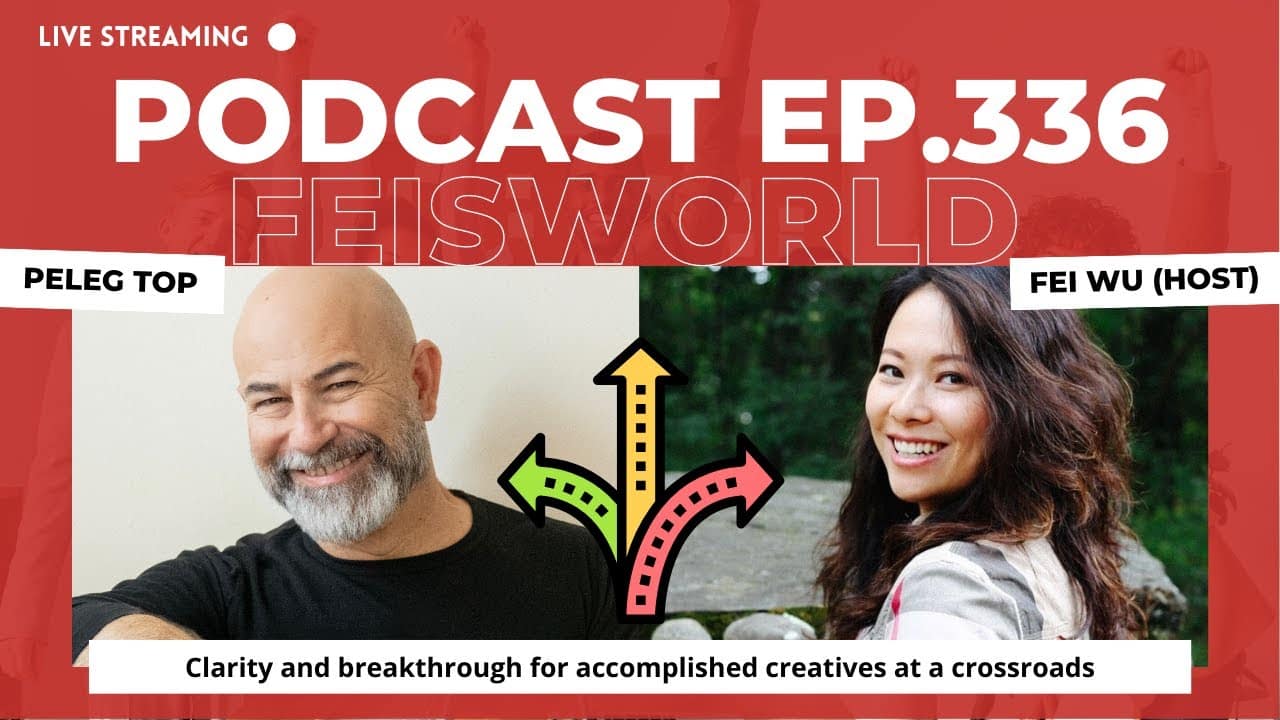
Our guest today: Peleg Top
Peleg Top is an artist, a speaker, and a Creative High Growth mentor. At 23, he founded Top Design, a premier branding and design agency in Los Angeles specializing in entertainment and cause-related work. He authored several design books and was a sought out speaker at creative conferences around the world.
After two successful decades, he sold his agency and
transitioned to a new vocation as a business mentor and a spiritual director.
Peleg is the creator of the “100 Days of Creative High Growth” program- a soul awakening course that guides people on a powerful path of rediscovering their creative free spirit and expressing their authentic voice. https://www.pelegtop.com/creativehighgrowth
Watch Our Interview
Transcript
Transcript
Fei Wu: This is Fei from Feisworld Media and I'm here with my new friend and spiritual teacher, entrepreneur, uh, Peleg Top. I absolutely adore this name and we can talk about it as part of this if you're interested. Um, and, uh, please leave us questions. We are going live right now. If you're watching this, we're listening to this at a later time on Apple, Spotify. Google, you're also welcome to leave your questions. Um, we do monitor this content and we'll. Alive on phase, world media, everywhere. Uh, but probably, if it's okay with you, I wanna introduce you first to my audience and we're gonna keep it short because today's topic is gonna be really juicy on, uh, you know, what it's like to be in the program, a hundred day creatives. And, you know, uh, there's just so much the cover and what love means. To creators out there. Um, so if you're not familiar with Peck's content, Peck Top is a creative, high growth mentor, a spiritual director, and an accomplished artist. Over the past 25 years, he has built and sold a design agency, spoken in front of thousands and guided many creative leaders through his 100 days of creative high growth program. We'll get into the details today. You're very welcome to ask questions. He's passionate. Spreading his message of love, creativity, and abundance to creatives and leaders in the creative world. So with that said, you know, my first intriguing question I think is that you talk about love all the time, constantly plic. And I think in, I think love as a word probably means first of all, probably has many different variations, means different things in different cultures. And in particular where I come from and the Asian culture is like, Ooh, it's a sensitive thing. We don't say even, I love you very frequently. Could you please maybe help us understand what you mean by love and love in creativity and and lovers in the world?
Peleg Top: Thanks for having me, Fei. It's such a treat. When I think of love, I think of love as a way of being. More than anything, it's a place where we come from and the way that we walk through the world. There's, there's really only two ways to come from as human beings, uh, the way that we, uh, show up to ourselves, show up to others. We can either come from love or we can come from fear. Hmm. And generally we, we grew up in a culture that, uh, fear is quite dominant. We get fear fed up, fed to us on a regular daily basis. You know, just turn on the tv, turn on the news. It's, it's all fear coming at us. Mm-hmm. And, I think the, the, the most important work that we can really do for ourselves, for our wellbeing, for our, um, spiritual growth, for our, um, For having a life of true purpose and meaning is to, uh, shift from that place of fear to the place of love. So come from a place of love in everything we, we, we do, and how we show up to ourselves. Um, doesn't mean that it's easy. It takes work, it takes practice. Mm-hmm. Um, and oftentimes that place of coming from love is quite unfamiliar for many people. Mm-hmm. Um, it was, for me, for many years, I didn't realize that I was operating from a place of fear, especially as a creative professional, which I spent close to two decades practicing in that, in, in that space. And, uh, really fear was the driving force. Of how I was showing up to my work, how I was showing up to my clients, it fear turned me into a people pleaser. Fear turned me into someone who was afraid to, um, charge what the work is valued. Uh, so it has, fear has, it has such a, a, a powerful force of energy in our lives that we don't realize that it's, uh, that it's present un until we do, until we begin to wake up and realize that, oh, I've been operating from. From this fear-based operating system, and ultimately it creates an uh, it creates a space of me abandoning who I really am, abandoning my true core self, my essence of who I am, and try to become someone that I'm possibly not just to belong and fit into the world. So, um, it took me in my own personal journey, um, years and years of inner work to, to truly learn to shift from that space of fear to love. Now it doesn't, man, it doesn't mean that I don't find myself in that space anymore. It's a natural thing to, to be in fear mode. I mean, we're wired that way. So once we understand how we're wired, once we understand what, how we're triggered, once we understand the wounds that we are carrying all the way back from childhood, how they show up in our a adult world, and how they express themselves. You know, we'll, we'll, we'll find ourself in a, in a pretty stuck space. Mm-hmm. You know, and that, that stuckness that so many of us creatives feel, right? Mm-hmm. That, that sense of procrastination, all of that. It's all fear behind it, behind the scenes. Wow. So that was a fair, very long and complicated answer to your question, but I can talk about this for, for days.
Fei Wu: I'm excited to be talking to you about this for days. I mean, I, you know, we found out, uh, during our pre-interview, That you've been interviewed by, uh, a number of guests who have previously appeared on my show. People I look up to as mentors. Um, you know, Joanna Penn, a big shout out to you and I really wanna break it down because I think about the, the number of people your, your, I believe of. Episode 336 and, uh, the, the number of people and just people's backgrounds, ethnicities, like different languages. We speak that we all come from such different places. Yet there is that common theme of operating under fear for different reasons. I was literally just having this conversation with my two friends, uh, who, you know, showed up in our house from New York, uh, yesterday. And so I guess my, my question is people who are not. In tune maybe with their own emotions and, uh, who are not talking to a mentor or coach about it. What is, uh, what is a way for us to even identify, for us to recognize the difference between fear and love? Because sometimes I, I really struggle with that. Is it fear that I'm operating under or is it love because I care about this kind, this person or this engagement so much?
Peleg Top: Yeah, that's such a great question. I think it's less. Operating, um, un under fear. It's more, it's more about the energy of that that is feeding our, who, who we are, right? Mm-hmm. So I, I think the best way to begin to identify where am I in my life is to begin to look at our emotional state of being, okay. Mm-hmm. Am I experiencing anxiety more than I should? Am I experiencing worry? More than I'd like to. Where am I meeting myself? That'll be the first indication to tell me that, um, something's off. If I'm experiencing fear, if I'm experiencing anxiety, if I'm experiencing self-doubt, if there's things that I want to create, but I'm finding myself stuck, I'm fighting myself not being able to turn inspiration to. Right. That means that there's, there's fear and scarcity that is more present than love and abundance because abundance responds to, to, to love and scarcity responds to fear. Hmm. I love it. The, the first thing is just to, uh, to kind of do a diagnostic, to to, to sit with myself and be real with myself and really ask. Okay. How much is anxiety and fear really present in my life? I may feel like, uh, a sense of of love and compassion towards someone, towards my work, towards my client doesn't mean that love is not present there. The question is, what is the driving energy? Like, what's, what is my, what are my decisions based off? Are they based on, uh, me being afraid of a certain outcome? Or, uh, is the decision, the decision based on, uh, coming from a place of love, true service, a willingness to express myself fully in the world, shine my light in the world without fear getting in the way. Doesn't mean that fear is not there. The question is, how do I respond to that fear? How do I heal that fear and shift to a place of loving myself more so that the creativity, the creative energy that's in me is flowing out of me without my inner critic getting in the way, without me stopping myself continuously inside of my creation process.
Fei Wu: This is a lot to chew on right here. So I'm gonna, I will be very happy to use my own experience as a Guinea pig. Um, but before we get there, because I realize that I have been a creator for quite a long time now, 2014 officially starting my show, my podcast, very consistent now, life Dream, and. Uh, since 2019 as a YouTuber, for those of you who are, um, not aware. And, and lately I've been blogging like 10,000 words every week. I feel like the, I, I just love that flow state. I'm gonna write no matter what. I will, I will sing, oh, will write, I will be in front of the camera no matter how I feel or look, but I think that muscle, uh, those muscles took a little while to build. And, uh, I tell people, I'm like, oh, I've developed very thick skin. They're all, you know, uh, I think all those things are just part of building the habits, but at the same time, I realize. I, I have spoken with a lot of people and lately I've joined these webinars, uh, you know, the writing workshop for instance, where I do hear from people that they really, they find it very satisfying, get very triggering to get in touch with her inner inner self to put something out there like Seth Godin would say, here, I made this, I made this for you. And um, so what are your thoughts on helping people? Kind of have that first breakthrough to say, put yourself out there and put those voices in in place and, you know.
Peleg Top: Yeah. Um, what are my thoughts on putting yourself out there? Well, I would first want to look at the question that, what's stopping me? What's, what's stopping me from putting myself out there? What's the, what's the belief? That is present, that is holding me back. And generally that belief is, is most likely some kind of a belief that we've adopted in a very early part of our life and our childhood somewhere. And we climbed onto it and we made it our truth. So, so, I wanna identify that belief first, and I wanna challenge that belief. And that belief could be, I'm not good enough. Mm-hmm. It can be I'm, um, you know, I'll get rejected. Uh, I'm bad, you know, that's, I'm a bad writer, I'm a bad artist. I'm not good. I'm not good enough. Mm-hmm. Those generally are the operating systems' belief that holds us back as creators. Even tapping into the courage that it takes to put something out there into the world. Mm-hmm. So, um, So, what was the question again? Yeah, no, I, you're like good at a rollercoaster here.
Fei Wu: Yeah, absolutely. I think, uh, I, I can use more specific examples. Exactly like you said, the voices in people's, in creators, new creators heads are like you said, uh, I'm not good enough, or they look at their own professions. I'm a lawyer. I am, um, you know, doctor. I, I'm not a blogger. I look terrible in front of the video. I'll never be able to do these things, uh, that other people are doing. It's not for me. I'm not good. I will never be good. So how do you kind of tame and we're train that voice to be something different?
Peleg Top: Ah, that's the beauty of self-love practice. So when we, coming from a place of fear, um, our, our inner critic tends to be in charge. Those negative thoughts tend to be our truth because we have trained ourselves to believe that that's the truth. Mm-hmm. Uh, we, it's, it would be much harder for us to actually tap into a greater flow because we are operating on a re on from a place of reactivity. We're reacting to things in our lives. We're not coming from a creative space, a space that is, uh, that has free flow of spirit in it. So that space is a space of scarcity. It's, it's a low space. Think about a scale. There's positive and negative, right? There's, uh, um, low and high, um, levels of vibration that we carry with us, right? So if I'm cooperating in the world from a. Can you hear me okay? Mm-hmm. Because your, your video just went a little wonky and you're, you're frozen, so.
Fei Wu: Oh, no, I, I think we're good. I can see you and me very clearly here.
Peleg Top: Okay, cool. So, um, Those negative voices that we have, the negative part of us think about a scale if, if one side of it is fear, one side of this love, right? If fear is, is the the dominant, um, energy that I'm caring, right? And, and it looks like me being really critical about myself, me being very judgmental about myself, all those negative scripts that are continuously. Well, if fear is down here because it's really heavy and that's what I'm carrying, then love is up here, right? Mm-hmm. What we want to do is, rather than focus on the negative, rather than bring energy into trying to stop those negative feelings, we want to actually increase the positive increase. Our self-love practice, increase our creative expression practice, increase our practice of, um, gratitude for what we have, versus always comparing ourselves and seeing what we don't have. Being in a space of, of expectation from the, from the world, right? Mm-hmm. So, so the work really is about learning to increase love in my. The more I increase love of my life, fear will naturally begin to subside. Mm-hmm.
Fei Wu: Yeah. What are some of the things that people can do today to bring more love into their lives?
Peleg Top: Wow, that's a big question. Well, let me ask you this. What, what kind of things do. That Yeah. That help you. Again, it's less about bringing love into, it's not like love is out there and I'm trying to bring it into me. Mm-hmm. Right? Mm-hmm. Love is out there as well, but if, if that's the, my only relationship with love is love is outside of myself, and I have to work hard on, on getting my share. Mm-hmm. I've missed the whole essence of love. That love actually starts inside of me. Mm. Right? Mm-hmm. So it's, it's less about bringing love into my life and more about activating love.
Fei Wu: I love it. I think the way that I see, I mean, first of all, I, I have the luxury. I've been working from home even before the pandemic. So I realize there's a shift in me, peg, which is, uh, that since I left my full-time job, since I. The source of my fear or not feeling good enough, we can definitely delve into that, but I finally had this moment of sitting with. Understanding what meditation is. I'm not doing it to be blog, to blog about it, but try different meditations, different ways of sitting, standing. And then another way, like you said, to connect with myself. I realized that I, as I, you know, I'm about to close a chapter in my thirties this year, I realized things. Sometimes just, uh, not stop working or not quite work the, the same way as they were before. Like, you know, I never really thanked my teeth, my skin, like, you know, I didn't grow up with a lot of, with, with, um, lot of skin issues. I never really thanked my skin for, uh, I never really thanked my hands. Like I, James Alta Church says like, kiss your hands. Magic happen. Absolutely. And um, I, I remember sometimes we lose, you know, I haven't really lost my voice, but I've been on webinars where the speaker would be like, oh, I mean, a really terrible cold and, and never thanked my voice. So now I take, instead of me going through my twenties thinking, oh, I got a tummy ache. Why is this happening to me? Hello? Like, Work correctly. Like I got a lot of things going on today instead today, these days. I, I want to thank, I thank myself different parts of my body for, for trying its very best and for, for feeling and being okay of them, not always in perfect conditions and things will come up. Even if I'm doing all the right things, taking all the right vitamins, and so that's one part. And the other part I think it just never fails also, is just being in nature. I now have the luxury to live in nature, to take a walk, to not listen to podcasts and have to be super productive every step I take just like very small things that I just. Makes me feel enough vibration that you're talking about. So
Peleg Top: yeah, I think what you've tapped into Faye is super important and key, really key to shifting from that place of fear to love. And the key, uh, the key is what you said is I've, I've, I've learned to. Sit with myself. Mm-hmm. Okay. You've, you've learned to be with yourself. You've learned to go inward for your healing versus ex, you know, look for the healing outside of yourself. Mm-hmm. Right? And, and that's really ultimately the, the healing path that we want to. Is we're, you know, for many of us, it's really hard to be quiet with ourselves. It's really hard to be quiet with ourselves. Mm-hmm. Especially in, in a world where there's continuous messages coming from, from the outside, you know, telling us how we should be or what's the right way to be or, mm. Anything else that, that. Creates a distance between me and my true essence of who I am. Mm-hmm. So whether it's, you know, sitting in silent meditation or, uh, going to for a walk in nature or, uh, opening a journal book and journaling about what's going on for me right now, having this, this dialogue with myself. Being in that space with myself is the first step. Unless I'm willing to do that and unless I'm willing to be in that, I'm, maybe it's an uncomfortable space for me to be in, but that's really the only way I can grow is if I'm willing to be in that space and experience what is going on with me. Mm-hmm. Begin a different type of conversation with myself, begin to meet different parts of myself that I may have been afraid to meet.
Fei Wu: Mm. What are some of the parts that you, at one point, felt like you may be afraid to meet? I'm just curious.
Peleg Top: Oh, wow. Well, uh, my inner imposter, you know? Mm-hmm. Meaning that imposter part of myself that, that, that will hold me back from, um, doing the things that I want to do, showing up in a powerful way in my life. Mm-hmm. Right. So meaning meeting that part of myself and gaining a better understanding of what's feeding that part of myself. Mm-hmm. And addressing those parts so that when my inner imposter does make sh may come up, right? Mm-hmm. I, I will know how to be with myself in that moment. How to help myself shift out of that space because something, something may have triggered me that brought me into that space again. Right? So I, I really wanna stress that all this work that we do to heal ourselves and to shift from that space of fear to love doesn't mean that. Goes away, right? That imposters will still be there. Your inner inner critic will still be there. Mm-hmm. But now, When you are more activated in that energy of love in your life and you have practiced the tools, you've mastered the tools that keep you stay aligned to your two essence, when that fear shows up, it's not such a big deal. We know how to support ourselves in that space. We know how to very quickly shift out of that. Right? Mm-hmm. Because now we recognize that that's not really who I am. That voice that's telling me that you suck. You're no good. You're not good enough. That's not really me. That's a part of me that. That's a part of me that that protected me at some point. Mm-hmm. And at some point I gave it all the power and said, okay, you are in charge. Just keep protecting me for the rest of my life. Mm-hmm. And that part of me, in a sense, became inflated. Mm-hmm. To a point where, It's oftentimes the only voice I hear. Mm. I cannot tell you how many students of my, when they come into this work, the level of their loudness of the inner critic is, is, is, is so loud and sometimes so out of control. It, it's sometimes it breaks my heart to see that there's. Amazing artist sitting in front of me with this unbelievable talent and an unbelievable, um, uh, ability to. To heal people, to create something amazing in the world, and yet there's this voice inside of them and there's part of them inside that's saying, no, you're not good enough. Or, you know, all the other negative thoughts that they, that they believe. Mm-hmm. It gives me no greater sh joy to, to witness a human being shift from that space because man, when that love is activated in a. Wow. It's an amazing, it's amazing thing to witness. Yeah, absolutely. We've, we've all seen it. We've all seen it. It, it resonates in us as well. Hmm.
Fei Wu: Yeah. That's why I love the creative work to be surrounded by creative entrepreneurs. You can see their eyes. And they just, they just light up. They light up the room, they heal the people around them. Well, speaking of tools and practice, so I, I really believe that combination. You could have the tools, you could be thrilled, but if you don't put in the practice, you know, those tools are just there. You know, they're locked. Away somewhere. So you have created this program for a hundred days to work with? Yeah. Creatives. And, uh, I'm curious, like if you could tell us a bit about the program, why a hundred day just sounds pretty intense.
Peleg Top: It is incredibly intense. I am, I'm I. In awe of my students in the commitment that they bring to themselves in doing this work. Mm-hmm. Uh, why a hundred days? You know, um, I, I work in a very intuitive way and, um, I don't ask questions. But when ideas come and present themselves, if they resonate, if they align, I just say, thank you to divine inspiration. And I just go, mm-hmm. And I trust that is exactly where I need to go because that idea came. And when I started creating this course, uh, Um, it was on, on the heels of close to, you know, 12 years of working with, uh, creatives and entrepreneurs one-on-one in the coaching capacity. And at that point, I mean, I clocked in the 10,000 hours of, of working with people and I began to see, and, and that, that. At the end of the day, we're all alike. At the end of the day, we're all dealing with very similar, um, uh, issues when it comes to our inner world and. I noticed that, um, uh, uh, that the, the, the work that I was doing with people 1 0 1 was limiting the, my ability to, to support my bigger mission of activating love in the world and other people. So when I sat down and decided to create this program, I really didn't know where it was gonna go. But what I knew is I knew that I wanted to teach people. All the tools. That helped me heal from a place of, uh, fear and insecurity and self-doubt, and all of those places that held me back because I kept seeing those same symptoms come up in every single person. And, you know, in the beginning of my coaching, uh, career back, uh, in my late thirties, I, I was really more focused on coaching people with their business issues and their, uh, uh, sales and marketing. It was an expertise of mine at the. And what I've noticed very quickly that every business issue was a personal problem in disguise, and that personal problem had a spiritual component that the person wasn't looking at. And once we began to look at those issues, once we began to heal those parts and begin to shift from a space of fear to love, all of a sudden all those business problems begin to take care of the. Interesting. Yeah. So that was a good sign for me that, oh, this is the area that I was staying in. This, this is where the juice is. This is where things become, um, uh, healed. This is where true change, this is where, uh, what the person wants when they come into the work. Um, they generally get what they need. And what they need is something bigger than they could ever think about.
Fei Wu: What are some of the examples of the tools? Uh, or, you know, what, what is an example of a module will look like? I was just wondering how are people engaged as part of the program?
Peleg Top: Yeah. Well, the program's delivered online. It's, it was, um, designed, uh, for a person to basically have the experience of having a hundred sessions in a hundred days and their, uh, recorded sessions that I. That my students receive. Where? Um,
Fei Wu: uh, I think that, yeah, I think your mic is sh maybe is shaking a bit on your desk. Uh, okay. Is this any better? Okay. Yeah. Like, I think it's, yeah, hands free from the desk.
Peleg Top: Hands, hands off. Got it. Also. Oh good. So, um, The program is designed for a person to meet themselves every day with guidance. Mm-hmm. So a, a, a typical session will include, um, deep inquiry, uh, questions that come up, uh, a teaching for the day, a concept, something that I want you to begin to understand and illuminate in your life. Mm-hmm. Um, so I, I, I guide you through, uh, this deep inquiry. Because I really do believe in the power of inquiry, the power of questions. We don't ask ourselves enough questions, right? Mm-hmm. We, we continuously l want the answers, but oftentimes we're not asking the right questions. So, uh, in this work, there is a deep inquiry. Around where I'm coming from, like what, what is influencing where I'm coming from? And it begins to illuminate the places in my life where fear is present and, uh, the, the ongoing inquiry in the writing that we do every day in this work. Is a big part of what helps us shift because it teaches us to be real with ourselves. It teaches us to be vulnerable with ourselves. Um, in addition, there's daily creative expression. So we, we uh, we go through a process of, um, creating an intuitive art on a daily basis. That is art that's created for two reasons. One, art. For the sake of art, just for the sake of expressing something, not for the sake of selling it or, um, creating, uh, something for a client. It is just what, what is inside of me that wants to express itself. Um, The second part we use art is because a big part of this program is, um, learning to tame that inner critic voice. And in order for to, to tame that voice, we kind of have to activate it in a way where we can begin to recognize how it's showing up. Mm-hmm. Making art is the best way for us to, uh, that's what I've discovered anyway. It's the most effective way to activate that inner critic to a point where we can identify what it looks like and then learn at.
Fei Wu: So when you say intuitive art on a daily basis, and I love it without sales or mm-hmm. You know, I have a lot of art, uh, in my house, in my room. Yeah. And my mom is really quite a, a master at it, but, Again, you know, this is even a conversation we have on ongoing basis. She's 70. She says, what kind of art should I be creating? I said, not the ones for sale. The ones that you've always wanted to create. So I know it's a, it is a different genre of, uh, it's the same conversation. So what are some of the art that maybe, maybe it's not traditional art. What types of art do we encourage people to practice creating on a, on a daily or on a regular basis? Like what do you mean by art?
Peleg Top: That's a great question. Well, for someone who hasn't experienced this work, the idea of art may sound intimidating. Um, the idea that I'm trying to, uh, to teach people is creating art. As a self-expressive tool and the medium doesn't really matter. I mean, we go through in the process of going through a series of different mediums of art practice only because it, uh, keeps us all in, uh, on track and everybody's, you know, practicing a similar medium. So it, uh, it helps, uh, with the, with the learning process and the teaching process as well. But when I talk about expressing yourself through art, the medium doesn't really. It could be a pencil, it could be a pen, it could be clay, it could be, um, gush or watercolor or whatever. Whatever it is, it doesn't matter. Mm-hmm. The point of it is, it's an ex expression of something that's going on with me emotionally. Right. So it's a, it's art. There's more creative for an emotional component versus an intellectual c. You follow me because my screen froze here.
Fei Wu: Yeah. Yeah, it's good. As long as you can hear me, it, it's good. I think because for, for those who are watching listening is, I made Pegues a 10 80 d p uh, you know, hd. So, but your, your video's coming through really, really clear for me. Um. I think the example, like what about lately? Kind of, I've been experiencing seeing blog writing, writing in general, whether with a pencil or I'm typing, uh, inside a blog post. For me it's like I'm also in kind of a, I'm also feeling quite high on a vibration, uh, even recording videos, like knowing I'm now taking words on paper to be in front of the camera. Yeah. Are, are those also possibly seen as arts as well?
Peleg Top: Absolutely. Yeah. Absolutely. A again, this is the, the art that I'm talking about is, is more of a self-expressive, a self-expression that you're doing for you Hmm. Versus anybody else for any other purpose. Mm-hmm. It's for the joy to experience the joy. Oh no.
Fei Wu: Hi everyone. Sorry, I was gonna just about to type a message, but in just a moment. This has never happened before. Peck will be back, uh, and if you're still watching while I'm waiting for him, please let me know in the comments below what your thoughts are on practicing art daily. What is that you do? Maybe, I don't know. It's cooking, it's baking. And there he is. You are back. And don't no need to change the video settings. I was like giving a little Okay. Little speech asking people what their daily art practice is gonna be. Okay. And please leave us. Uh, in the comments below, I'm just so, I'm so ready to learn and explore different ways. So welcome
Peleg Top: back. Yeah, thank you. Sorry. We had a little technical snafu. Um, and I'm not sure what, how much of, what seconds, what I said, uh, uh, last, but, uh, again, it's, it's less about the medium and it's more about the experience of creating for the sake of creation, not for the sake of the. Like Mm, mm-hmm. For the sake of creation. So once we begin to create for the sake of creation and begin to experience what that feels like, that's an incredible feeding force because we are fitting ourself with creation energy. We're not letting our inner critic or our negative thoughts getting the way, judging the work as we're, as we're creating. This is what creating for free spirit means. Mm-hmm. I'm simply creating, I'm allowing something to come through me right now. It could be a song, it could be a painting, it could be a sculpture, it could be a dance, it could be anything. Anything at all. Mm-hmm. That supports the act of expressing myself. Hmm.
Fei Wu: Ooh, that's deep. Supporting myself. Art of, you know, making art, allowing me to express myself. Uh, that's really liberating. I think Paul, that reminds me of like flow writing or journaling, daily journaling. Not even let the pen leave the paper and just write whatever is on your mind. You're not showing this to anyone. You certainly are not selling it, publicizing it, but it's so freeing. It just like random stuff starts to show up. And if you do that at the top of the day, uh, I, I don't know, like. You feel like you have this weight that's been offloaded from you in this like simplest, cheapest way possible, and I love it.
Peleg Top: Oh, Julie, so
Fei Wu: pages pe I think your, your voice, your audio came in and out just a bit. So just that I've. Yeah. Oh, you're wearing AirPods, aren't you? Those things are, can be a little tricky. Uh, so all right, so let's double check your setting with the gear button and uh, if you know, uh, yep, I'm here. Yep, you're back. Okay. Yeah, if this happens again, you can just take off, uh, AirPods and then just use your speaker instead.
Peleg Top: I know. Okay. Sounds good. Uh, you're frozen on my end, so, uh, uh, but what I was saying is what, what you described, uh, Julia Cameron calls it, uh, morning pages, and that's a practice that I, I, I highly recommend as an entry point to beginning this journey of, um, inner awareness. Right? Mm-hmm. It's the idea of starting the day with writing three pages of anything that comes to mind, not having an editor at all, writing, whatever, whatever comes to mind. Um, there's something, it's almost like a brain flush. Hmm. Um. Oftentimes, you know, once we begin to do that practice on a regular basis, that space opens up for us to begin to channel higher, higher wisdom so we can begin to ask questions as we are writing and begin to see that we, we have a part of ourselves that we can tap into that can give us guidance. Mm-hmm. And, and that's a big part of what excites me in, in the work that I do in the world, is. Helping people gain access to, to that part of themselves. That higher wisdom that, that truth that oftentimes we, we don't wanna listen to or we're afraid to listen to. Mm-hmm. That is, that, that is that our intuition. And when we begin to operate from that place of love and, and practice that on a regular basis, our intuition becomes sharper and more on point and truly becomes a, a, a force of guidance in our life. Right? Hmm. And once we learn to trust that part of ourselves, to trust that inner voice. That higher self part of ourselves. I mean our, our life looks mu mu much different. Yeah. That's when, uh, that's what I'm talking about when I say that Love Energy's wanting us.
Fei Wu: Yeah. I think it could be such a superpower once you have. Uh, realized, uh, that really find that connection between you and your, uh, we generally call it creativity, but, uh, I think that spiritual connection, uh, or what you call a finding home, uh, yeah. You know, ki finding your way home to yourself. Uh, yes. And it's so important. So my my follow-up question is, for those creatives out there, you know, at a crossroads or accomplish graders, which are the primary group that you're, you're focusing on, you're trying to help is I think perhaps in a way that I might fall into a subtitle. That is that I also find it challenging sometimes to feel so excited, truly. Authentically excited about different projects. I literally go to sleep, wake up the, the, the next morning and seeing notes to myself to say, this is an article I really wanna work on. This is the person I really wanna interview, which means I need to reach out first. Uh, and uh, I also come from a project management background, which means I innately, like I have some skills to maintain them, but how do I. Prioritize. How do I not overwhelm myself or, you know, what we call like the burnout, uh, which happens so frequently with people in our world. Like, what are your thoughts on that? Okay, pal. I think your voice, uh, your audio went out again. That's, oh, done. Okay. You came back after a few seconds. Okay, let's try again, pal. Do you mind taking off the AirPods and see if that helps? Yeah. Okay. Let's see. Yeah. Yeah, perfect. I can hear you perfectly. And there's no echo or anything. Yeah, I'm not hearing
Peleg Top: you at all.
Fei Wu: Oh, okay. Okay, okay.
Peleg Top: Okay. Yeah.
Fei Wu: All right, let's try again. I think sometime by taking off AirPods, we'll reset.
Peleg Top: Got it. Cool. All right. Okay. So repeat the question again. Oh, yeah, sure.
Fei Wu: Uh, is the kind of the burnout of sometimes from doing too much or getting feeling truly excited about, uh, Yeah. Different things all the time. As a creative, like how do we tame that energy?
Peleg Top: Um, I don't know if we want to tame that energy. I think when we're in a good creative flow and ideas are coming to us, it's a blessed experience, right? Mm-hmm. The, the question that we want to ask ourselves is, um, What is it that I am, what is it that resonates with me and will grow me first? Right? So all these ideas that are coming to me, all these projects that I want to do, right, it's hard to prioritize that for ourselves sometimes because, uh, there's. To create them All right. Same, almost simultaneously, all at the same time. Mm-hmm. And that's, that's virtually impossible, right? Oh, the voice of the audio just shifted, but we're good. Yeah. You,
Fei Wu: you went out for like two seconds, but, uh, we're still, yeah. We're all still here.
Peleg Top: Yeah. Um, so how do we learn to prioritize? I think the first thing we gotta learn is to slow down. To slow down and, um, create space in between the things that we're doing. If we're constantly in that creative flow, if we're constantly outputting up, outputting up, outputting mm-hmm. It, it's gonna be hard for us to get perspective, right? Mm-hmm. Slowing down enough and possibly taking a a a a break, taking a rest. Will give us the perspective that will allow us to really notice what are the things that are truly going to fulfill me and satisfy me versus the things mm-hmm. That I think I should be doing. Because they will, uh, you know, have a, I'm, I'm attached to an outcome. Right. Mm-hmm. So, mm-hmm. When I'm looking at this and all the ideas are coming in, uh, some of the most important questions that we can ask selves is, why, why do I wanna do this? Like, what's driving it? Mm-hmm. It's a, is it an, what's the outcome and that is that outcome, something that I'm. Um, willing to put energy into, is that important to me right now? Oftentimes it may not be right, but begin to discern between the, the all the ideas that are coming to, to me, also ask myself, is this gonna be a satisfying to me? Is this going to be fulfilling? Is this something that I'm doing first for me, for my own growth as an artist? Mm-hmm. And if the answer is yes to that, and it'll be interesting experiment for you, Fay, to begin to look at all your ideas and, and kind of, kind of begin to discern and see which of these ideas are for the sake of an outcome that I'm trying to create. Mm-hmm. Versus for the sake of just activating love in me, fulfilling me as an artist, growing me as an artist, challenging me as an artist. I'm doing this for me first. And, and, and see what the, see what comes out, out of that, out of that particular exercise. I think that would be very telling for you as far as how to prioritize.
Fei Wu: Yeah, I love that. And there's a question from Cammi and thank you so much for staying with us for pretty much the entire session. Yeah. And, uh, I love this question. Is there, if there's always output, when is there time and energy for input? Ooh.
Peleg Top: Yeah, I think that's more of a comment than a question. True. You know, what, what Cammi is saying, if we're continuously bringing, bringing information in, right? And in that information is also, you know, the outside world and the news and the media that. And social media that's continuously throw, bombarding us with information and messages, right? Mm-hmm. It's gonna be hard for us to have energy for output, right? So this is why rest and a break and a slowing down is essential for, for us as creative individuals, as artists in the world, right? Yeah. We have to respect that space. We have to respect our artistry enough. To slow down and create this distance between myself and the external world so that I can really get to know who I am. And in that process, from that space of, of deep self-awareness, I am creating, I am expressing myself, and that is the most authentic and beautiful art that I can make.
Fei Wu: Mm-hmm. I, I would like to add that question. I think. To kind of challenge what we're talking about here for a second as well. So, I'm an older millennial, uh, by, by age obviously. And, uh, I come from a place. The fear that I have built in childhood is, you know, a wonderful childhood with my parents and then moved in with my grandparents, which. Accumulated lots of trauma, fear that I still carry to this day, but I'm managing that better and better now. But I also, for me, it feels like when you said, um, separating the work between output and this is something, this is love for me, this is something I really wanna create. So I feel like on a daily basis, or even I look at my calendar, This work right here, what we're doing, this is love for me. This is something I, I love doing, but at the same time, I also have client work. I've sponsored videos to write. I also have certain types of, I don't like the word affiliate, uh, but certain review posts I write, do I enjoy writing those? I actually do, but certainly not as much as what we're doing here. So, um, that, that's kind of my take of balancing that and constant. Measuring shifting. And, uh, I do check in with myself at the end of the day, but at the same time, I also know other creators or people that I know who are struggling because they wanna devote all their time to the work that they love. And they don't, you know, they, they don't want to focus on client work. They don't wanna focus anything that's just for revenue generation purpose. But at the same time, I'm thinking, You know, my property tax is over $3,000, $3,500 every quarter. I, I gotta pay the bills somehow. You know, how, how do I think about that, uh, with the, the framework that you have just like taught us about?
Peleg Top: Yeah. Yeah. Uh, I don't think the, how is is the right question. Hmm. Right. I, I really believe that if. If you are inner, if and when your inner world and spending time with yourself on a regular basis as a practice to help you stay connected and aligned to yourself, slow down enough where you can actually, um, begin to make wiser choices. Um, the how will sort itself out, right? Mm. So the how really is about, um, it's less, it's less about trying to manage all the things that I'm trying to do, including the things that I'm, that I need to do in order to earn a living. Mm-hmm. It's also seeing that the most valuable time that I can spend in my life. It's first of all with myself and my inner world. Mm-hmm. And once that becomes my ongoing daily ritual where I'm meeting myself and my truth every single day. That shifts me to a place of being able to make better choices and maybe not take on so much or so many things that overstretch me. Mm-hmm. Or saying yes to projects that are more attractive to me or more lucrative. It's, it's, Mm-hmm. Again, it's where I'm coming from, right? It's not so much about the how. It's when I continuously work on staying in love in that space of love. Right? Which means love. Love takes practice. Mm-hmm. Love exists, but it takes practice for us to be tapped into it on a regular basis when we're not doing that inner work. We default and we default to that fear space. And from that place it's very easy to spin and ultimately lose touch of who I am at my core.
Fei Wu: Mm mm So we have a lovely comment from Randy. The more I slow down, I love myself, the more energy and love I have to share with others projects. That is very true. Slowing down ourselves is a practice I, that's something I am constantly working on. Um, so thank you so much for sharing that, Randy. That's something to keep in mind. Awesome. I just, I'm so curious about a question. I feel like, and then we could definitely talk about the program because I, again, Cammy expressed her gratitude towards you, um, about the 100 day program. So actually I do wanna talk about this for a second. Yeah. What is your take pe of teaching people what to do versus creating a course and creating a community where people can come together, really experience that, um, you know, uh, why do you think that's important?
Peleg Top: Well, I've created both. We, we have a community of people who have, who have gone through the a hundred days process and, um, are actively engaged in, um, in staying connected and engaged with each other. Mm-hmm. Uh, and, but, but the question is, why, why is it important to, to do this work on a daily basis?
Fei Wu: Yeah, do it regularly. Regularly, in a way, I think do it as part of a community as opposed to I'm just doing this on my own.
Peleg Top: Oh, oh, right. Yes. Yeah. Yes. Got it. Um, well, There is incredible power in vulnerability and one of the things that, uh, is required as part of this process is the inner work that we're doing, the daily writing and inquiry and um, uh, the expressive art. Everything that I'm producing inside the work, I share it with the rest of my cohort. Mm-hmm. And through the process of the a hundred days, the act of sharing my work every day. Teaches me how to be more vulnerable and honest without, without carrying what other people think. Because that space inside of this, inside of this work is incredibly safe. There's zero judgment. Mm-hmm. So I may be the kind of person who has been afraid to talk about what, what my truth, my entire. And because I believed I may be rejected or may be laughed at or whatever story I had going the practice of doing the work in community and witnessing each other's wounds, witnessing that at the end of the day we're all the same, that we're all dealing with the same version of a wound that has been. Uh, present in us, uh, from childhood and that healing those wounds, and I always tell every person who comes into this program, everybody gets exactly what they need in particular to, to heal. Mm-hmm. The process is really teaching you the tools so that on day 100 or one when the program's complete, right, you have. Daily ritual that you have with yourself where you continuously practicing this work. Mm-hmm. And you have a treasure chest of tools that can accompany you for the rest of your life to help support, you always go back to alignment with your essence and your true self. Mm.
Fei Wu: Hmm. I love it. So what are, I realize we're just about to reach the top of the hour, but what are some of the things that I didn't ask that, that you really hope to share with our audience
Peleg Top: today? Wow, that's a big question. Um, well, I would love for people to ask what's the next step in me doing this work? You know, and I would. I would point people to the creative high growth website, creative high growth.com or my website, and download a sample creative high growth session. Um, it is, it's free, it's an audio, uh, session and experience what it's like to meet yourself mm-hmm. Uh, through a guided process that, um, will give you a taste of what this creative heart growth space is all about. Mm-hmm. It's all you need really is an internet connection and pair of really good headphones, a journal book and some art supplies, and come and spend an hour with me inside of that space and. See who you discover, see what insights come to you about yourself. Hmm.
Fei Wu: I love that. So I already listed the program right now on the screen, but awesome. If you're listening to this, it's also in the description. Wherever you're listening to this episode, I wanna thank you so much, poll for joining us, and they're just, You know, you have, uh, done so much for your community and there's many more resources on your website, which is pal tom.com. I encourage people to check it out. You've written books as well and, uh, yeah, this has been so lovely and I'm really grateful for, uh, the introduction for us to be able to share this time together. And, uh, I hope you will join me in the future. Maybe we should invite some students to come on and share their experiences and we can create a little live cohort here.
Peleg Top: That would be wonderful. Yeah. I love, I wanna give a shout out to some of my students who are on this call who, uh, who contributed their, their love. And thank you Faye for, uh, everything that you do in the world. You are, uh, absolutely love driven in many ways and it's, it's a pleasure to, to be in that company with you.
Fei Wu: So thank you. Oh, thank you so much. That means so much. Thank you so much everyone, for being here and in the future. I'm gonna take us offline now and I'll see you.
Connect with Peleg Top
You might also enjoy…

Written by
Fei WuFei Wu is the founder and CEO of Feisworld Media, a Massachusetts-based digital media company helping brands get discovered by people and by AI. An Adobe Global Ambassador and brand partner to ElevenLabs, Synthesia, and 50+ other tech and AI companies, she hosts the Feisworld Podcast (400+ episodes, 500K+ downloads — guests have included Seth Godin, Steve Wozniak, Chris Voss, and Arianna Huffington) and co-created the documentary Feisworld: Live Your Art on Amazon Prime. Fei writes for CNET, Lifehacker, and PCMag, and her work has been featured in Forbes, Harvard Business Review, and WIRED. She has been publishing on the internet since 2014 — long before AI discoverability had a name.
View all posts by Fei Wu→Stay updated
Weekly insights on content, AI, and digital media.
Keep Reading
Related Articles
Joanne Lipman on Mentors, Untapped Talent and Why Women Should Stop Waiting to Be Perfect
Marc Randolph on Curiosity, Messy Starts and Why “Nobody Knows Anything”