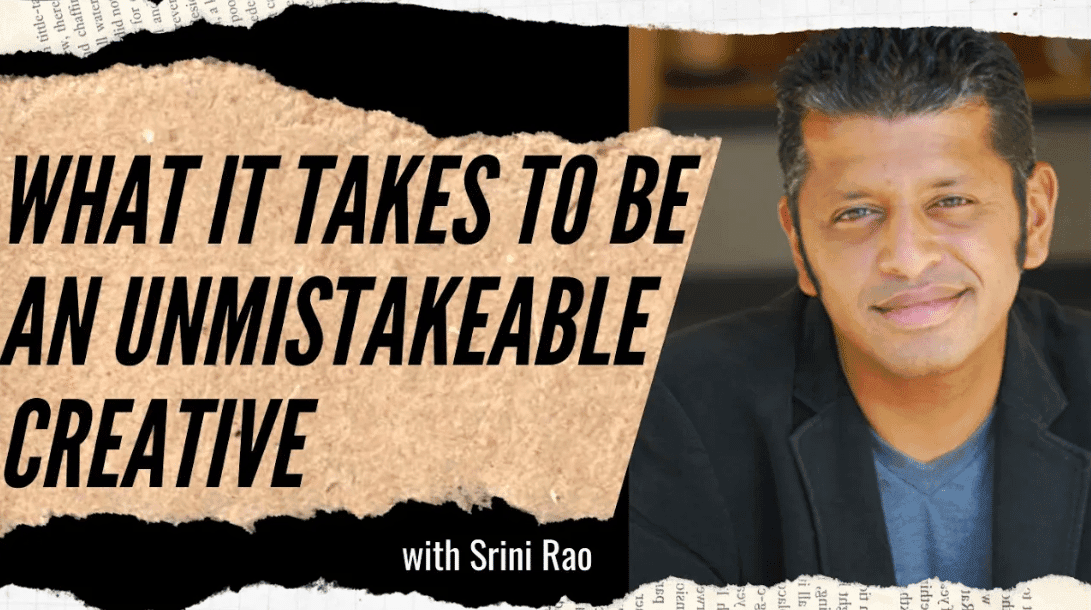
Our Guest Today: Srini Rao
Srini Rao (@umistakableCEO) is the host and founder of The Unmistakable Creative podcast where he has conducted over 600 interviews with thought leaders and people from all walks of life. Srini has a distinctive viewpoint on branding, storytelling, and marketing. I’ve followed his podcast for over a year, never missing an episode. Unmistakable Creative is a popular podcast, with new episodes released twice a week. Srini recently partnered with Soul Pancake, who helped create a series of animated shorts for over 1.6 million viewers.
Srini’s platform provides a rich and unique experience. He enjoys asking questions that have never been asked before, and he doesn’t let anyone off the hook.
Instead of focusing on Srini’s achievements, and putting Unmistakeable Creative on a pedestal, I took a different approach to delve into his daily practice, routines and beliefs. I hope you take away as much as you can today to practice what Srini has taught us.
We Cover a Lot in This Episode Including
- How Srini first discovered the magic of surfing, which has been an integral part of his creative life for the past 7 years
- Srini discusses his two new books, to be released in 2016
- The process of working with a publisher vs. self-publishing
- Why Srini chooses not to check emails for the first 4 hours of the day
- What is a typical day like for Srini?
- How he spends the first hour after he wakes at around 6:30am
- Demystify habits of the most creative people
- Bulletproof coffee and low carb meals
- What does it mean to Srini to practice his freedom
- Diving into Unmistakeable Creative: How Srini creates / produces / iterates on inputs and outputs. (Plus, why he believes iterations and experimentations are essential for creative work)
- New animated shorts – how they elevated the Unmistakeable Creative brand and altered brand perception
- How Srini prepares for his 600+ interviews
- Creative input vs. process (How to choose guests and where to seek inspirations)
If you learned a few things while listening to the podcast, please give Srini a shoutout on Twitter.
To learn more about Srini and Unmistakeable Creative, please visit http://unmistakablecreative.com.
Animated Short: The Crossroads of Should and Must With Elle Luna
Animated Short: Expanding Yourself Through Expereince With Dave Vanderveen
Transcript
Transcript
Fei Wu: Welcome to the Phase World podcast, engaging conversations that cross the boundaries between business, art and the digital world for the first time on a surfboard. And that kind of divided my life into two moments before and after surfing and, uh, kind of, you know, been the driving force of everything that I do. I mean, I've surfed for the better part of seven years now. Um, I don't know that I've ever done anything that long. Can you think of any other sport where you, uh, get your social, physical and spiritual needs all met in one activity? It's like going to a bar, church and a gym all in one day. And, and the thing is that, you know, people have this idea that creative people have these really, you know, insanely interesting lives and that they're, you know, living, you know, in a constant state of chaos. But that's not really true. I mean, I think that the most productive, creative people are the ones who are driven entirely by habit. Like the, their days are very predictable. Um, and to me that, uh, I, I try not to do anything that will throw off that. Hi everyone. You are listening to the Phase World podcast. This is your host, FA w. I want to take a moment and thank all my guests who have appeared on my show, listeners who have been so helpful in making phase world better. Every day we're just short of a 10,000 downloads. A number I would have never imagined if you asked me a year. But 10,000 really isn't all that many, uh, or impressive compared to top podcasts. However, one of my favorite metaphors is that imagine how many people it takes to fill an auditorium, usually less than 10,000 people, and imagine that you can speak to all of them multiple times. I have a very special guest. Someone I have admired from afar as a listener, so please join me welcoming Sereni Ra from the Unmistakable Creative to the Face World Podcast. Sereni is the host and founder of the Unmistakable Creative, where he has conducted over 600 interviews with thought leaders and people from all walks of life. Sereni has a distinctive view into branding, storytelling, and marketing. As a result, I have followed unmistakable creative for over a year. Never missed a single. Unmistakable Creative isn't your typical interview podcast. You never hear from the same people. Topics and guests invited to Siri's show all have very interesting lives, insights, and unique point of views. To add to that, sir Sereni asks questions that have never been asked before. He won't let them off the hook. Easy and expects no easy answers. Interviewing Sereni, on the other hand, was not an easy task because he expects the same from an interviewer like me. Instead of focusing on Siri's achievements, putting unmistakable creative on a pedestal, I took a different approach and asked him about his daily practice. The purpose is simple. I hope you take away as much as you can today, not tomorrow, and to start practicing with Sereni has shared with us on this podcast. It would be great if you could say hi to Sereni on Twitter at unmistakable CEO, and tell him, well you have learned and how perhaps has impacted your life. I also think the theme of Face World and in particular of today's podcast is that creativity is rooted in insatiable curiosity. So next time you run into someone who's interesting, make sure you ask them a few questions. Without further ado, please welcome Sereni Rao from the unmistakable. Thank you so much for joining Face World. I really appreciate your time. Yeah,
Srini Rao: no problem. Happy to help.
Fei Wu: I am, uh, as a result of this podcast, I was able to learn so much more about you, your writing. I am, in particular, extremely excited about the shorts, the animated shorts that you've been producing as well.
Srini Rao: Cool. I'm really glad to
Fei Wu: hear you like them. Yeah, they're, they're fantastic. And, um, for, I think for most of my listeners, uh, first of all, I feel like I'm surprised when I talk to people that I haven't heard of, uh, on mistake creatives. So, which mm-hmm. makes me feel like it's a, it's a hidden gem and it's such a fantastic resource. Um, That it, it's, it's a shame that not more people have taken advantage of it, but personally, uh, as a result of listening to it for the past year or so, I have been posting a lot, been following you, and as a result, a lot of my friends have subscribed and they've all given me just, uh, phenomenal feedback on the conversations you've had. So.
Srini Rao: Nice. Well, I'm, I'm really happy to hear.
Fei Wu: Aw, I know how as a podcaster, I feel like, you know, for you. How, how many, how many years has it been? I, I couldn't get the accurate read of the number of years you've been running unmistakable
Srini Rao: creative podcasts. Yeah, so as a brand, unmistakable is only two years old, but as a, as a, you know, we started as a podcast for bloggers called Broadcast FM about six years ago, I think in 2010. So it'll, it'll be six years after.
Fei Wu: Fantastic. And you've, you've had, uh, thought leaders over so far, over 500 interviews recorded from, uh, people from like old walks of life, including mm-hmm. , uh, you know, Seth goin an obvious one. And then this morning on my way to work, I saw a new approach of like, best of 2015. And I thought, right, oh, that was so phenomenal. It's a great way to kind of rebroadcast, um, some of the, the, I guess the favorites and mm-hmm. the best of, so, I, I spend a lot of time learning about you, Sereni, and I must say I am a surfer, wannabe, and I've spent , I'm originally from Beijing and, sorry, I haven't even introduced myself, uh, yet, but, um, I'll get into that after I add this, ask this question, but one of the. A surprising thing I found out about you is, uh, surfing. And then I realize the moment that we're triggered and I see more and more of that themes in your writing, uh mm-hmm. in your conversations with your guests. Could you tell me a little more about how you got into that?
Srini Rao: Yeah. Um, I actually was doing a study abroad in Brazil. Uh, you know, while I was in graduate school and I went to graduate school, coincidentally near the beach in Pepperdine, in Malibu, all places. Uh, but, you know, I took leaving California and leaving Malibu for some reason to, to take the surfing. Uh, you know, I, I, we were spending so much time in the water that inevitably I just kind of finally got in and two days before I came home, I stood up for the first time on a surfboard. And that kind of divided my life into two moments before and after surfing, and. Or into two parts really. And, uh, it's kind of, you know, been the driving force of everything that I do. I mean, I've surfed for the better part of seven years now. Um, I don't know that I've ever done anything that long, but, wow. But it's, it's been, you know, one of those things that's, uh, you know, it's a spiritual practice. It's exercise. You know, I, I jokingly say, I'm like, how you, can you think of any other sport where you, uh, get your social, physical, and spiritual needs all met in one activity. It's like going to a bar, church, and a gym all in one.
Fei Wu: Hmm. I, I love that metaphor. It's awesome. .
Srini Rao: Wow. Yeah. That's, that's how it started. And it's, you know, kind of been integral to everything that I do. Is this
Fei Wu: something that you do on a daily basis?
Srini Rao: Um, I try to, it's not always daily, but, uh, it, it's pretty frequent several times a week. What about this morning? Uh, not this morning , uh, I've been writing cause I have a deadline for my publisher, uh, which, you know, uh, we can talk a little bit about that as well if you want. But yeah, I'm, I'm working on that right now. So, uh, that's, that's kind of my big priority. Mm,
Fei Wu: I I read about that. I believe it's a new book that you're writing and I would love to hear more about that. If, if there's a, is there a release date? Is there a, a title that's been determined?
Srini Rao: What the word? Um, there is a title that's been determined and there is a release date. The, the title is unmistakable. Why Only Is Better Than Best, and then the release date is August of, uh, 2016.
Fei Wu: Wow. And, and on average, I'm so fascinated by like the making off process. Mm-hmm. , uh, I interview a lot of authors on my podcast and, um, I, I try to do kind of a crosscheck. I'm also friends with James Cher and we mm-hmm. and in Claudia. We spent a lot of time talking about writing and you, uh, you know, are a, you know, wall Street Journal bestseller of the Art of Being Unmistakable. Mm-hmm. I love that title because when I was, I think you might find this interesting, when I was interviewed at the agency I work for, called Arnold Worldwide by a researcher about, um, you know, how, or you know, Faye, do you consider yourself creative, uh, outside of work because I'm a digital producer here. And I said, of course. And she said, what, what kind of creative do you consider yourself to be? And I said, I'm mistake of all creative. And I said, you should also check out the podcast. Awesome . Actually tell us a little more about the new book because I'm, I'm really fascinated by your writing and I feel extremely uplifted. Uh, every time. Uh, I read your book, including the one I I mentioned, and last night I found the PDF version of the Compass. Mm-hmm. and. I, I'm so eager to kind of, I started printing it at home and it was 80 pages, and I, I feel like, you know, I'm not sure if I mentioned this to you via email, but I I think it's gonna be a great 2016 calendar for most people to print it out. Mm-hmm. , and then just think a piece of paper where they work, whether, you know, at a job or at a home and mm-hmm. and it, it would be a great compass for life.
Srini Rao: Interesting. I never thought of it that way, but yeah. Um, so what, what is the question
Fei Wu: again? Sorry, I yeah, that's, sorry. The previous question I asked is, could you maybe tell us a little more about the book you were working on? How, you know, is there a different approach? Is there new
Srini Rao: storyline? Yeah, it's, I mean, it, it's very different. I mean, the art of being honest take, I think was really just a series of observations and, you know, thoughts. Uh, I don't know that you. Technically call it a book. It was just kind of thrown together. I mean, you know, we edited it obviously, and, uh, it did very well, unexpectedly, uh, you know, kind of exceeded all, all the expectations I had. But, um, this is really kind of a, a real book with a publisher. You know, it has a real structure. I think that's one thing that, uh, that book didn't really have. Mm-hmm. Um, so, you know, the idea behind it is, is to kind of create a framework or compass really for, uh, this entire process of how do you, you know, figure out what it is that makes you. Uh, unmistakable and, you know, we're, you know, going through case studies, going through, um, examples and, you know, observations, my own story. Uh, so it's, it's been a pretty grueling long process of, of creating it, you know, I mean, every day, you know, you're working on it and, you know, it's, it's, you know, 50,000 words and it all has to tie together and, you know, you've got editors who are scrutinizing every detail, so it's not the same as, um, you know, it's very different than self-publishing. But I think that, you know, the, the thing that I realized is that, you know, getting to do a book with a publisher is, , uh, really, you know, we, there's, you know, a lot that can be said for getting to choose yourself and, and, you know, getting your workout into the world. But I don't think we've gotten to that point yet in publishing mm-hmm. where a self-published book has the same sort of credibility layer as a traditionally published book. Like, we're getting close, but we're not there. And that's one of the big reasons to do it, is because it really does, you know, lend a sort of layer of credibility to your career, especially if you want to be a speaker or do any of that kind of stuff. So, But that's, you know, that's in a nutshell what the book is
Fei Wu: about. Mm, interesting. And this is one of the debates that I hear very often after interviewing authors. What are some of the, you know, Uh, marketing vehicles or the benefits of working with a publisher that you have experienced so far? Well,
Srini Rao: so I, I don't think the marketing vehicles really are, are the, the major benefit. I mean, they come to you because you have a platform and you've demonstrated that you can build an audience and you've got an audience that they can sell books to. But I think the, the bigger part of it is just the, the caliber and the quality of the work is, uh, held to a whole other standard. And the thing is, you have resources, uh, and people. Like an editor, like, uh, you know, a writing coach, like people who design book covers to do layout and all that stuff. The things that I don't think, um, we've quite gotten, you know, we could do it with, with Vanity Publishing, but I don't think we're quite there yet. You know, we, we still haven't gotten to those points. And of course then distribution is another one. Um, you know, getting you into bookstores and stuff like that. Like you don't find self-published books, uh, in bookstore. Like you couldn't buy the art of being on a stakeholder at Barnes and Noble if you went. Um, so those are kinds of the small things. Um, but I think the bigger thing really is, uh, it's a credibility thing. You know, I mean, as much as we rave about self-publishing and I'm a huge fan of self publishing cause that's how it started for me, you know, I realized, okay, I'm not gonna sit here and wait for somebody to come along. In fact, it's because I saw publish that I ended up getting a book deal, uh, with a publisher. So I, there are pros and cons, but I, I think that, you know, you really, if you're sitting around, wait, Um, you, you're better off putting something out into the world and, and learning and iterating on that.
Fei Wu: Mm, I like that approach. It's, it's something that I wanna also work on 2016 and I think I might consider the route of considering self-publishing. Put it on Amazon for 99 cents and if it's going somewhere and if Face World Podcast is growing, maybe uh, maybe a publisher will come to me. So fingers cross, that may be the path I can take on as well. Mm-hmm. , um, there's a lot I wanna talk about. Uh, knowing that you spend a lot of time working on your book, uh, today and in the, in the next, I guess, foreseeable future for a number of months, and then in your email yesterday, I noticed that you said that you don't check your email for the first three to four hours in the morning. That's correct. Why is that? For the
Srini Rao: most part, ? Um, I, you know, I'm, I'm incredibly driven by habit. Uh, you know, my first, uh, few hours of the day are the most critical. That's when I'm the most productive and most creative. So I make sure that I guard that time religiously. Like you notice it's 10 o'clock in the morning. Um, I don't allow any distractions to come into my world before 10:00 AM. Uh, it's just mainly from a productivity per, you know, point. And, you know, the thing is, it's easy. We convince ourselves that we need to check email when we really don't. Um, most of the time you could get away with checking email one or two times a day. Like most of us are not, you know, fight diffusing nuclear bombs or, um, you know, uh, managing World War ii. So I, I think that, uh, the idea, I mean, your inbox gives you a false sense of productivity. That's, that's really what it boils
Fei Wu: down to. Totally agree. Um, one of the reasons I'm super excited to chat with you today, Sereni, is because I have taken a leap that I've never done in my life. Is after working for 10 years, really build, um, kind of a, a client base, um, whether it's professionally work and also. Leveraging my skills outside of work. I have, uh, put in my notice very recently this week to say that I think I'm ready. And this is all in between of researching you reading the art of being unmistakable. And don't worry, I'm not blaming you for quitting my job, . So I just, I am perfectly ready, uh, you know, sort of mentally, financially ready to, uh, take on something new on my own. Mm-hmm. and I'm, you know, it's like the lifestyle when you wrote about, at the beginning of the book when you wrote. You know, really planning things around surfing and people and things that make you happy and mm-hmm. I am completely supportive of that. And then I begin to really see myself in it. And you write even more about, you know, courage and confidence, which we'll get into later. But I am really curious about how, you know, is there a typical day for you and how do you usually spend your day? Like when do you get up and when you go, where do you go surfing and. What do you do for the rest of the day? Yeah,
Srini Rao: so I mean, my typical days are very much sort of, um, you know, I mean, today actually is a good example of the typical day, you know, minus the surfing part. Um, you know, I'm up by 6:00 AM most days. I spend the first hour reading, uh, a book, and then I write by hand for about a half hour, 45 minutes. Um, I try not to turn on any devices for the first hour of the day because I find that it's, it's actually really quiet. Um, I also meditate for about 10 minutes. That's, um, the habit that I picked up in the last. 60 to 90 days, uh, just based on, you know, things I'd heard from people on unmistakable creative. I was like, okay, you know what? I, I think it's time to embrace this habit. Clearly it has some, uh, you know, uh, interesting benefits. So, uh, that that's, you know, and then of course on days that are surf, you know, while surf and then from anywhere from 10 to 2:00 PM usually is when I'm doing interviews for the podcast. Um, by afternoon, usually I'm pretty shot. Like I try not to schedule too much stuff then, and that's when I read books and catch up on things. , you know, and try to catch up on email and review numbers and, you know, basically do anything administrative, um mm-hmm. . So that's really, uh, kind of the way, um, You know, it's, it's, and, and the thing is that, you know, people have this idea that creative people have these really, you know, insanely interesting lives and that they're, you know, living, you know, in a constant state of chaos. But that's not really true. I mean, I think the, the most productive, creative people are the ones who are driven entirely by habit. Like the, their days are very predictable. Um, and to me that, uh, I, I try not to do anything that will throw off that routine.
Fei Wu: Mm. I'm also very interested in what types of food, what are some of the types of food and drinks that fuels your.
Srini Rao: So I do the whole bulletproof coffee thing in the morning. You know, something I picked up from friends. Um, I try not to eat carbs for breakfast or lunch, uh, just because I find that they slow me down. I mean, I'm Indian, so eating, not eating carbs is damn near impossible, . Um, but you know, I try to limit that. I try to eliminate them from my breakfast and my lunch. So that's food wise. Diet, you and diet wise? Mm-hmm. .
Fei Wu: Oh. . Amazing. But what, what types of food, I guess, like, besides carb, like is there something, you know, do you, if you're working from home, I wonder like, do you make it a routine to kind of step out of the house and go to your favorite cafe or lunch spot, or do you make most of your meals?
Srini Rao: Um, no, I mean, I do make most of my meals, uh, but you know, I mean, if I need to all go to cafe, but it's very rare.
Fei Wu: Mm. Awesome. Very, I, I, I'm taking notes and I love to be able to practice how you lead your life, and I find it so refreshing to hear that. You know, it's rooted in habits because the way I see my freedom for the past 10 years, it's only been during the weekends and, you know, not emailing vacation, that's when things become extremely chaotic. But, you know, I feel like, like this morning Monday, uh, people asked me how was my week? How was my weekend? And I was like, oh, I did too much and I didn't really have enough time for myself. And coming back to work was more exhausted and I, I felt on Friday. So I love to shift that to sort of the model that you had recommended. I think that would be really interesting.
Srini Rao: Yeah, I mean, it, it, like I said, I mean for me it's, it's all about habits.
Fei Wu: Um, getting into, uh, speaking of habits, I. It. That's especially critical, uh, because even though I don't have a team, uh, you know, unlike unmistakable creative to work on phase world podcasts, you have a team of people you manage. And the team has really grown over the years and you are now simultaneously writing a book. And I know, uh, correct me if I'm wrong, I think unmistakable. It's probably like a weekly show. I do see a lot of updates coming through. Yeah, it's, uh, it's twice a week. Oh my God. It's twice a week now. Wow. Yeah. Do you manage that? I mean, that, that's a, that's insane amount of work for people who don't do this line, you know, don't understand what goes into all the production and the shorts. Like how do you balance all these tracks?
Srini Rao: Um, I don't know. I don't necessarily think I really think about it as balance, cuz I don't think of it as, as, you know, that much work. I mean, it's just, you know, it, it, it's, I think, you know, the, the idea of time management and balance, like, I think we all think we're busier than we really are. Uh, but really what we're doing is just wasting insane amounts of time on Facebook and s screwing around online . I, I think that actually tends to be the case more often than not. Um, so I don't know. I don't necessarily think of it as balance. I mean, I think part of it is I'm just deliberate about how I spend my time. Um, and most of us are not deliberate about how we spend our time. We kind of just live in sort of a reactionary workflow, like other people dictate what we do. And so I don't let other people dictate the course of my day. Mm.
Fei Wu: How much creative. Um, supervision. What direction do you apply to, for instance, a unmistakable creative podcast? Um, after you record the conversation, you know, what is that sort of post-production process like for you and your team?
Srini Rao: Um, it's fairly straightforward. I mean, I think the, one of the, the myths is, is that, you know, all that that is edited, but I mean, that's actually how the conversations come out. We don't do a lot of editing. Mm-hmm. , um, one, because that kind of editing that you hear in sort of a startup or this American Life podcast is extremely expensive and time consuming. Um, you need, you need skilled producers and we, you know, we're. We're sound editors, not, you know, audio producers. And so it's not particularly crazy. I mean, it's going through listening for, you know, soundbites, uh, that are worthy of turning into show notes and stuff like that. And, you know, we'll be changing our show notes format up pretty drastically cuz we realize show notes are pretty worthless. Um, so we want to basically make the show notes more useful, which will be more of a profile of each person. Like, you know, you know, read this stuff that this person has created, watch them give this Ted Talk, whatever, you know, it might be so, . Yeah. Uh, that's, that's really, I think, uh, what is, um, you know, it's, it's not, like I said, it's not particularly exciting or interesting.
Fei Wu: Mm. It's funny that you mentioned show notes, I think, because I also released a new episode this morning and last night I was just thinking, wait, you know, I. Use Sumo me and I have all the plugins, the heat maps, and realizing that I put put in so much time into taking show notes and the minute marks and all that, and nobody's reading, nobody's even looking at them, you know? And so I begin, began to change my format as well, so, I'm, I'm curious to see, uh, how it works out because you have a much bigger, larger audience and I wonder how people is gonna respond to that. Um, you
Srini Rao: know, I mean, part of it is experimentation, you know, like seeing how people are gonna respond. I mean, what we know is people listen to the show. I don't think they read the show notes and, you know, I mean, we are, we're always willing to experiment and try things that are new and, and try things that are different. Mm. Mm-hmm. , how
Fei Wu: has the animated. Uh, been working out and I saw that it was also broadcasted on Soul Pancake, uh mm-hmm. , it's phenomenal. Like over, I think over 1.6 million viewers. Subscribers like
Srini Rao: to have, right? Yeah. Um, it's, it's been phenomenal. I mean, it's been a, it's been a very challenging project cuz it's, it's incredibly time consuming. But I mean, it's been really one of those things that I think has sort of raised the capabilities of our brand and, and showed people that, you know, wait a minute, these guys do a lot more than just build a, uh, you know, create a podcast.
Fei Wu: And I think also on top of that, it creates, I think you attract all of a sudden completely different cohort, and as a result people are thinking, okay, let's find out what else is unmistakable creative doing, what else is Sereni doing? Mm-hmm. . And, and then there's kind of the crosspollination happening. Um, and personally, I, I feel like the, I, I've been like extremely impressed by the. Because I, um, last beginning of this year, I guess, I interviewed a producer, a Disney producer, um, Christina Reed, who basically was the lead producer on a big hero six a Paperman. And she talks about, you know, sort of the budget and the labor that go into these endeavors, which is incredible. So, Looking at the animations, I wonder if, is there any like, sort of behind the scenes, uh, tips and tricks that you've come across, you know, the software you use and, and how to, you know, have you, because right now I've seen like at least four or five so far, do you think that process is in improved? Well,
Srini Rao: so I, I guess, you know, it's probably worth noting that we weren't the animators, right? Mm-hmm. , we were the producers of the series. So I think that is not a question that I can really answer in much detail because, um, we weren't the ones who animated it. I mean, you were the ones who chose the audio, but we worked with a team of multiple people. You know, there's the entire soul pancake team, animators, you know, an audio engineer. So it's not exactly, uh, you know, it's, it's not as, as straightforward, like, you know, because we weren't the an we, we ourselves weren't the animators. I don't think it's, um, something I can really answer. .
Fei Wu: That's okay. I, I wasn't sure. So I, I should have set up that question a little bit, uh, simpler than that. Um, but in terms of the impact, you know, people are certainly responding to that. I start reading the comments, but do you think like in terms of impact as, uh, met your expectation or what was your expectation going?
Srini Rao: Hmm. Um, yeah, I mean I think for us, like, you know, the real goal was to create something that, you know, we hope people would love. Uh, you know, that was just kind of beyond sort of the standard podcast and overlaying audio on a bunch of slides on YouTube. Cause that isn't what YouTube is for. It's a visual medium. Mm-hmm. . So, uh, in that sense, I think we absolutely accomplished the goal. I mean, I think people really kind of, uh, saw it and, you know, like I said, I think it, it kind of altered our brand perception and raised the value of our.
Fei Wu: And I think it's completely on brand too, because Yeah, for sure. The comics, cartoon animation has always been, uh, unique to me, a very unique differentiator for, uh, unmistakable. And, you know, going into when you first establish unmistakable, who's I, I mean, was it your idea to kind of. Uh, looking at the sea of sameness, look at all the podcasts. Mostly it's a headshot or, you know, it's an image, big fonts, but all of a sudden you, you're using, you know, basically hand sketched, uh, you know, comics and it's just so fascinating and it's. Totally different when you pull out the podcast. Like how did you brainstorm that and or come up with the idea? Um,
Srini Rao: you know, it was actually the byproduct of, uh, a 30 day project where I was teaching myself how to draw and I was just kind of, you know, screwing around and I, you know, just. It, you know, and I wasn't, you know, I was just, you know, documenting it on Instagram and I knew that I couldn't draw very well, but I, I realized that other people could. And so I asked, uh, you know, somebody, if they'd be willing to illustrate something for the podcast. And, uh, what ended up happening was one of those album covers came back and we looked at it and were like, oh my God. And so in the rebranding process from, you know, what was the broadcast FM brand? To what became unmistakable. We ended up, uh, you know, coming up with that entire concept and it kind of infused, um, the entire brand. I mean, in addition to that, I mean, visuals play, play, played a big role in our brand largely because of that 30 day drawing project.
Fei Wu: Mm. Who knew? My goodness. I, I don't think I have read that anywhere, uh, in the book just yet, but that's, that's where eye opening, like how a 30 day project turned into the theme and the branding of mm-hmm. your platform, um, speaking. Your platform. I noticed something. Uh, very different with the way that you conduct interviews and what something I, I don't think I, I couldn't ever get there, but I realize that you could probably tell from my voices, I get really excited. I get really worked up and I jump in, but somehow, doesn't matter who you interview, I feel like your, your voice, your emotions are very, even like, whether it's Seth Godin or somebody we've never heard of before, um, is that done? Purpose Or like, I guess a better question would be how do, how do you prepare for your interview going into it?
Srini Rao: Well, you know, I think, I think that I don't really view it as sort of an interviewer or some sort of, um, you know, interrogation I guess. Cause I feel like a lot of interviews come across as interrogations, whereas I, I kind of just see it as, you know, me sitting down in a coffee shop with somebody having a conversation. Mm-hmm. , uh, yeah. But I've also had a lot of practice, right? Like, I've done, you know, 600 of these. And then the other thing. that I actually go back and I listen to every single interview that I've done multiple times. Like that's why I still edit my own interviews. You know, it's not efficient, but the, the thing I realize is, as a byproduct of editing my own interviews, I think I have an unusual level of. Um, insight into that entire process and how it, it all goes together. So that, I think is, is really what, uh, you know, is, is the big thing that makes it all possible is that it's been a lot of practice, um, as well as, uh, you know, a bunch of other stuff. I mean, again, you know, it's years of work and then iterating and, and working through, um, each one and, and learning from each one and, you know, looking at what I could do differently each time. Mm-hmm. . . I don't know. I don't know that I can necessarily boil it down into a formula for you. Mm.
Fei Wu: When I talked to Krista Tibit recently and she said, Faye, you know, there's something that's great about getting older and doing something longer, you do get better at it, so, mm-hmm. . So I was wondering in terms of the format, I couldn't quite, just by listening to the podcast, I couldn't guess whether you are in person or on Skype or, or elsewhere.
Srini Rao: They're, they're almost all by Skype. Um, wow. But I think that I have, uh, an ability to intuitively sense where a conversation is going. It just, again, I think part of it is, has been refined through years of practice.
Fei Wu: Mm. What are some of the things that you, in terms of techniques or, you know, shifting? I think just coming from a, a podcaster's perspective, like exactly like you mentioned, I noticed the, the things, the mistakes I tend to make myself and trying to kind of note down, but then all of a sudden you interview another person and their style is completely different. And what are. The tips that you could give to a podcaster like myself. Um,
Srini Rao: you know, part of it is knowing your subject really well. I mean, so this is a double edged sword, right? I don't do a lot of research on my guess, but then I find that when people don't do a lot of research, a lot of them end up sounding like they don't know what the hell they're talking about. Mm-hmm. , uh, which, you know, you end up wasting somebody's time when you do that, which is frustrating to, to a lot of people. But that's one. But I think the bigger one, um, is. This is hard. So I don't script any of my questions. Mm-hmm. , uh, I think learning how to be a really good listener, that is probably the most critical thing that anybody as an interviewer has to learn how to do. Um, and they have to realize that the interview is not about the per about them, but the person that they're interviewing. And, and the goal is to, you know, shine a spotlight on them and bring out as much as you can out of them. And then I think the other big one for me is I'm constantly looking for how do I get something outta this person that they've never talked about. And so that's, you know, I, I, I realize that that's not a lot to work with, but it's kind of hard to, um, like, you know, I mean, if you've heard the podcast, you know, I always say you get a compass, not a map. And I don't know how to extract the idea of how to conduct an interview
Fei Wu: when you, I, I think it's, as you mentioned when you were talking to Seth Goden and you said, You know, he's not really teaching us how to live, but really teaching us how to think Yeah. And how to approach, uh, certain questions and people and situations. And, uh, what I thought was interesting is you said, so you don't do a ton of research up front, but yet you wanna cover things that a guest has never talked about before. Mm-hmm. . So how, how do you, how do you find a middle there? I think that that probably requires extensive research on things. The person. You know, does talk about a
Srini Rao: lot. Yes and no. I mean, it, it's, you know, the thing is like, you know, um, you know their work to some degree, uh, but you also, like, I know, you know, I know the stories that people have told, right? So I, I, I kind of have an idea. Uh, of, of what kinds of work that they're doing. But I, that's, that's, you know, part of why I don't do any research is I know how to get there, basically, uh, by probing, like I, I treat it as a therapy session almost with this person. So, I mean, I dig deep, like I don't let people get away with surface level answers.
Fei Wu: Mm-hmm. , what are some of the questions that when people approach you about unmistakable creative mm-hmm. There must be some very common questions that people tend to ask, but what are some of the, the better questions you feel like people could ask but haven't yet? What are the real juices beneath of, you know, kind of everything that you're doing that you really wish to trigger that what's deep
Srini Rao: inside? I think that, you know, uh, really understanding, you know, how do you make things unistaff. Um, you know, what does this process look like for how you guys put such a consistent, you know, br quality of brand work into the world? You know, I, Tara until recently interviewed me for the Creative Live podcast, and I think she asked some of the best questions I've ever been asked. Um, she basically said, you know, she had me walk through. How did you arrive at getting to, to this point of something so consistent? Um, you know, how do, how do other people do? And I, I think that the other thing that's, you know, for me, uh, interesting is when people start to ask about, you know, sort of inflection points and the various influences in your life and the people and, and you know, people who shaped sort of your perspective on things. Cause I think that's, that's always really powerful when somebody can share those things with you. Um, that's, you know, it, it, like, there's, there's so many places you could go and I feel like often, um, we don't get people asking us, uh, a lot of things that actually lead to sort of deeper, richer conversations.
Fei Wu: what do you do? Uh, speaking of diving deeper, what do you do when you sort of experience that creative block? You know, to turning new content, to constantly interviewing and writing is extremely exhausting, uh, at the mental and physical level. I.
Srini Rao: Well, surfing. Yeah, so surfing is a big one. Um, you know, I think that in general, like I think that one of the best things anybody can do for the creative work is to basically unplug for like an hour a day. Just shut everything down. Uh, you need time to think. Cuz then there's so many inputs coming at you, it you just don't have room to think. Like you're just kind of digesting information endlessly and that really is, is bad for you on so many levels,
Fei Wu: you know, create in terms of creativity and all the work that we put in. One theme that, um, you had, I feel like you have mentioned through several episodes, is to, to be able to, you know, face your work again and just to show up and, you know, truly believe in the process. So, Having, you know, having done this for years. Um, and this is something Jonathan Fields also talks about is like, what is that predictable, uh, success and mm-hmm. So how do you, you know, go about creating, like how do you go about creating a content calendar for yourself, for your podcast, and, you know, who do you go and, and have the next conversation? What is the, what is, I try not to call it a formula, but. What is that process like?
Srini Rao: Yeah. So I, I think, you know, what you're talking about is creative output versus, um, you know, just process. Mm-hmm. , uh, you know, so our content calendar has always been the same. It's just about consistency. Right. You know, we know Mondays and Wednesdays we air episodes, and Sunday we do a newsletter. All the rest of the days we're basically promoting our content or writing stuff. So that's, that's really that. But in terms of the guest selection process, I mean, it's, it's really driven entirely by curiosity and that is really hard to boil down into sort of a set, you know, formula of, okay, this is how you make me curious. So, I mean, I'm always looking for things that most people wouldn't look for. Like I look for a guest that most people wouldn't think to interview. Um, I try to get people that you typically don't find in other shows, and I, I've prided myself on that. In fact, I go outta my way to do that because I, I just don't want to contribute to, uh, sort of an echo chamber.
Fei Wu: What are some of the triggers for you to say, oh my God, you know, do you go to an art show? Do you, uh, you know, do you watch a movie and think like, well that was amazing. Like, what are some of the, the trigger points you've identified to say, I really wanna talk to that person. I mean, I'm gonna follow up with him or her. Um,
Srini Rao: I think really what it is, is that if their work is really distinctive in some way, I mean, think about the amount of stuff that you're exposed to on a daily basis, and then think about the stuff that really stands out, right? Mm-hmm. , it's a small percentage that just says, okay, wait a minute. After, of all the things I saw today, this really got my attention. Um, and that's what I'm always looking for is, okay, wait a minute. This was really different. This was really powerful. Um, this impacted me emotionally. And those are the kinds of things that I think really are what draw me to, um, you know, being interviewed by somebody. Mm. Or, or, or interviewing somebody.
Fei Wu: Mm. It's so interesting to listen to that, not only as just a podcasts listener, but someone, uh, kind of also handles a lot of the same similar process. Um, one, one of the questions I. I tend to wanna know from other people's experience is dealing with rejections or dealing with nos or, or silence is, uh, you know, James told me that it takes him about 20 tries to get a yes from, you know, one of his guests, the people you wanna interview. Mm-hmm. . So what is that, what, I don't wanna call the success rate, but what, in terms of the response rate. Have you noticed for unmistakable?
Srini Rao: So I don't get the, the 20 tries thing. Um, but that's probably, cuz I'm not as patient or persistent as James when it comes to that. Uh, I, I do, you know, I still get turned down. People think that I don't get turned down just because, you know, we've built this, this podcast. I mean, and a lot of it is timing. A lot of it is, you know, hey, this isn't the right time. Check back with me in five months. You know, I'll give you an example. Like, we had Derek Silvers and every time I asked him, he said no. And then out of the blue he, he emailed me back and said, Hey Eddie, if you're ready, I'd like to do the interview. And so, So, you know, and I, it was about, you know, saying, okay, like when somebody says email me back in six months, I'm kind of, I actually have a note on my calendar to do it. Um, whereas most people don't do that. That's what I think really keeps them. So I, you know, I think my success rate is pretty high in terms of getting people, but I also, you know, again, I'm not trying to get, you know, uh, like President Obama on my podcast, .
Fei Wu: Yeah, definitely. So I, I think some level of follow up maybe is necessary because a lot of these people do, uh, you know, have really huge endeavors and they're doing multiple things, and I think podcast does take away, uh, time from them. So, mm-hmm. . Um, when was, do you remember the time or was it over a period of time that you look back or you look at the state of unmistakable, uh, creative as a platform to say, wow, this is, this is really a thing. Now I can see myself do this for years until I don't enjoy it anymore. You know, when, when was that and what was it like that moment?
Srini Rao: Um, I think that that really is, is something that continually has happened. It's, it's been an evolutionary process, right? Like there are moments when you, you know, you didn't. Um, you know, uh, and all that, like it was gonna succeed. And then there were moments when, you know, were on top of the world. But I think, you know, when, when the self, the, the self published book came out and was successful, uh, that really was one of those, you know, moments, uh, that I think I, I realized, okay, wait a minute. There's a career here. And then, you know, obviously, you know, getting a book deal with a publisher, those are certain moments. So you have these tipping points, right? Um, but the thing is that you have to do all the work in between. It's not just that these points happen, like there's so much work that happens in between, and a lot of that is very monotonous and unglamorous and, and you know, ugly at times, and you have to wrestle with self doubt and all the things that any, you know, any creative project
Fei Wu: requires. Mm. Do you compare yourself with, uh, and I, the reason for me to ask this is like, I feel like it's hard for me to compare Aist mistake creative with another, with like, with another group of podcasts. I feel like it's kind of in, its, uh, in its own spot, kind of in its own league in a sense. Do you feel the same way?
Srini Rao: So I guess it would be really arrogant to say yes, but, um, but yeah, I mean, I think, I think I do. Uh, you know, and, and that's been entirely by design. That's not, you know, that, that, that's not, that's not unintentional. It's not an accident. Mm-hmm. , uh, you know, and so, and that's, that's really, I mean, so much of what our work is about is to, you know, get into a place where you're in your own league where you're not compared mm-hmm. uh, you know, where your competition becomes irrelevant. Like, you know, we're not looking at competition. We're not looking at what other podcasters do. You know, this is another thing I was just thinking about this other day, and I, I kind of wanna pose this question on the podcast movement form and say, Hey, if your entire audience is other people who have podcasts, are you really reaching an audience? Uh, you know, that that's a big, that's a question worth asking. What, I guess, what are you hoping to accomplish with a podcast? With
Fei Wu: my podcast? Yes. Um, I feel like it's, it's that magical space, uh, for me. By the way, I'm, I'm 32 and I. You wrote about kind of like, it's around similar, um, age and time and just kind of realized, wow, you know, life is more than this and what can I do with my one life? Mm-hmm. . And that's the trigger point for me. And I feel like I'm in a unique position as well as in, you know, being, uh, actually a little bit different as I, I did grow up in Beijing. On my most recent podcast, I said, well, this is Phase World's a collection of personal mentors, uh, from Beijing to Boston. That's exactly almost 7,000 miles. And people have come across and I've approached and, and it just unbelievable. And with the digital age, I think the beauty is, you know, just like the conversation that we have now, like we have never met. And I really hope to be able to meet you one day, you know? Um, And I think it's, it's be able to share success stories that other people might not have heard before. And, but it's so reachable. I mean, the people on my show, you know, in Boston are creative directors, doctors, authors, and, uh, have done very well for themselves. But yet that people, you feel like you could, you could aspire to become one day. You know, so that's, that's really, that's really it. . To close the podcast, and you've given very, very super thoughtful and very precise answers, which just shows how experienced you are. I guess my, my last question would be, what's, what's next for you and what's next for unmistakable?
Srini Rao: You know, mainly right now, I think the big priority is getting a book out. And then of course I have a second book coming after that, cuz it was a two book deal. So those are kind of my two big projects at the moment. Wow. What is the second book about? Uh, it's gonna be called 1000 Words a Day. Wow. Like the entire process of, of, you know, uh, writing process and creative habits.
Fei Wu: I, I will start
Srini Rao: practicing. I assume that's always, uh, that's the way it.
Fei Wu: Yeah, I personally feel like I'm unmistakable, creative hasn't had the sort of just the waves of people and you know, they're are listening to consistently in my, in my world, which I find surprising because I work in creative. But if I look on Facebook and, you know, Twitter, everywhere else, that they're certainly there in terms of the following and the sort of the, uh, social impacts and, and all, all of that. Like what is your, what is your vision? Do you want it to be a more intimate environment where,
Srini Rao: Well, I mean, I, I think, you know, we'd be lying to you if we didn't tell you we wanted to get really big. I mean, my goal is to reach a million people. Um, like I want to have a million people listening to the show. Uh, like we'd like to be on par with Ted in terms of the audience we were reaching, the impact that we're having.
Fei Wu: That's awesome. Thanks so much Sereni for, for doing this. I really appreciate it. Yeah.
Srini Rao: Absolutely.
Fei Wu: To listen to more episodes of the Face World Podcast, please subscribe on iTunes where visit face world.com. That is F E I S W O R L D, where you can find show notes, links, other tools and resources. You can also follow me on Twitter at Face World. Until next time, thanks for listening.

Written by
Fei WuFei Wu is the founder and CEO of Feisworld Media, a Massachusetts-based digital media company helping brands get discovered by people and by AI. An Adobe Global Ambassador and brand partner to ElevenLabs, Synthesia, and 50+ other tech and AI companies, she hosts the Feisworld Podcast (400+ episodes, 500K+ downloads — guests have included Seth Godin, Steve Wozniak, Chris Voss, and Arianna Huffington) and co-created the documentary Feisworld: Live Your Art on Amazon Prime. Fei writes for CNET, Lifehacker, and PCMag, and her work has been featured in Forbes, Harvard Business Review, and WIRED. She has been publishing on the internet since 2014 — long before AI discoverability had a name.
View all posts by Fei Wu→Stay updated
Weekly insights on content, AI, and digital media.
Keep Reading
Related Articles
Joanne Lipman on Mentors, Untapped Talent and Why Women Should Stop Waiting to Be Perfect
Marc Randolph on Curiosity, Messy Starts and Why “Nobody Knows Anything”